Tag Archives: Ticino

Village Walks: Corippo In Ticino, Switzerland (4K)

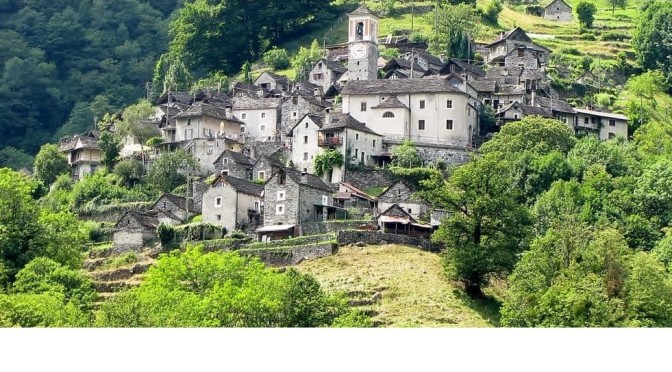
Corippo is a mountain village in the Verzasca valley some 12 kilometers (7.5 mi) from Locarno, at the north end of the artificial Lake Vogorno and 20 km (12 mi) from the border with Italy. The houses are built from the local Ticino granite with slate roofs and have changed little for several hundred years, leading the Italian writer Piero Bianconi to describe Corippo as “Verzasca’s gentlest village”.

Its early 17th century Church of the Blessed Virgin Annunciata (later the Blessed Virgin Carmine) was extended in the late eighteenth century. Corippo’s architectural value has caused the entire village centre to be placed under a conservation order, and in 1975 the European Architectural Heritage Congress named the village as an “exemplary model” for historical preservation. Corippo was originally part of the larger parish and commune of Vogorno (though maintaining a certain degree of autonomy), before becoming a fully independent municipality in 1822. The village first became connected to the wider world in 1883 when a road was built linking it to the Verzasca valley road.
Travel Tour: Ticino In Southern Switzerland

Ticino is an Italian-speaking region in southern Switzerland with palm-lined lakes and sharp Alpine peaks. Its architecture, cuisine and culture is closely related to that of neighboring Italy. Bellinzona, the capital of Ticino, is home to medieval castles. Lugano, a town on glacial Lake Lugano, is known for its waterfront promenade and Piazza della Riforma, a square lined with neoclassical buildings.

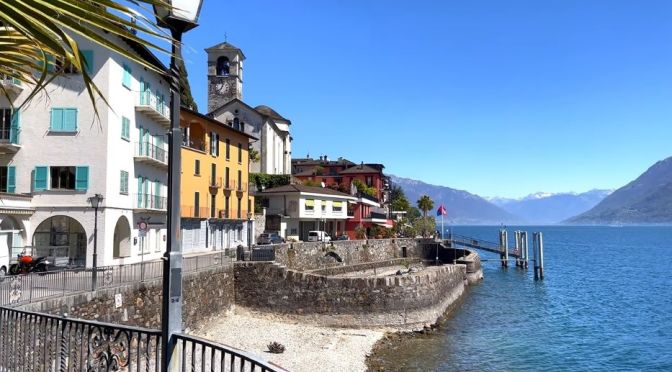
Lake Walks: Brissago In Ticino, Switzerland (4K)

Brissago is a municipality in the district of Locarno in the canton of Ticino in Switzerland. A wonder swiss town, lying at the lowest point in Switzerland, just 197 metres above sea level, and perched between the shores of Lake Maggiore and the steep mountains behind, Brissago is a small town on the Italian frontier.

The lowest and oldest part of the village is clustered around the beautiful Renaissance church of St. Peter and Paul, surrounded by centuries-old cypresses. In the narrow lanes leading down to the lake you will find some picturesque spots to admire: gardens where lemons, oranges and cedars grow in the open air, as well as beautiful mansions. Brissago is famous not only for its tobacco and cigar factory, but also for its islands, which seen from above look like bright green spots in the blue of the lake.

Between 1885 and 1928 Baroness Antonietta Saint-Léger, a Russian of German origin, planted a botanical garden designed as an earthly paradise, and her successor, the department store king Max Emden, continued her work. Today the neo-classical villa contains a restaurant and the administration offices of the Botanical Park of Canton Ticino. Their plants are still there, together with the Himalayan cinnamon with its scent of camphor, the Madagascar gladiolus, the bald cypress from the swamps of North America with its trunk under water, and numerous other exotic species.

Alpine Drives: Gotthard Pass, Switzerland (4K)

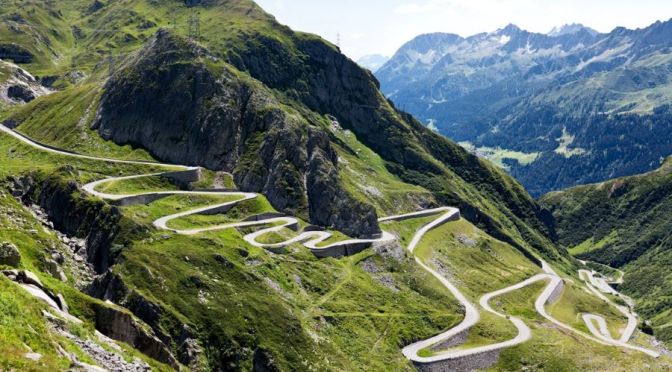
The Gotthard Pass or St. Gotthard Pass at 2,106 m is a mountain pass in the Alps traversing the Saint-Gotthard Massif and connecting northern and southern Switzerland.

The pass lies between Airolo in the Italian-speaking canton of Ticino, and Andermatt in the German-speaking canton of Uri, and connects further Bellinzona to Lucerne, Basel, and Zurich. The Gotthard Pass lies at the hearth of the Gotthard, an important north-south axis in Europe, and it is crossed by three major traffic tunnels, each being the world’s longest at the time of their construction: the Gotthard Rail Tunnel (1882), the Gotthard Road Tunnel (1980) and the Gotthard Base Tunnel (2016). With the Lötschberg to the west, the Gotthard is one of the two main north-south routes through the Swiss Alps. Since the Middle Ages, transit across the Gotthard played an important role in Swiss history, the region north of Gotthard becoming the nucleus of the Swiss Confederacy in the early 14th century.

Swiss Villages: Foroglio – Waterfall In Ticino (4K)

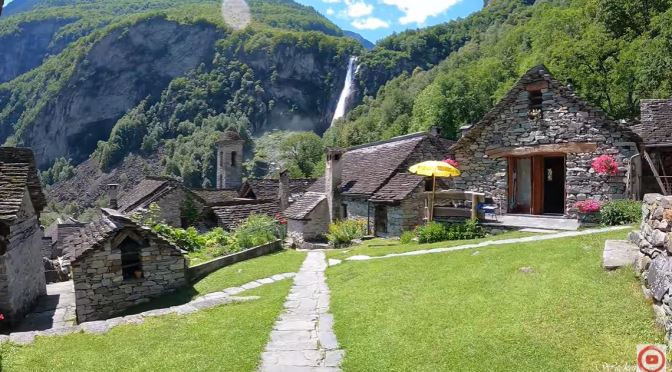
FOROGLIO in Ticino is probably mostly known for the waterfall of the same name. The waterfall can be seen from all over the village. It is possible to reach, or at least get closer to, the waterfall from two sides, an easy path close to the foot of the fall and a more challenging hike from the opposite end of the village. The reward for the challenging route is a fantastic view over the valley and directly to the side of the waterfall. At a height of more than 100 meters, it splashes down the rocks causing a cooling mist of water. The stream from the Calnegia river then ends up in the Bavona river.

The village Foroglio, like most of the small villages in the Bavona Valley is without electricity, but it is still possible to have a delicious lunch in the Osteria Froda. The stone house village is very picturesque and complete tranquil, except at the most touristic periods.

Walking Tours: Lugano – Ticino, Switzerland (4K)

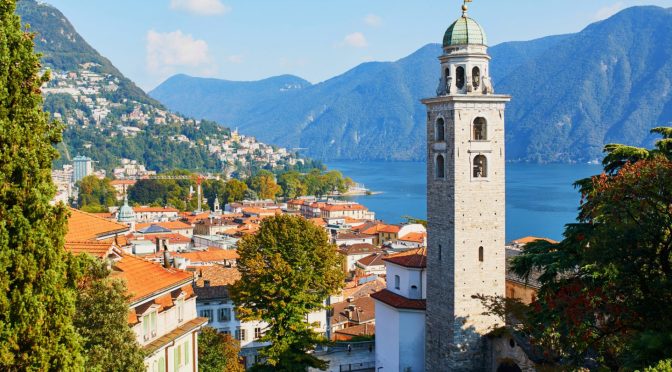
Lugano is a city in southern Switzerland’s Italian-speaking Ticino region. Its Swiss-Mediterranean mix of cultures is closely related to that of Italy’s northern Lombardy region. This mix is reflected in its architecture and cuisine. The city stands on the northern shore of glacial Lake Lugano, surrounded by mountains. Its main square, Piazza della Riforma, is ringed with pastel-colored, neoclassical palazzi. 

Travel: ‘Ticino – Southern Switzerland’ (4K Video)

Filmed and Edited by: Alessandro Walpen

Ticino is an Italian-speaking region in southern Switzerland with palm-lined lakes and sharp Alpine peaks. Its architecture, cuisine and culture is closely related to that of neighboring Italy. Bellinzona, the capital of Ticino, is home to medieval castles. Lugano, a town on glacial Lake Lugano, is known for its waterfront promenade and Piazza della Riforma, a square lined with neoclassical buildings.