
Tag Archives: The New York Times Travel

Travel Tour Of Scotland: “36 Hours In Glasgow”

The New York Times (October 19, 2023) – Glasgow, Scotland’s largest city, crackles with character. It’s a hub of grass-roots energy where  art showsplant sales and film screenings pop up in tenement flatsrailway waiting rooms and disused buildings. 

Here is the itinerary:

Friday

Burrell Collection

People look at artworks on display in a museum with walls that are painted a dark teal. Framed paintings are at eye level, and larger geometric works hang in a row farther above.

3 p.m. Wander through woodlands to a world-class museum

Start your weekend at the Burrell Collection, a glass-roofed art museum that rises out of a meadow in the city’s southern Pollok Country Park like a vast, gleaming greenhouse. The 9,000-piece collection was donated to the city at the close of World War II by William Burrell, a Glasgow shipping merchant, and opened in this specially commissioned building in 1983. The free-entry museum reopened in 2022 after a six-year refurbishment of its red sandstone, glass and wood interiors. Though it is busy, the Burrell offers a peaceful immersion in an unmistakably personal collection, drifting from Degas and Rembrandt to tabernacles, tulip-motif textiles and ancient Chinese roof tiles. The tapestries are especially wonderful, including the palatially sized “Wagner Garden Carpet” made by master weavers in 17th-century Iran.

Saturday

Papercup

Diners inside a cafe sit at small wooden tables. On the wall is a large mural of a blue rose painted in the style of traditional tattoo art. A banner across the rose reads:

10 a.m. Grab a brekkie roll, then discover a Glaswegian jungle

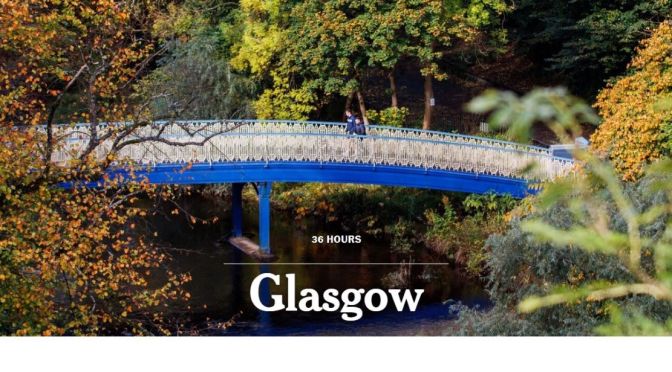
If it’s not raining, take advantage of clear skies with a botanic stroll in Glasgow’s affluent West End. Grab breakfast at Papercup, a small and friendly cafe that has original period details, like egg-and-dart molding and an ornate ceiling rose. Try the brekkie roll with a sausage patty (£5), or eggs on toast with a side of vegan haggis (£8.50). From the cafe, wander to the Glasgow Botanic Gardens, either directly, along Great Western Road, or take the more meandering Kelvin Walkway down by the River Kelvin, crossing the blue, steel Botanic Gardens Footbridge to emerge into the scented gardens on the other bank. Enter the domed Kibble Palace, a spectacular glasshouse in which to explore a jungle of orchids, begonias and ferns, among other leafy treasures.

Hoos

The inside of a home goods store. Blankets, cushions, candles and more are on wooden shelf displays.

12 p.m. Browse Scandi home goods and woolly Scottish knitwear

Glaswegians have an appetite for sustainable shopping and for secondhand goods of all stripes. Hoos, next to the Botanic Gardens, stocks chic Scandi home goods, while the Glasgow Vintage Co., farther along Great Western Road from Papercup, has a thoughtful selection of second-hand Scottish knitwear alongside show-stopping coats and dresses from the 1970s. Up the hill on Otago Street, above Perch & Rest Coffee, Kelvin Apothecary sells a nice range of gifts including handmade Scottish soaps and wooden laundry and cleaning tools. In the cobbled Otago Lane is the chaotic Voltaire and Rousseau secondhand bookshop, with teetering, vertical book piles. Unlike many Glasgow shops, this store isn’t the most dog-friendly, because of the resident cat, BB, who supervises from his perch at the till.
Read more

Travel: 7 Great ‘City Walks’

Zadar: A Loop Through History

An ancient cylindrical building of pale stone is surrounded by other ancient buildings, among them a very old, slender, five-story stone building with a tall, steep roof. A wall of stones extends halfway across this scene. Above, the blue sky is cloudless.

A nearly two-mile walk circumnavigating Zadar’s Old Town is a journey across a timeline that spans nearly every stage of Croatian history. And it’s a long history, dating back to the 9th century B.C., when the Liburnians first settled this peninsular spit of land on Croatia’s spectacular Dalmatian coast.

Dozens of people sit on the shallow, wide, pale stone steps that start at a plaza and go right into the lapping sea. In the background are trees and a vista of red-roofed, pale stone buildings of several stories.

Start your stroll on the northwest corner of the peninsula at the Morske Orgulje, or Sea Organ: a set of 35 pipes spread under a 230-foot section of the city’s seaside promenade, known as the Riva. Awarded the 2006 European Prize for Urban Public Space, the Morske Orgulje plays beautifully discordant melodies as the Adriatic laps the stone and pushes air through the pipes beneath — converting the walkway into an invisible, ethereal orchestra.

Marrakesh: A Spider Web of Passageways

A group of women in long, colorful, traditional Moroccan robes and head coverings, congregate in a plaza with a surface of geometrically arranged pale brown tiles. There are covered market stalls in the background, more people and various buildings.

The wail of snake charmers’ horns will lead you to your departure point: Jemaa El Fna. This carnivalesque, open-air market in the medina — the ancient neighborhood where Marrakesh was born — brims with juice stands, restaurants and souvenir shops, to say nothing of musicians and performers.

The double doors of two busy storefronts in an old orange-brown stucco building have been thrown open to shoppers. One displays posters of barely clothed, muscular men. The other is packed with shelves stacked with containers of colorful candy; bags of yellow, pink, black and white soccer balls in a big plastic bag; stacks of plastic bottles of water; and various snacks tended to by a young man wearing a circular cap, tan jeans and a yellow-and-white-striped T-shirt.

Before you embark on this meandering 2.2-mile walk, you should have water and sunscreen (summer temperatures can pass 100 degrees Fahrenheit in this Moroccan city); outfits that cover most of your skin (doubly useful in Islamic societies, which discourage revealing clothes); and a willingness to lose your bearings. Nearly twice the size of Central Park, the medina enfolds a vast spider web of passageways that seem designed to disorient outsiders.

Seoul: Following the Fortress Wall

People walk along two adjacent paths, divided by a long patch of lush grass in the daytime. Bordering the path on the right is a low fortress wall. Over the wall, houses can be seen in the distance below.

To walk along the Seoul City Wall is to walk in the footsteps of scholars of bygone centuries, trace scars of war and take in the modern behemoth of a city built around it all. Its history stretches back to 1396, to when present-day Seoul first became the capital of what was then a kingdom called Joseon.

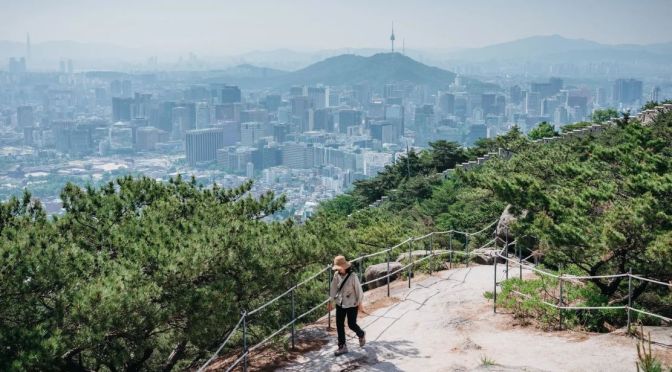
Inwangsan, a mountain in central Seoul, offers sweeping downtown views.

Then, the wall encircled an area that’s but a small fraction of today’s sprawling city, incorporating the slopes of the four mountains that afforded natural fortification. Like Seoul itself, the wall has been destroyed and rebuilt several times — and after restorations in recent decades, it’s become a popular urban walk.

READ MORE

Travel: The ‘Chic Magic’ Of The Island Of Ischia, Italy

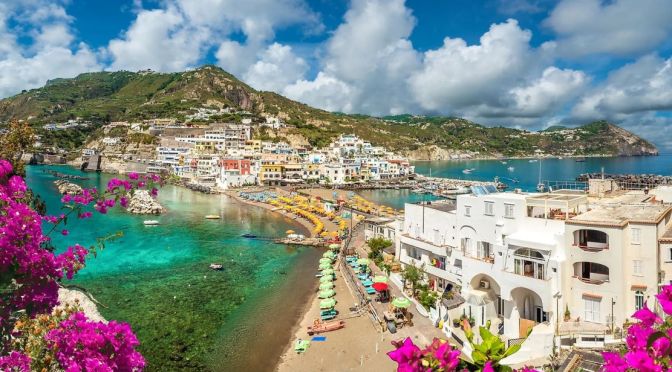
From a rooftop you look over a village, with a strip of sand with a beach on one side and a harbor on the other, leading to a small rock island.

The New York Times Travel (June 9, 2023) – The Italian island, long in the shadow of its fashionable neighbor, Capri, is newly chic, but remains deeply authentic, with rocky harbors more likely to dock fishing boats than megayachts.

This Is Ischia’s Moment in the Sun

By Ondine Cohane

A red-walled building with white crenellation and black shutters on the windows stands on a cliff above the sea.
The Hotel Mezzatorre is perched on a finger of land with a view onto the bay of Naples and the beach of San Montano below.

Ischia is one of a trio of islands (known as the Phlegraeans) off Naples that also includes Capri and Procida. Capri’s size and popularity with day trippers means it can easily feel overrun and overexposed. Procida is the smallest of the three and has never gotten the attention of its siblings (although it too is worth a visit for its pastel villages and artisan workshops).

A face in a stone wall spouts water from its mouth into a pond with lily pads surrounded by vegetation.
La Mortella gardens in Forio were created by the renowned garden designer Russell Page. 

Ischia’s magic is that it’s suspended between the newly chic — with the recent overhaul of the Mezzatorre Hotel by the hotelier Marie-Louise Sció, who brought a crowd that had never heard of the island but were fans of her über-photogenic hotels — and the authentic. There are simple bars, beach clubs and harbors more likely to dock fishing boats than megayachts. With a surface area of almost 18 square miles, the island is home to a number of charming villages to explore like Forio, Ischia Ponte, Sant’Angelo and Casamicciola, among others. Add in natural thermal spas, lush vineyards and deserted coves, and it’s easy to see why Ischia is quickly become one of Italy’s rising destinations.

Read more