Tag Archives: Southern Africa

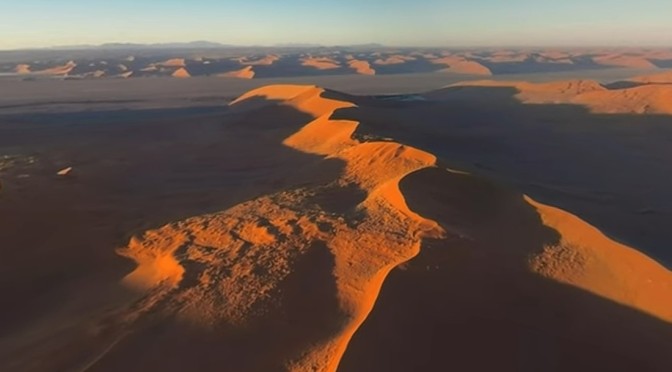
360° Travel Views: Namib Desert In Southern Africa

AirPano VRNamib, Portuguese Namibe, a cool coastal desert extending for 1,200 miles (1,900 km) along the Atlantic coast of Africa from Namibe (formerly Moçâmedes) in Angola southward across Namibia to the Olifants River in the Western Cape province of South Africa. It reaches inland 80 to 100 miles (130 to 160 km) to the foot of the Great Escarpment. The southern portion merges with the Kalahari on the plateau atop the escarpment. Its name is derived from the Nama language, implying “an area where there is nothing.”

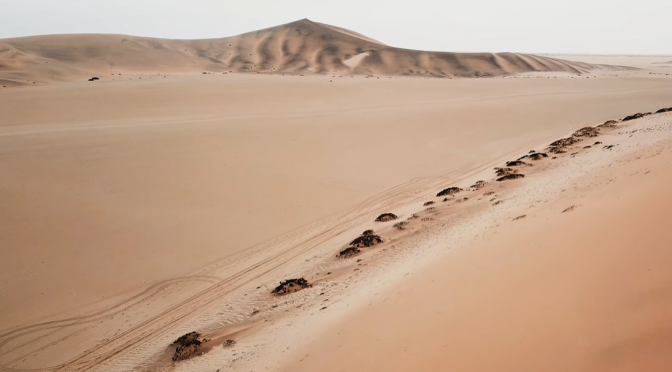
The Namib is arid and is almost totally uninhabited, except for a small number of scattered towns. It is important because of the trade routes that cross it, its mineral deposits, the fisheries of the bordering sea, and its increasing utilization for recreational purposes.

Aerial Views: Namib Desert In Southern Africa (4K)

The Namib is a coastal  desert  in  Southern Africa. The name Namib is of Khoekhoegowab origin and means “vast place”. According to the broadest definition, the Namib stretches for more than 2,000 kilometres (1,200 mi) along the Atlantic coasts of AngolaNamibia, and South Africa, extending southward from the Carunjamba River in Angola, through Namibia and to the Olifants River in Western Cape, South Africa.[2][3][4] The Namib’s northernmost portion, which extends 450 kilometres (280 mi) from the Angola-Namibia border, is known as Moçâmedes Desert, while its southern portion approaches the neighboring Kalahari Desert. From the Atlantic coast eastward, the Namib gradually ascends in elevation, reaching up to 200 kilometres (120 mi) inland to the foot of the Great Escarpment.[2]

Aerial Travel: ‘Cape Town – South Africa’ (Video)

Cape Town is a port city on South Africa’s southwest coast, on a peninsula beneath the imposing Table Mountain. Slowly rotating cable cars climb to the mountain’s flat top, from which there are sweeping views of the city, the busy harbor and boats heading for Robben Island, the notorious prison that once held Nelson Mandela, which is now a living museum. 

South Africa is a country on the southernmost tip of the African continent, marked by several distinct ecosystems. Inland safari destination Kruger National Park is populated by big game. The Western Cape offers beaches, lush winelands around Stellenbosch and Paarl, craggy cliffs at the Cape of Good Hope, forest and lagoons along the Garden Route, and the city of Cape Town, beneath flat-topped Table Mountain. 

Travel Video: ‘Victoria Falls On The Zambezi River, In Zambia And Zimbabwe’

Victoria Falls is a waterfall on the Zambezi River in southern Africa, which provides habitat for several unique species of plants and animals. It is located on the border between Zambia and Zimbabwe and is considered to be one of the world’s largest waterfalls due to its width of 1,708 metres. 

Travel Videos: “Namibia” By Marcello Ercole (2020)

Directed, Filmed, Edited by: Marcello Ercole

Produced by Ercole / Ricci
Music by Ryan Taubert

Namibia, a suggestive country. Eroded cliffs by the wind, very deep canyons, boundless deserts, the cold ocean and wild animals makes Namibia an inhospitable and sublime land. A fragile ecosystem that we must preserve.

Website

Namibia officially the Republic of Namibia, is a country in Southern Africa. Its western border is the Atlantic Ocean; it shares land borders with Zambia and Angola to the north, Botswana to the east and South Africa to the south and east. Although it does not border Zimbabwe, less than 200 metres of the Zambezi River separates the two countries. Namibia gained independence from South Africa on 21 March 1990, following the Namibian War of Independence. Its capital and largest city is Windhoek, and it is a member state of the United Nations (UN), the Southern African Development Community (SADC), the African Union (AU), and the Commonwealth of Nations.

Namibia, the driest country in Sub-Saharan Africa, was inhabited since early times by the San, Damara and Nama people. Around the 14th century, immigrating Bantu peoples arrived as part of the Bantu expansion. Since then, the Bantu groups, the largest being the Ovambo, have dominated the population of the country; since the late 19th century, they have constituted a majority.

From Wikipedia