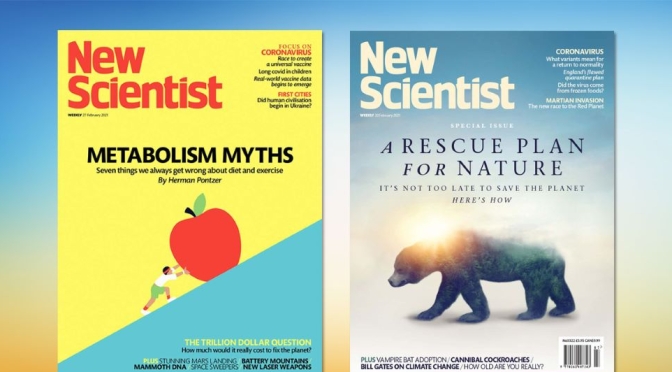

New Scientist Magazine – October 11, 2025


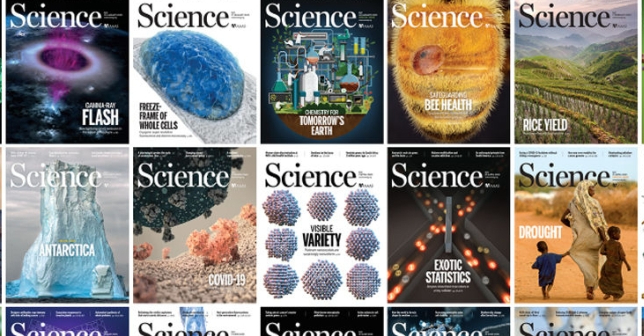
SCIENCE MAGAZINE: The latest issue features ‘Slipping through the cracks’ – Plants attract bacteria by leaking glutamine from gaps between cells when root barriers break down.


SCIENCE MAGAZINE: The latest issue features ‘The Color of Prey’ – Selection for warning coloration and camouflage.
Ancient layers of saline permafrost are melting below zero, deepening lakes and weakening coasts
Termites use microbe-infused soil to protect a fungal symbiont
Three theories could explain why the North American H5N1 epidemic has not been more deadly
Parental lysosomes modify epigenetic signaling to influence offspring life span
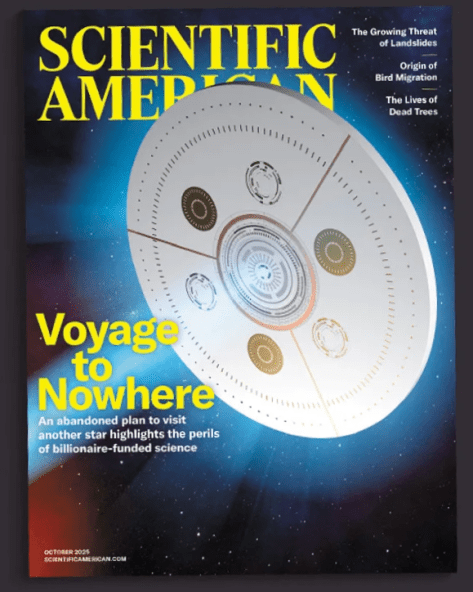
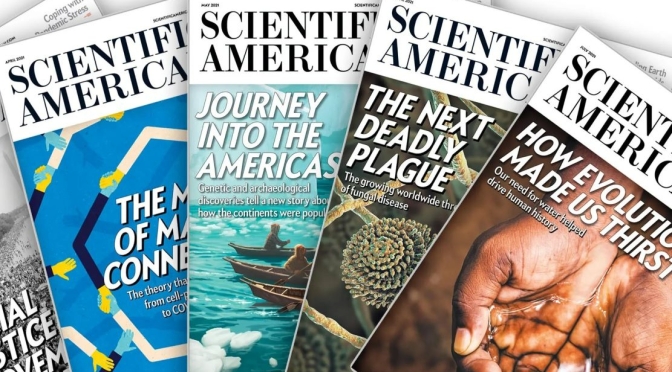
SCIENTIFIC AMERICAN MAGAZINE: The latest issue features ‘Voyage to Nowhere’
An abandoned plan to visit another star highlights the perils of billionaire-funded science
As warming temperatures bring more extreme rain to the mountains, debris flows are on the rise
Tiny fossils hint at when birds began making their mind-blowing journey to the Arctic to breed

SCIENCE MAGAZINE: The latest issue features ‘Bringing In Light’ – A Swirling supercomplex captures ocean light for photosynthesis.
Chikungunya cases break records in France; West Nile virus appears near Rome
Studies identify a solid inner core and buried remnants of giant impacts
Pollutants in sediment core suggest mining and smelting did not tail off
“Overtone” in gravitational waves from black hole merger matches predictions of general relativity

SCIENCE MAGAZINE: The latest issue features ‘Rules of Thumb’ – The importance of a hand that holds in the evolution of rodents.
If confirmed, vast cloud could test predictions about the Galaxy’s hidden architecture
The unusually tiny particles of hexavalent chromium could pose a health hazard despite low levels, researchers say
“Hyperlocal” forecasts help Mumbai prepare for dangerous downpours
Rapid growth in drone use is upending expectations but also inducing trade-offs

SCIENCE MAGAZINE: The latest issue features ‘Return of The Herd’ – Ecosystem effects of migrating bison.
Bison move through Yellowstone’s Lamar Valley at sunrise. Their movements and grazing accelerate the nitrogen cycle, increasing the annual nutrition that plants provide to herbivores. After decades of recovery, bison now add heterogeneity that sustains soil nutrient storage and plant productivity while allowing plant communities to become more diverse, highlighting the importance of restoring native grazers in large numbers and with freedom to move. See page 904.
Lab study shows how RNA could have helped amino acids join up—without preexisting protein machinery
Earth’s mantle is peeling from the crust in the eastern Atlantic, a possible sign of the ocean’s eventual closure
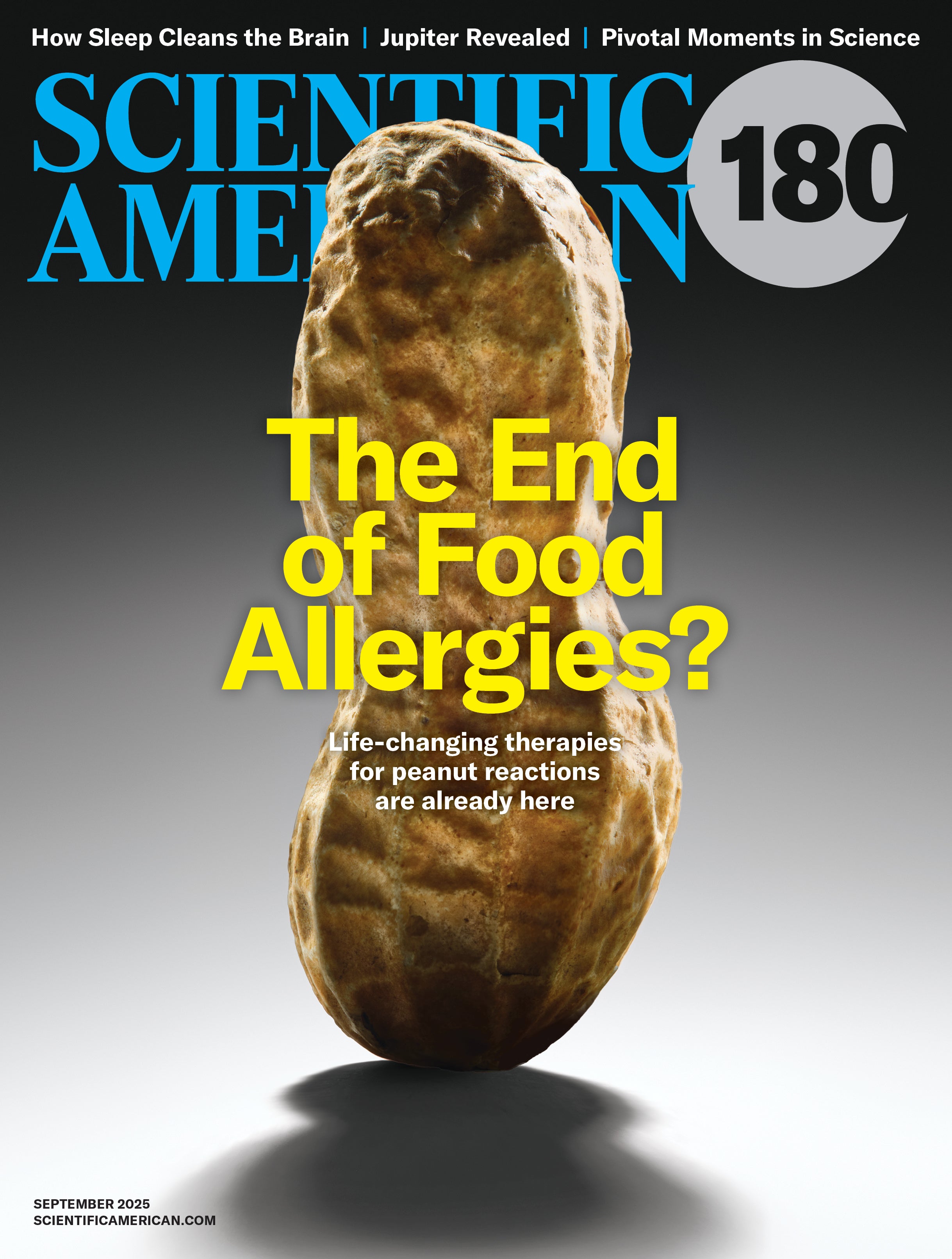
SCIENTIFIC AMERICAN MAGAZINE: The latest issue features ‘The End of Food Allergies?’ – Life-changing therapies for peanut reactions are already here.
Washing waste from the brain is an essential function of sleep—and it could help ward off dementia BY Lydia Denworth
Charles C. Mann
Richard Panek
Philip Ball
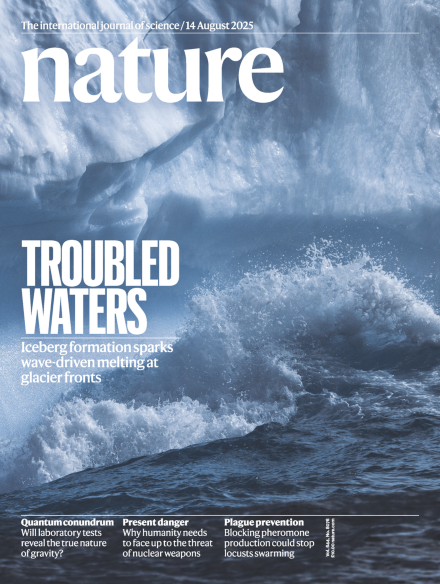
Ice coverage is shrinking on Heard Island — a UNESCO World Heritage Site and a haven of biodiversity.
A nanoscopic machine transforms a molecular chain into interlocking loops.
In creatures that walk on land, a protein called Slurp1 protects skin cells from stress.
Experiments identify a bacterium as the cause of sea-star wasting disease, which has devastated populations along the western coast of North America.

SCIENCE MAGAZINE: The latest issue features ‘Evoloving Immunity’…
Hybridization 9 million years ago gave potatoes the genetic knack to develop tubers, a new study finds
Sophisticated global networks are infiltrating journals to publish fake papers
One-fifth of computer science papers may include AI-written sentences

 Boomers Daily