

SCIENTIFIC AMERICAN MAGAZINE: The latest issue features ‘A (Friendly) Robot Invasion – Can we live alongside intelligent machines?

SCIENTIFIC AMERICAN MAGAZINE: The latest issue features ‘A (Friendly) Robot Invasion – Can we live alongside intelligent machines?

SCIENCE MAGAZINE: The latest issue features ‘2025 Breakthrough of the Year’…
The seemingly unstoppable growth of renewable energy is Science’s 2025 Breakthrough of the Year
Images of China’s clean energy infrastructure reveal a transformation of unmatched scale and speed
Dense seismic array more than 4000 kilometers long promises new views of Earth’s interior
Ferroelectrics could bolster “flash” memory in AI data centers and autonomous robots
‘

A study of the effects of COVID-19 policies highlights the underexplored impacts of commercial cooking on air quality.
Emerald’ or ‘Paris’ green was once a highly popular pigment among painters, but the chemistry behind its slow decay over time has been unclear.
Studying trapped antimatter could help to explain why our world is so full of matter.
A specially trained algorithm could aid the search for biological activity both on the early Earth and on other worlds.

SCIENCE MAGAZINE: The latest issue features ‘Herding Cats’ – Ancient DNA suggests later arrival for domestic cats in Europe.
Rapid gene expression changes during treatment of neonatal sepsis indicate reversibility of host immune response and enable prognostic approaches.
Technology that uses a less known sensory system to substitute for olfaction could one day help anosmic people detect some odors
With China’s surge in renewable energy, greenhouse gases are reaching a turning point

SCIENCE MAGAZINE: The latest issue features ‘Soft 3D Transistors’ – Hydrogel semiconductors for biologically compatible electronics.
With details as fine as short-term weather forecasts, model achieves newfound accuracy
Pending bills in U.S. Congress could degrade data from national surveys
Ganaplacide, developed by Novartis, eases worries about drug resistance—but hard choices loom on how to use it
Scientists, ethicists, and patient advocates mull biology’s latest provocative technology
Biologically inspired electronic neurons could boost the efficiency of artificial-intelligence systems.
People who rack up most of their daily steps in walks lasting less than five minutes have a higher risk of cardiovascular disease than do those who amass their steps in big blocks.
Modelling shows how the infant Universe might have stayed warm and dense during its primoridal expansion.
The moisture emitted by forests travels across national borders to provide precipitation to far-away fields.

SCIENCE MAGAZINE: The latest issue features ‘Share My Good Mood’ – Positive affective contagion in bumble bees.
Mass distribution increases risk of antibiotic resistance, but benefits vanish when treatment is restricted to babies
Messenger RNA in the shots could act like a “siren” calling immune cells to destroy tumors
Nobel laureate develops new method of making regulatory T cells that could treat autoimmune conditions

SCIENCE MAGAZINE: The latest issue features ‘Advanced Nanoscopy’ – 3D rendering of photochemically sectioned brain tissue.
Museum specimens reveal loss of genetic diversity in marine fishes of the Philippines
“Bold” hypothesis suggests tolerance for lead allowed Homo sapiens to outlive Neanderthals
Spongelike materials called metal-organic frameworks can separate and store gases
Mass layoffs, and subsequent reversals, have added to research spending woes
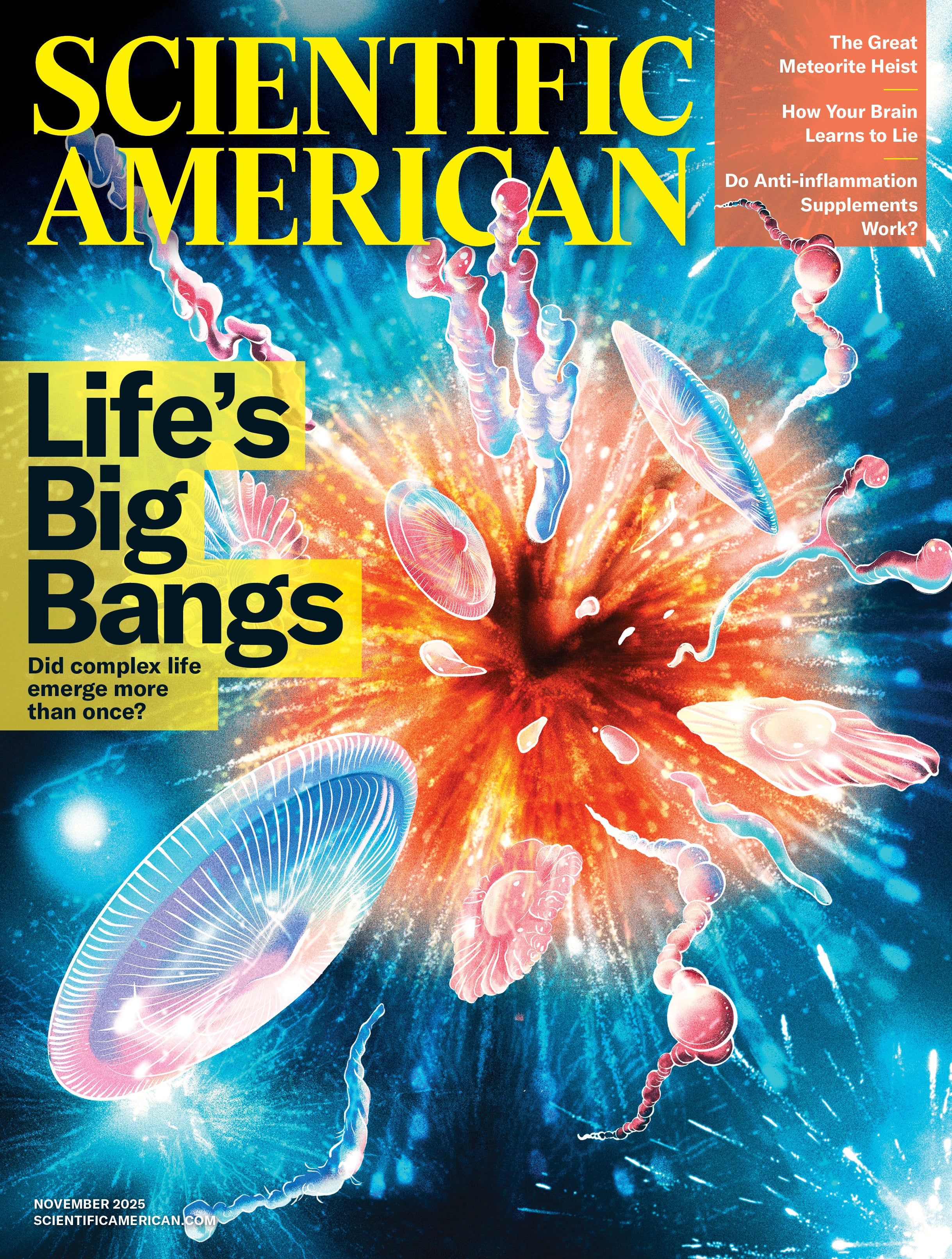
SCIENTIFIC AMERICAN MAGAZINE: The latest issue features ‘Life’s Big Bangs’ – Did complex life emerge more than once?
Controversial evidence hints that complex life might have emerged hundreds of millions of years earlier than previously thought—and possibly more than once
Your brain gets used to wrongdoing. It can also get used to doing good
Experts say the strongest scientific studies identify three compounds that fight disease and inflammation
How a space rock vanished from Africa and showed up for sale across an ocean

SCIENCE MAGAZINE: The latest issue features ‘Eclipsing the Sun’ – A unique cosmic event shows an influence of light on bird behavior.
Three scientists honored for revealing how regulatory T cells prevent autoimmune disease
Breakthrough paved the way to many of today’s budding quantum computers
High-power fiber lasers are used in a range of scientific fields in addition to their standard use for technology. However, increases in laser output power are limited by nonlinear effects that can damage the optical components and reduce the beam quality. Rothe et al. used a spatial wavefront-shaping technique for multimode fiber lasers that mitigates their detrimental processes, thus enabling output power to be increased appreciably while maintaining beam quality.
 Boomers Daily