Tag Archives: Reading

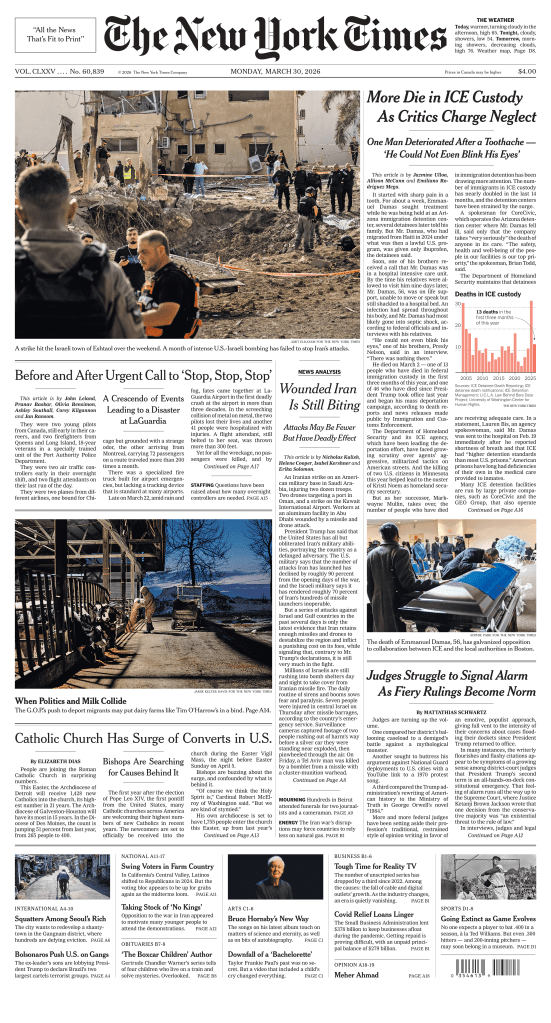
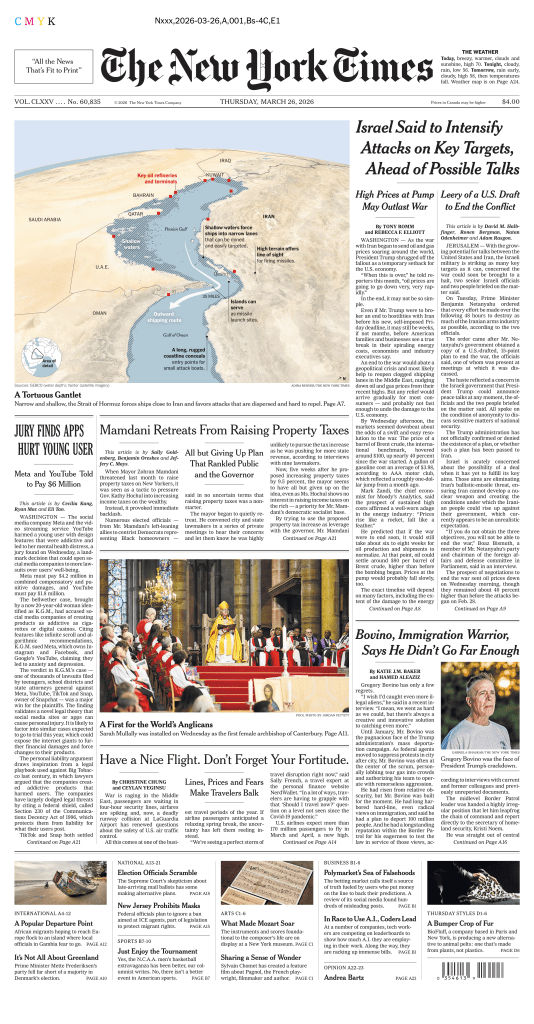
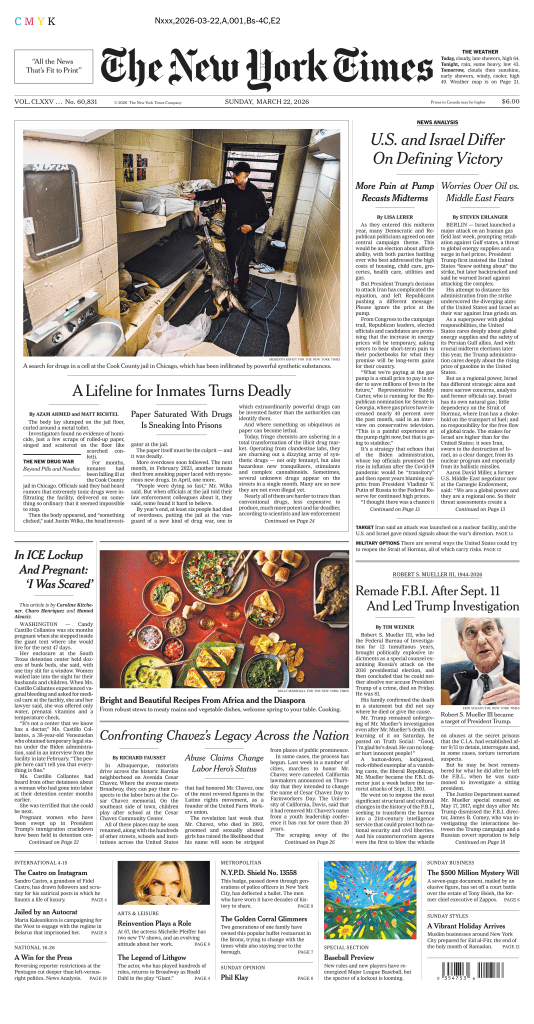
THE NEW YORK TIMES – MONDAY, FEBRUARY 16, 2026

Despite Epstein’s Toxicity, Steve Bannon Stood by Him, Texts Indicate

Mr. Bannon, a MAGA podcaster, developed a seemingly chummy relationship with Jeffrey Epstein. He said it was in the name of getting Mr. Epstein to open up.

Epstein’s Ties With Academics Show the Seedy Side of College Fund-Raising

Professors and presidents are often eager to raise outside cash. Some are now facing blowback after connecting with Jeffrey Epstein.

The Quiet Architect of Trump’s Global Trade War

Jamieson Greer, a low-key lawyer from a working-class background, is rewriting the rules of the global economy at President Trump’s behest.

In Xi’s Purge of the Military, a Search for Absolute Loyalty

By reaching back to Maoist tactics of “rectification,” Xi Jinping is signaling that control over the gun requires a state of perpetual cleansing.

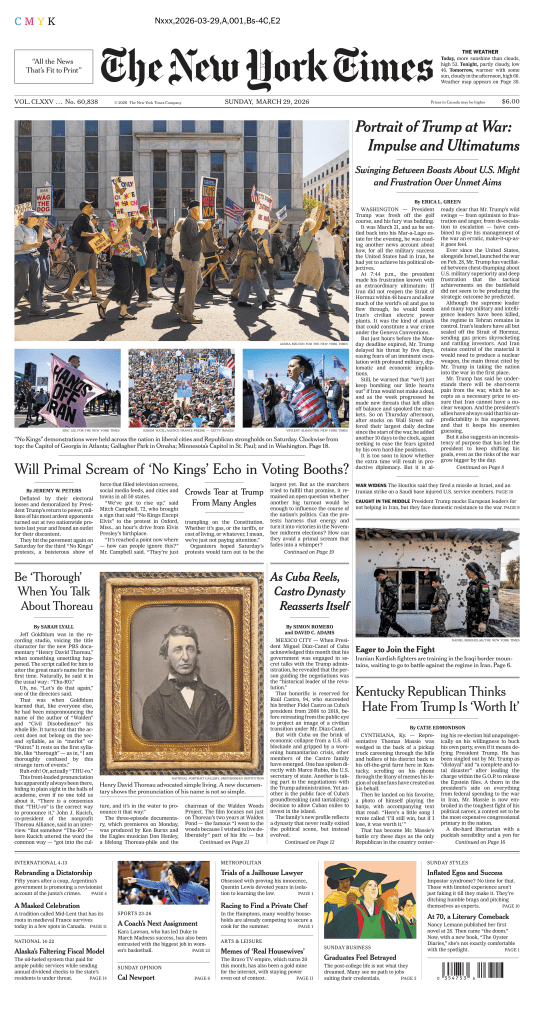
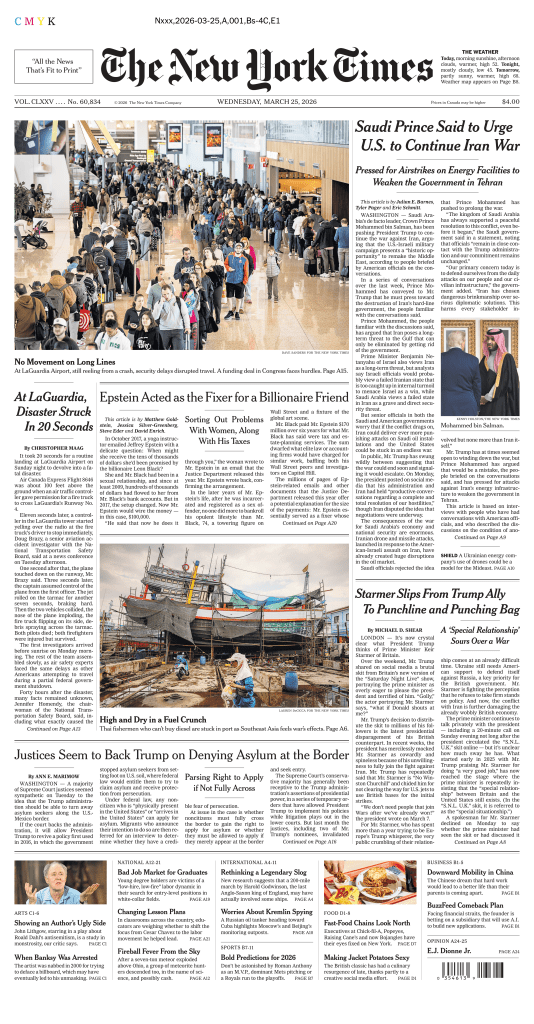
THE NEW YORK TIMES – SUNDAY, FEBRUARY 15, 2026

Deep in China’s Mountains, a Nuclear Revival Takes Shape

Satellite imagery of secretive nuclear facilities reveals Beijing’s efforts to expand its arsenal, just as the last global guardrails on nuclear weapons vanish.

Trump’s Relentless Self-Promotion Fosters an American Cult of Personality

President Trump has engaged in a spree of self-aggrandizement unlike any of his predecessors, making himself an inescapable force at home and around the world.

Republican State Legislators Rush to Limit Their Own Regulators

South Carolina’s state legislature is one of 17 that is moving to handcuff state agencies at a moment of tectonic changes in energy, technology and finance.

Iran Protester’s Death in Custody Sparks Outrage. His Family Believes He Was Executed.

Rights groups are investigating the death of Ali Rahbar as a potential extrajudicial killing. Iran denies executions have taken place.54m agoBy Sanam Mahoozi and Erika Solomon

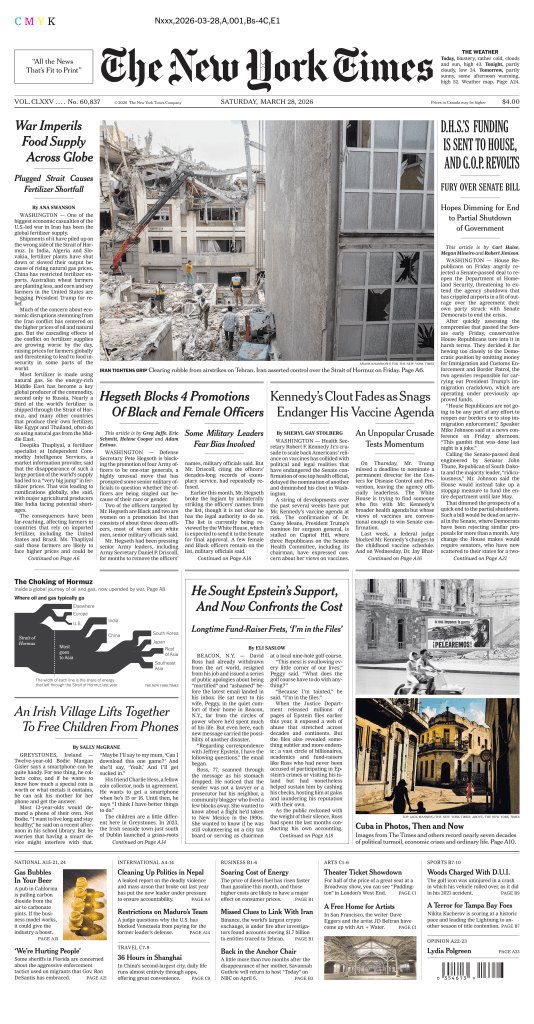
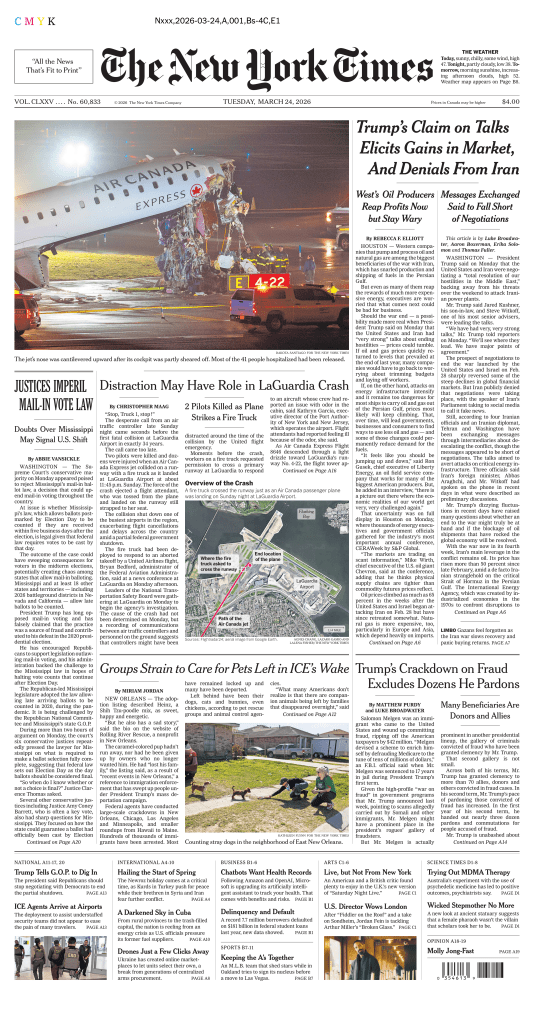
THE NEW YORK TIMES – SATURDAY, FEBRUARY 14, 2026

Inside the Debacle That Led to the Closure of El Paso’s Airspace

The F.A.A., citing “a grave risk of fatalities” from a new technology being used on the Mexican border, got caught in a stalemate with the Pentagon.

Department of Homeland Security Shuts Down, Though Essential Work Continues

ICE Tried to Justify a Minneapolis Shooting. Its Story Unraveled.

The collapse of the Trump administration’s version of events in the case was another instance of an account of a shooting that was later contradicted.

Homeland Security Wants Social Media Sites to Expose Anti-ICE

In Munich, Rubio Calls Europe a Friend but Says It Must Change

European leaders expressed relief at the tone of Secretary of State Marco Rubio’s remarks, but it was clear that the trans-Atlantic rift remained.

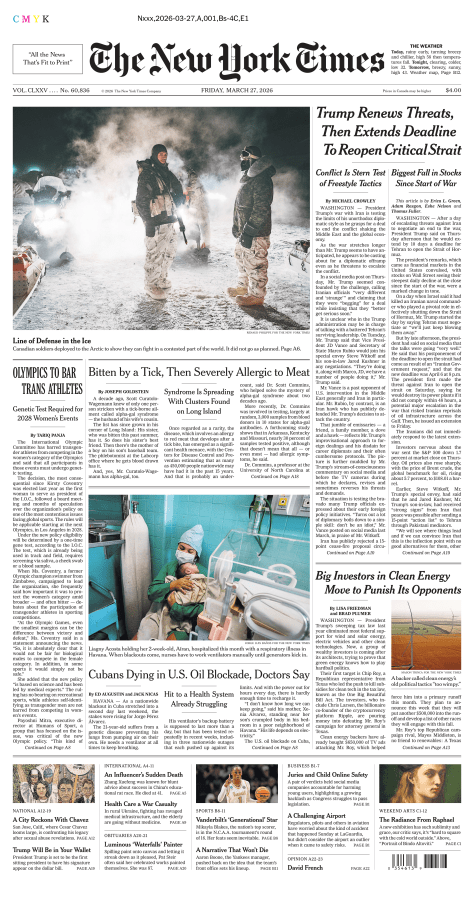
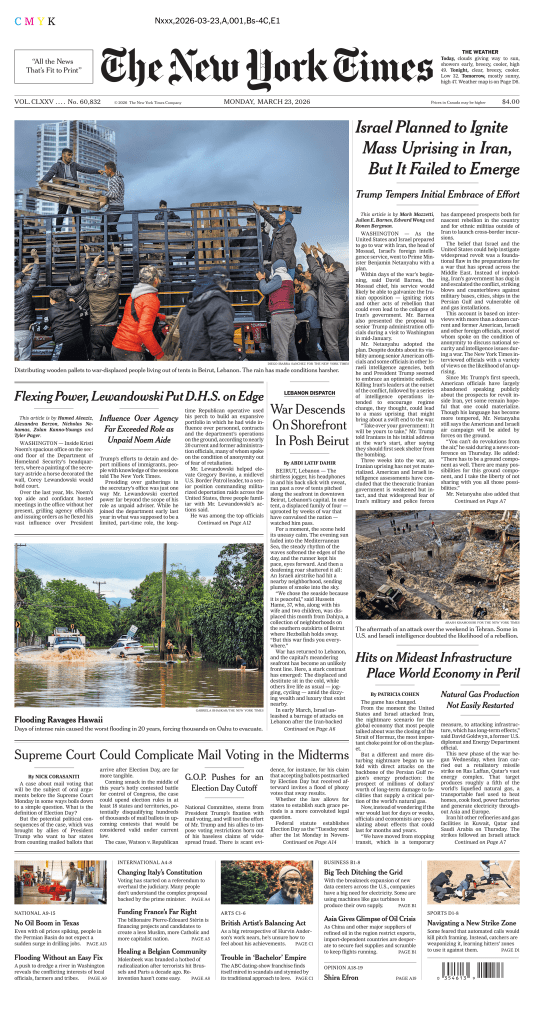
THE NEW YORK TIMES – FRIDAY, FEBRUARY 13, 2026

U.S. Inflation Eased at Start of the Year

Overall inflation eased to 2.4 percent in January from the same time last year, offering a reprieve to the Federal Reserve.

The Epstein Files and the Hidden World of an Unaccountable Elite

The search continues in the documents for ironclad criminal conduct, but the story of a sexual predator given a free ride by the ruling class has already emerged.

Goldman’s Top Lawyer Departs Amid Revelations About Her Ties to Epstein

Kathryn Ruemmler, a former Obama administration lawyer, is out at Goldman Sachs after emails revealed her years of friendship with Jeffrey Epstein.

German Leader Says International Order ‘No Longer Exists’

Chancellor Friedrich Merz of Germany, speaking at the Munich Security Conference, criticized President Trump’s rapid reorientation of U.S. foreign policy.

Iran Turns to Digital Surveillance Tools to Track Down Protesters

As the authorities restore some online services after crushing antigovernment demonstrations, they are using technology to target attendees of the protests.

THE NEW YORK TIMES – THURSDAY, FEB. 12, 2026

Border Agency Is Said to Have Caused El Paso Closure by Firing Anti-Drone Laser

F.A.A. officials said privately that the agency did not have enough time or information to assess the technology’s risk to commercial aircraft.

Trump’s Director of Election Security Is an Election Denier

Even in a government full of conspiracists, Kurt Olsen stands out. He made a key referral in the Fulton County, Ga., election case.

How Trump Sees the World: It’s Personal

Historical relationships play little if any role in the second-term worldview of President Trump, who holds himself as the constant center of global events.

U.S. Attorney Chosen to Replace Trump Pick Is Quickly Fired by White House

Donald Kinsella had been appointed top prosecutor in the Northern District of New York after the Trump administration’s nominee was found to be serving unlawfully.

Trump’s Trade Deal With India Has Become a Headache for Modi

Prime Minister Narendra Modi won a big reduction of sky-high tariffs, but critics said he undermined Indian sovereignty and undercut the nation’s farmers.

THE NEW YORK TIMES – WEDNESDAY, FEB. 11, 2026

F.A.A. Halts All Flights at El Paso Airport for 10 Days for ‘Security Reasons’

The agency provided no details, but its order will leave one of the largest cities in Texas without air service of any kind until Feb. 20.

Trump Decries a ‘Nation of Renters’ but His New Policy Promotes One

A recent executive order that would bar investors from acquiring single-family homes includes an exemption that allows them to build homes for rent.

Unemployment Rate in Focus as Fed Considers When to Restart Rate Cuts

Mass Shooting in Remote Canadian Town Is One of Deadliest in Nation’s History

Nine people were killed and 25 were injured at a high school and a residence in British Columbia, the police said. The shooter was also found dead.

Grand Jury Rebuffs Justice Dept. Attempt to Indict 6 Democrats in Congress

The rejection was a remarkable rebuke, suggesting that ordinary citizens did not believe that the lawmakers had committed any crimes.

THE NEW YORK TIMES – TUESDAY, FEBRUARY 10, 2026

Russia Nears Capture of Key Ukrainian Towns After Year of Grinding Assaults

Russian troops have advanced slowly in recent months, but gains in southern and eastern Ukraine could give Moscow an edge in U.S.-mediated peace talks.

Trump Threatens to Block Opening of New Bridge to Canada

The Gordie Howe International Bridge, expected to open early this year, was built by Canada to ease cargo transport between Detroit and Windsor, Ontario.

Trump’s Threats to Cuba’s Oil Suppliers Put Mexico in a Bind

The longstanding alliance between Cuba and Mexico is under mounting pressure from the U.S., forcing President Claudia Sheinbaum into a balancing act.

After U.S. Criticism, Nicaragua Blocks a Once-Popular Route From Cuba

Susan Collins Runs for Re-election, in One of 2026’s Top Senate Fights

The Maine Republican is one of her party’s most vulnerable senators, and her seat is crucial to Democratic hopes of retaking control of the chamber.

THE NEW YORK TIMES – MONDAY, FEBRUARY 9, 2026

Epstein’s Longtime Companion Refuses to Answer Lawmakers’ Questions

Ghislaine Maxwell invoked her Fifth Amendment right in response to every question asked during a deposition before the House Oversight Committee.

Billionaire Called Epstein a ‘Blessing’ as They Made Deals

Andrew Farkas has played down ties to Jeffrey Epstein. But they swapped business favors, and in nearly 2,000 emails, expressed admiration for each other.

A Raid in a Small Town Brings Trump’s Deportations to Deep-Red Idaho

Wilder, Idaho, prided itself on comity. Then federal agents stormed a racetrack outside of town, and the reverberations are still shaking the community.

Bad Bunny’s Halftime History Lesson

The superstar showcased Puerto Rican pride during a 13-minute set that turned a global opportunity into an intimate, personal performance, our critic writes.

Trump Criticizes Bad Bunny’s Super Bowl Halftime Show

Bad Bunny, the Puerto Rican superstar who has denounced ICE, celebrated Latino heritage in his largely Spanish-language performance.

Seahawks’ Super Bowl Victory Highlights a New Way of Winning in the N.F.L.

Quarterbacks have ruled for decades, but opportunistic general managers are increasingly the key to success, a columnist for The Athletic writes.

A Teary-Eyed Ending to Drake Maye’s Breakout Sophomore Season

Literary Review Of Canada – March 2026 Preview

March 2026 Archives | Literary Review of Canada

Literary Review of Canada The latest issue features:

Ulysses Unbound

Navigating this Age of Appetite by Krzysztof Pelc

Here’s a question I often bat around with graduate students in my International Political Economy seminar: In book 12 of the Odyssey, how do the shipmates know which Ulysses to trust?

You know the story. Ulysses and his crew have been on Circe’s island for a year. They’re finally about to depart when the goddess takes Ulysses aside and warns him of the dangers that await them. The first of these is the “piercing songs” of the Sirens. “So listen,” she says, “I will give you good instructions; another god will make sure you remember.”

Circe tells Ulysses to put wax in his sailors’ ears but that he can listen to the Sirens if he wants to — as long as his shipmates bind him “hand and foot” to the mast: “So bound, you can enjoy the Sirens’ song. But if you beg your men to set you free, they have to tie you down with firmer knots.”

As their ship approaches the Sirens’ sharp rocks, the wind dies down, they pull the sails, and they begin to row. As predicted, Ulysses yells out to his men to set him free. He is still their captain. But instead of obeying his orders, Eurylochus and Perimedes stand up and “tie him down with firmer knots.” How, I ask my students, do they know to trust the first Ulysses over the second? How is it that as readers, we never question their choice?

Cemented Legacy

Form follows Ford by Kelvin Browne 

Albert Kahn has been called “the father of industrial architecture” and “the architect of Detroit.” His firm was certainly prolific: it was responsible for the Ford Motor Company of Canada factory in Toronto, near a laneway that bears his name, and the General Motors assembly plant in Regina, along with nearly 900 buildings in Motor City alone. Kahn’s oeuvre encompassed offices, grand homes for his industrialist clients, and libraries and fraternity houses at the University of Michigan, in Ann Arbor, not to mention a post office, a synagogue, and multiple hospitals and skyscrapers. Many of Kahn’s buildings reflect a pastiche of styles that might be considered a precursor of a postmodern eclectic. Yet this prolific architect is relatively unknown today, especially outside of Michigan.

Albert Kahn Inc.: Architecture, Labor, and Industry, 1905–1961 by Claire Zimmerman

The MIT Press / 488 pages, hardcover

Floe State? – On trouble in Greenland

By Michael Strizic

The mood on the Sea Adventurer’s bridge was grim. “She’s only making eight knots,” said our expedition leader. “We need to hit at least fourteen to keep to our itinerary.” We were four days into a two-week sailing and anchored off Ilulissat, near a UNESCO World Heritage site nestled into the crenellated western coast of Greenland.

Earlier that day, I had found myself at the helm of a Zodiac, manoeuvring the rubberized craft through thick fog, near-freezing water, and growlers. The ten high-paying passengers under my care likely had no idea that this was my first trip with the tour operator or my first time north of the Arctic Circle.

THE ACADEMY AT CAREGGI

Marsilio Ficino and the Lost Art of Intellectual Friendship

By Michael Cummins, Editor, September 15, 2025

Earlier that day, a letter had arrived at each doorstep—written in Ficino’s careful Latin, sealed with the Medici crest. Come tonight, it read, for the stars are in accord and the soul requires company. It was invitation and summons at once. Poliziano scoffed at the astrology but tucked the note into his cloak. Pico, fresh from disputation, still had ink smudged on his fingertips when he broke the seal. Landino read it slowly, savoring the phrasing, then closed his worn Dante with a sigh. Gozzoli sharpened a charcoal stick and packed it beside a folded manuscript. Lorenzo glanced at the letter, smiled at its formality, and placed it beneath a pile of state papers, as if to remind himself that philosophy and politics were two halves of his life.

As evening drew in, the roads up to Careggi darkened. Lanterns swung from servants’ hands, lighting the cypresses along the ascent. Cloaks were drawn close, breath visible in the winter air. One by one they arrived—Poliziano striding quickly, as though words themselves propelled him; Pico lingering at the threshold, whispering a Hebrew phrase before stepping inside; Landino slow but steady, leaning on a servant’s arm; Gozzoli already sketching the turn of a staircase as he climbed; Lorenzo last, but never late, carrying the ease of a man for whom arrival was itself a ceremony.

In January 1486, at the Villa Medici in Careggi—north of Florence, in the hills of Rifredi—the villa seemed less a house than a harmony. Designed by Michelozzo di Bartolomeo, it bore the quiet precision of geometry translated into stone. Arcaded loggias opened onto citrus groves, terraces descended into the valley like measures of music, and every cornice seemed tuned to a mathematics of grace. Outside, the air was sharp with winter, the olive trees skeletal against a pale sky. But within the great hall, a fire crackled, filling the chamber with warmth. The walls, frescoed decades earlier, flickered as if alive in the candlelight. Tonight the villa was not a residence but a stage, and its occupants not merely guests but players in a drama older than Florence itself.

They gathered as friends, but each carried into the room the weight of reputation.

Poliziano, barely past thirty, was already Florence’s most brilliant poet. His Stanze per la Giostra, an unfinished hymn to Giuliano de’ Medici’s tournament, glittered with myth and memory. Quick of wit and sharper of tongue, he was both loyal to Lorenzo and ready to strike at those who questioned his genius.

Cristoforo Landino, older, stooped with age, was Florence’s commentator-in-chief. His lectures on Dante had turned the Commedia into a civic scripture, binding Florence’s destiny to its poet. If Poliziano was a flame, Landino was the lamp in which it burned steadily.

Giovanni Pico della Mirandola entered like lightning. Only twenty-three, he was preparing his audacious Oration on the Dignity of Man, a text that would dare to place human freedom on the same plane as angelic being. He had announced his intention to defend nine hundred theses, culled from Greek philosophy, Kabbalah, scholasticism, and Islamic thinkers, in a disputation that threatened to scandalize Rome. His learning was encyclopedic, his confidence dangerous, his youth incandescent.

Benozzo Gozzoli was quieter. His great achievement, the fresco cycle of the Procession of the Magi in the Medici chapel, was both sacred and political: angels mingled with courtiers, and the Holy Family arrived in Florence disguised as the Medici themselves. He preferred charcoal to disputation, sketching the turn of a head or the crease of a robe rather than wielding syllogisms. For him, philosophy was not abstract argument but the line that revealed the soul.

And then Lorenzo de’ Medici, il Magnifico, the center of the Florentine orbit. He had steered the city through the Pazzi conspiracy, outmaneuvered papal wrath, and cultivated a culture in which poets, painters, and philosophers could thrive. Half-banker, half-prince, he wrote verses of his own, presided over festivals, and wielded patronage as both weapon and blessing. His presence at Careggi made the evening not only intimate but official.

Marsilio Ficino, their host, sat at the head of the long table. Cloaked in scholar’s black, fingers resting on a lyre, he was the gravitational center of this circle. He had translated Plato, giving Florence back its philosophical ancestry, and wrote the Platonic Theology, arguing that the soul was immortal and divine. In his quieter moments, he prescribed music as medicine, believing that certain modes could cure melancholy as surely as herbs. He practiced a cautious astrology, binding celestial rhythms to bodily health.

Now, as the fire crackled, Ficino tuned his lyre and looked at his companions with quiet joy. These men—so brilliant, so flawed—were his constellation. He thought of Plato’s cave, of Plotinus’s ascent, of Florence’s restless brilliance, and wondered whether beauty could save it. Tonight, he wanted not to translate but to live a dialogue. He plucked a chord and listened not to the sound, but to the silence it left behind.

What survives when the body falls silent?

Landino spoke first, quoting Dante: L’anima nostra, che di sua natura è immortale… Death was no end but transition. His tone was measured, his gaze steady, as though Florence itself were listening.

Poliziano leaned forward, impatient. “But Plato required myth to prove it. Immortality may lie not in substance but in song. What survives is the echo, not the essence. My verses, your commentaries—those are what endure.”

Pico’s eyes burned. He leaned back slightly, his gaze still locked on Poliziano. “No, Angelo. The soul is indivisible, free, eternal. Your echoes are ash if not tethered to truth. Without immortality, justice collapses. Would you have us live as beasts, hoping only for memory?”

Gozzoli raised his parchment, showing the curve of a face. “I have painted expressions that gaze back centuries later. If souls endure, perhaps they endure through pigment and gesture. A fresco is a kind of eternity.”

Lorenzo swirled his goblet, amused. He let the silence linger before speaking. “You cling to your own crafts—reason, verse, paint. But power is remembered longer. Rome honors her emperors not for their souls but for their laws. If Florence endures, it will be for institutions, not verses.”

The fire snapped. Smoke traced its slow scroll into the rafters.

Is love a hunger, or a ladder to the divine?

Poliziano was quick, his words bright as sparks. “Love is hunger—sweet, bitter, wounding. It gnaws at the poet until words burst forth. To dress it as a ladder is to kill its fire. No poet climbs—he burns.”

Pico bristled, voice sharp. He gestured with his hand as though sketching the ladder in the air. “Plato teaches otherwise. In the Symposium, love begins in desire but ascends rung by rung until it gazes upon the divine. Hunger is only the first step. To remain in it is to remain chained.”

Landino, steady, mediated. “Love is both appetite and ascent. Dante saw it: love moves the sun and the other stars. The soul is pulled in both directions, and in that tension it lives.”

Gozzoli brushed a fleck of charcoal from his sleeve. “In art, love is light. Without it, color dies. When I painted angels, I painted not desire nor ascent, but radiance. That radiance is love.”

Lorenzo raised his goblet, amused. “If love is ascent, politics must climb as well. Yet a republic cannot live on love alone. Too little, it collapses; too much, it drowns. Love must be measured like wine—enough to warm, not enough to flood.”

The candles guttered.

Can beauty make a city just?

Landino’s answer was firm. “Yes. Beauty educates. A city shaped by harmony breeds citizens shaped by harmony. Florence’s dome, its piazzas, its frescoes—they teach order.”

Poliziano shook his head. “But beauty deceives. A poem can gild cruelty. A tyrant can mask injustice with marble. False beauty is the danger.”

Pico leaned forward, eyes alight. “Beauty is the soul recognizing itself in form. But to conscript it for politics is degradation. Beauty belongs to God.”

Gozzoli’s voice dropped. He smudged the charcoal with his thumb, as if testing his own words. “Every fresco I painted was persuasion. I gave Florence angels and saints, but I knew I was giving Lorenzo legitimacy. Was it justice or illusion? I cannot say. I only know that without beauty, citizens despair.”

Lorenzo’s smile was thin. He tapped the rim of his goblet. “Power without beauty is brutality. Beauty without power is decoration. Florence must have both, or she will falter.”

Do the stars heal, or do they bind?

Landino frowned. “Astrology is poetry mistaken for science. The stars inspire, but they do not compel.”

Poliziano smiled. “Yet I have written verses under moonlight as though cadence were whispered from above. If they bind, they bind in music.”

Pico’s voice cut sharp. “The stars compel nothing. To surrender to them is heresy. Grace alone governs man. To believe otherwise is to betray freedom.”

Gozzoli lifted his sketch of a face crowned with constellations. “The stars do not bind. They illuminate. They remind shepherds and kings alike that we are not alone in the dark.”

Lorenzo tilted his head. “The stars are politics written across the sky. Farmers plant, sailors sail, princes strike—all by their guidance. If they heal, it is belief. If they bind, it is because rulers use belief.”

Finally Ficino spoke, his tone calm but decisive. “The stars incline, but do not compel. Herbs, stones, melodies—all are instruments. They tune the body, but the soul remains free. Wisdom lies between denial and surrender—in harmony.”

The hall was quiet. Outside, olive groves bent in the winter wind. Inside, five men leaned closer, their words crossing like beams of light. It was not debate but something more fragile, more luminous: friendship turned into philosophy.

Centuries later, across the Atlantic, another landscape received that resonance. In the Hudson Valley of New York, winter light lay across the river like a mirror. At Olana, Frederic Church painted sunsets as though they were revelations, the sky itself a scripture of color. The Hudson River School sought not just landscape but transcendence: light as theology, horizon as hymn. A few miles north, at Bard College, a library with floor-to-ceiling windows overlooked the river’s bend, its glass walls holding a different kind of symposium.

Here, a circle gathered again—not princes or poets, but a painter, a philosopher, a civic activist, and a poet of the local hills. The painter spoke of light as memory, insisting every canvas was less depiction than resurrection. The philosopher invoked Spinoza, saying that God was not above but within, diffused through river, stone, and thought. The activist leaned forward, half in jest, half in earnest, and asked whether zoning laws might embody Platonic ideals. The poet, notebook open, wrote fragments, catching echoes of Careggi.

The fire was modern, a wood stove; the wine, from the Finger Lakes; the instruments, not lyres but laptops sleeping on a side table. Yet the air trembled with the same listening that had once filled Ficino’s villa. The Hudson, like the Arno, carried history but also invitation.

The true legacy of Ficino’s Academy is this: thought, when shared in friendship, becomes a kind of music.

THIS ESSAY WAS WRITTEN AND EDITED UTILIZING AI