
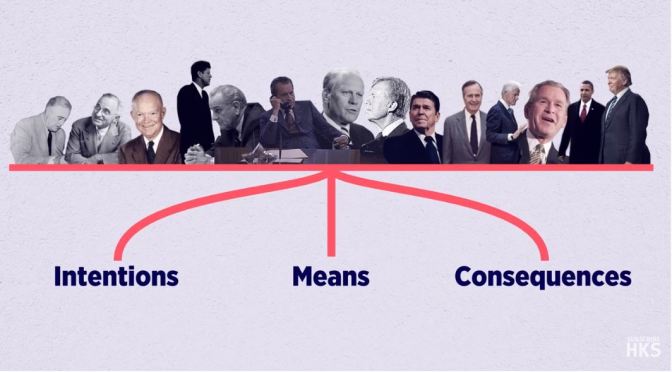
As one of the leading figures in the field of international relations, Joseph S. Nye, Jr., Harvard University Distinguished Service Professor Emeritus, has had a major influence on the way that policymakers think American foreign policy.
In his new book, “Do Morals Matter: Presidents and Foreign Policy from FDR to Trump,” Professor Nye explores the question of how heavily moral questions weigh on the decisions of U.S. presidents since the end of World War II. On this episode of Behind The Book, produced by Library and Knowledge Services at Harvard Kennedy School, we take a look at Professor Nye’s new book and how he assesses the legacy of past presidents based on the morality of their foreign policy.
“Do Morals Matter: Presidents and Foreign Policy from FDR to Trump” is published by Oxford University Press.
Joseph S. Nye Jr., is the University Distinguished Service Professor, Emeritus and former Dean of the Harvard’s Kennedy School of Government. He has served as Assistant Secretary of Defense for International Security Affairs, Chair of the National Intelligence Council, and Deputy Under Secretary of State for Security Assistance, Science and Technology.
His most recent books include The Power to Lead; The Future of Power; Presidential Leadership and the Creation of the American Era; and Is the American Century Over. He is a fellow of the American Academy of Arts and Sciences, the British Academy, and the American Academy of Diplomacy.
In a recent survey of international relations scholars, he was ranked as the most influential scholar on American foreign policy, and in 2011, Foreign Policy named him one of the top 100 Global Thinkers.
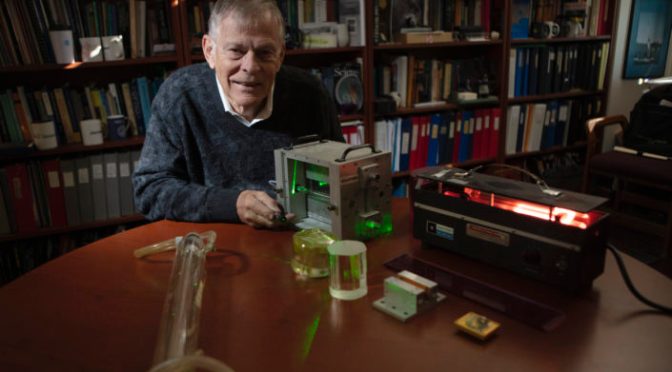
 Byer also helped develop the quietest, most stable laser in the world, called the diode-pumped YAG laser. YAG lasers are today found in everything from communications satellites to green handheld laser pointers, which Byer co-developed with two of his graduate students and cites as one of his favorite inventions (he had joined Stanford in 1969). YAG lasers also form the main beams of the gravitational wave-detecting instrument, LIGO, which in 2015 achieved the most precise measurement ever made by humans when its antenna detected the tenuous spacetime fluctuations generated by two colliding black holes 1.3 billion light-years away.
 One summer morning in 1964, Byer drove the hour from Berkeley down to Mountain View for a job interview at a California company called Spectra Physics. He walked in to find an empty lobby but could hear clapping and cheering in the back of the building. After politely waiting for several minutes, he followed the commotion to a darkened room filled with men whose jubilant faces were illuminated by a rod of red-orange light that seemed to float above an instrument-strewn table
 Boomers Daily