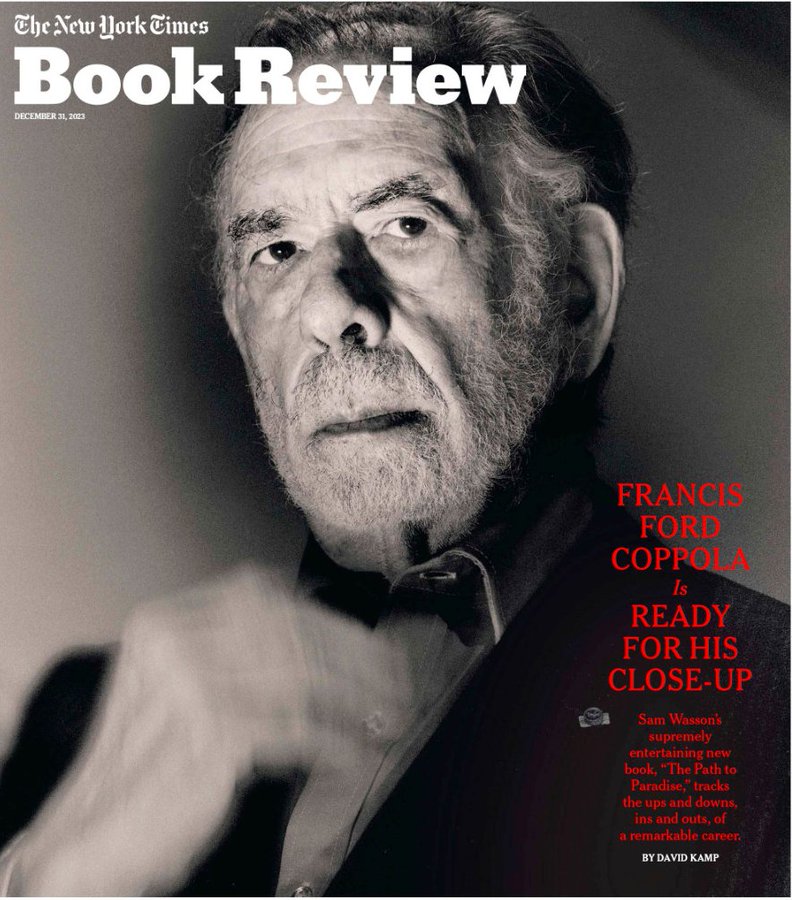
THE NEW YORK TIMES BOOK REVIEW (December 31, 2023): The latest issue features Francis Ford Coppola Is Ready For His Close-Up – Sam Wasson’s supremely entertaining new book, “The Path to Paradise”, tracks the ups and downs, ins and outs, of a remarkable career.
When the billionaire entrepreneur Elon Musk sat down for his profanity-laced interview at The New York Times’s DealBook Summit in late November, his petulant dropping of F-bombs received a lot of attention. Less noticed but far more revealing was his evident disdain for a humble word beginning with the letter T. “You could not trust me,” Musk said, affecting an air of tough-guy indifference in his shearling-collared flight jacket and shiny black boots. “It is irrelevant. The rocket track record speaks for itself.”
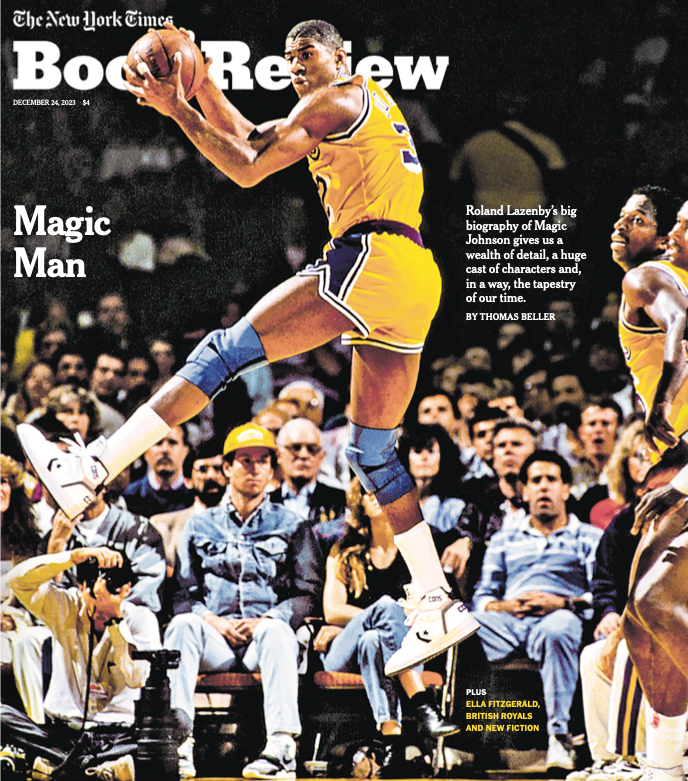
THE NEW YORK TIMES BOOK REVIEW (December 22, 2023): The latest issue features MAGIC: The Life of Earvin “Magic” Johnson, by Roland Lazenby; My Jewish Charlie Brown Christmas – The Peanuts special is the most overtly Christian TV holiday classic. So why does it speak to me so deeply?; Seven Fishes (Not Seven Dishes) for Christmas Eve – A modern Italian American take on the Feast of the Seven Fishes offers a streamlined menu any family can pull off….
Roland Lazenby’s big biography of Magic Johnson gives us a wealth of detail, a huge cast of characters and, in a way, the tapestry of our time.
By Thomas Beller
MAGIC: The Life of Earvin “Magic” Johnson, by Roland Lazenby
I once asked a portrait photographer why no one ever smiled in her pictures, and she replied, “A smile is a mask.”
I thought of this aphorism as I read Roland Lazenby’s 800-page biography of Magic Johnson. Sports Illustrated declared his smile to be one of the two greatest smiles of the 20th century. (The other was Louis Armstrong’s.) As Missy Fox, the daughter of his high school coach, says in the book, “That is the one thing he’s always had, that smile.”
My Jewish Charlie Brown Christmas
The Peanuts special is the most overtly Christian TV holiday classic. So why does it speak to me so deeply?
“A Charlie Brown Christmas” was a one-of-a-kind wonder when it premiered in 1965 and remains so almost 60 years later. Unlike the other jingle-belled baubles that TV throws down the chimney each year, it is melancholy and meditative. The animation is minimalist and subdued, full of grays and wafting snowflakes. I could wrap myself in the Vince Guaraldi jazz score like a quilt.
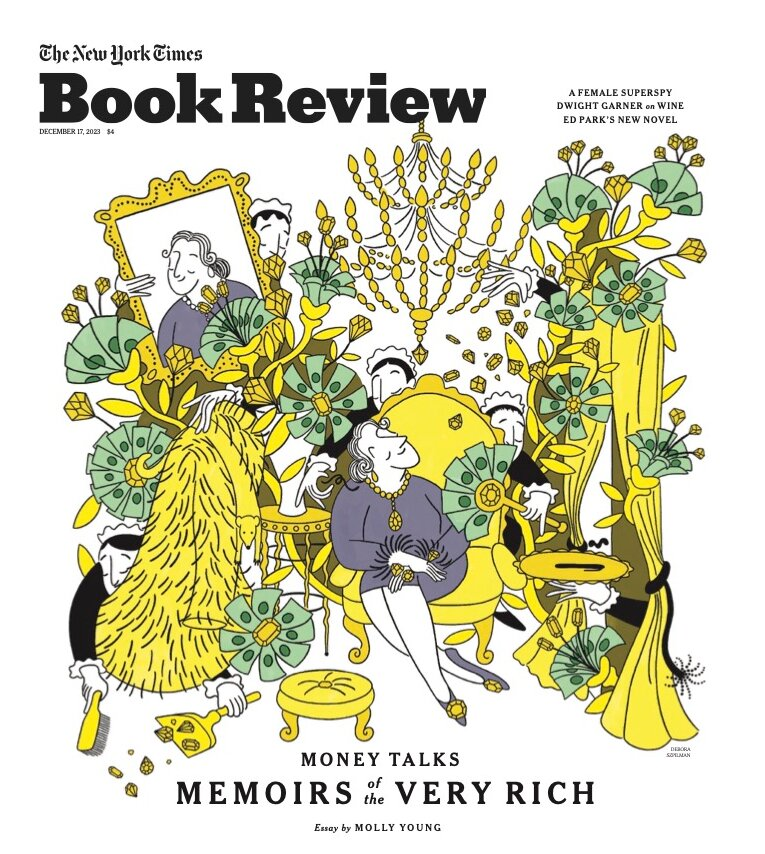
THE NEW YORK TIMES BOOK REVIEW (December 15, 2023): The latest issue features ‘Glorious Memoirs by the Very Rich’ – A look back at a time when the super-wealthy felt they had nothing to lose by letting readers inside their gilded corridors; For Kate Christensen, Bad Prose Can Never Yield a Great Book – “A book is made of language,” says the author, whose new novel is “Welcome Home, Stranger.” “How can a house be great if it’s made of shoddy materials? How can a dinner be great if it’s made with terrible ingredients?”
“Class consciousness takes a vacation while we’re in the thrall of this book,” Barbara Grizzuti Harrison wrote in the Book Review in 1985, in her evaluation of the heiress Gloria Vanderbilt’s memoir “Once Upon a Time.” To be clear, Harrison was referring to the class consciousness of the reader, not the author. Vanderbilt demonstrates perfect awareness throughout her book that most young children don’t play with emerald tiaras and alligator jewel boxes lined in chestnut satin, or rely on the services of multiple butlers, or lose count of their own houses. Harrison’s point was that Vanderbilt’s talent with a pen — and perspective on her own economic altitude — allowed consumers of her tale to suspend their envy and engage with the reality of growing up in opulent neglect.
“A book is made of language,” says the author, whose new novel is “Welcome Home, Stranger.” “How can a house be great if it’s made of shoddy materials? How can a dinner be great if it’s made with terrible ingredients?”
What books are on your night stand?
I’m living temporarily in a rented house in Iowa City, teaching at the Writers’ Workshop. When I arrived there was not one book in the entire place, so I made an emergency trip to the local used-book store, collecting whatever leaped out at me from the shelves, mostly based on the wonderful titles: “Overhead in a Balloon,” by Mavis Gallant; “Watson’s Apology,” by Beryl Bainbridge; “Anthills of the Savannah,” by Chinua Achebe; “The Brandon Papers,” by Quentin Bell; “The Marquis of Bolibar,” by Leo Perutz; “The Seven Sisters,” by Margaret Drabble; “Bruised Hibiscus,” by Elizabeth Nunez; “A Journal of the Plague Year,” by Daniel Defoe.
Ryan Gosling and Margot Robbie in “Barbie.”Credit…Warner Bros. Pictures
Films, TV shows, albums, books, art and A.I.-generated SpongeBob performances that reporters, editors and visual journalists in Culture couldn’t stop thinking about this year.
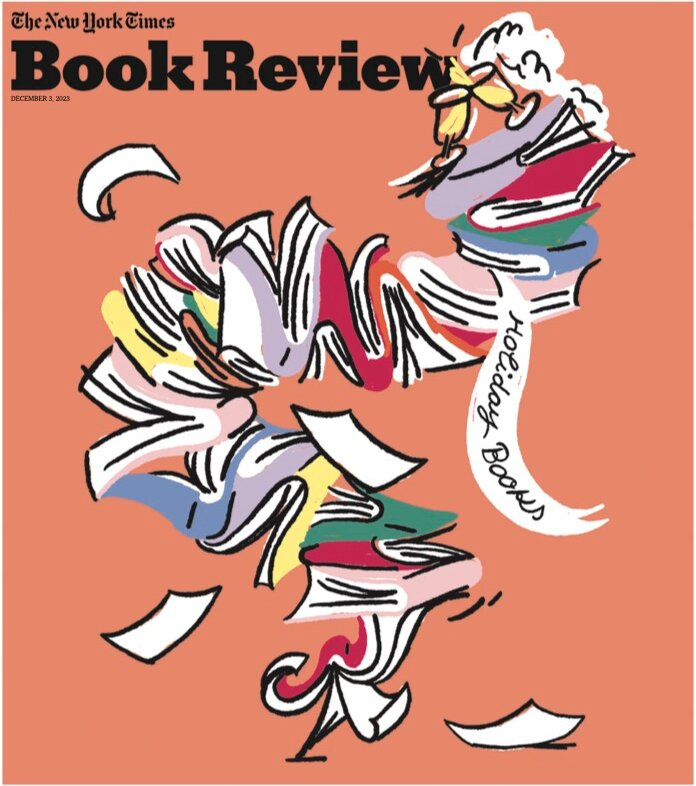
THE NEW YORK TIMES BOOK REVIEW (December 3, 2023): This week features the Holiday Books issue that lands with a thump, a 56-page behemoth crammed with reviews, coffee-table book spreads, recommendations from our genre columnists, a children’s book gift guide and our 100 Notables list.
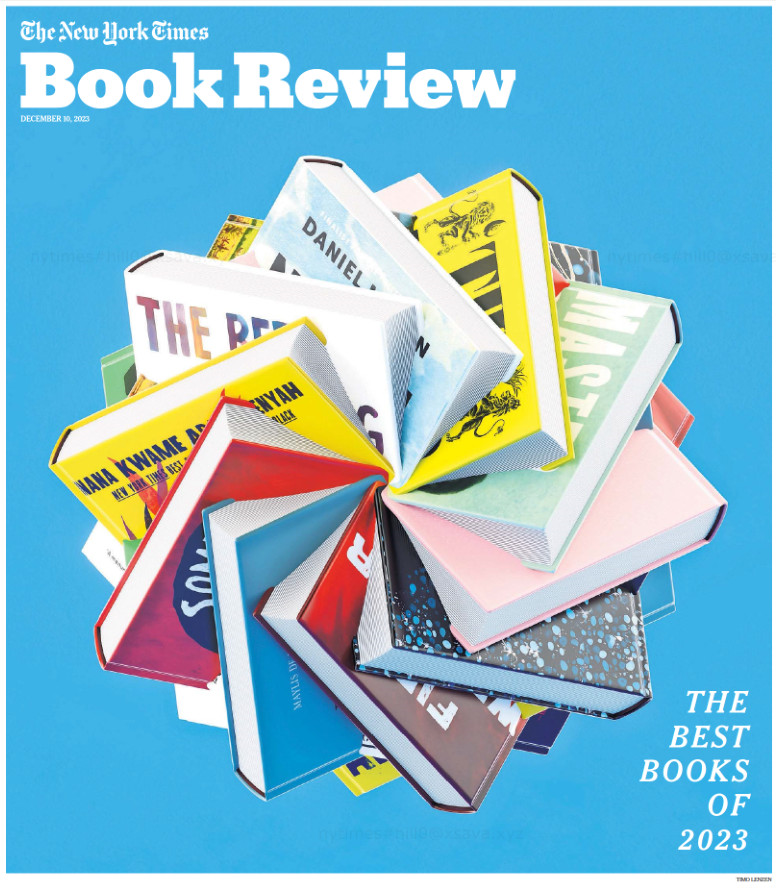
Each year, we pore over thousands of new books, seeking out the best novels, memoirs, biographies, poetry collections, stories and more. Here are the standouts, selected by the staff of The New York Times Book Review.
As long as people have been buying gifts for the holidays, they have been buying books. Books offer infinite variety, are easily wrapped, can be personalized for the recipient and displayed as a signifier of one’s own identity. They are, in many respects, the quintessential Christmas — or Hanukkah or Kwanzaa or other December celebration — gift.
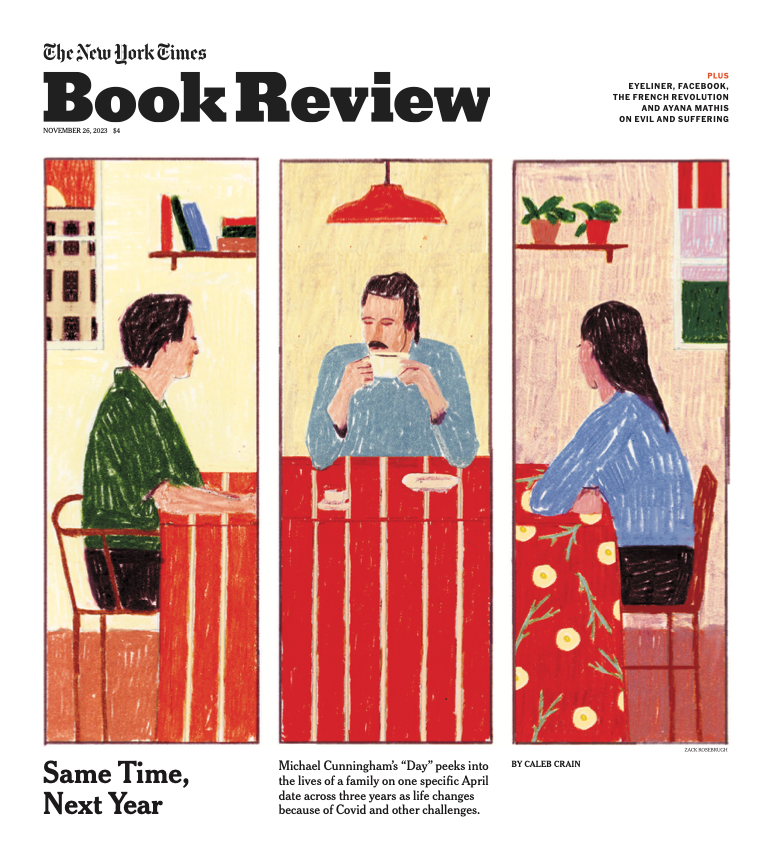
Michael Cunningham’s “Day” peeks into the lives of a family on one specific April date across three years as life changes because of Covid and other challenges.
By Caleb Crain
DAY, by Michael Cunningham
Michael Cunningham’s new novel, “Day,” visits a family on April 5 in 2019, 2020 and 2021 — before, during and after the onset of the Covid-19 pandemic, which shadows the book although the words “Covid” and “pandemic” never appear.
In Chetna Maroo’s debut novel, an adolescent girl mourns the death of her mother in the empty reverberations between points.
By Ivy Pochoda
WESTERN LANE, by Chetna Maroo
At the start of Chetna Maroo’s polished and disciplined debut, Gopi, an 11-year-old Jain girl who has just lost her mother, stands on a squash court outside London. She isn’t playing. Instead, she’s listening to the sound of the ball hitting the wall on the adjacent court, “a quick, low pistol-shot of a sound, with a close echo.” It is not so much the shot itself that Gopi is hearing, but that echo, the empty reverb, the lonely response as the ball’s impact gives the striker a split second to retreat to the T, the center of the court, and prepare to counteract her opponent’s responding shot.
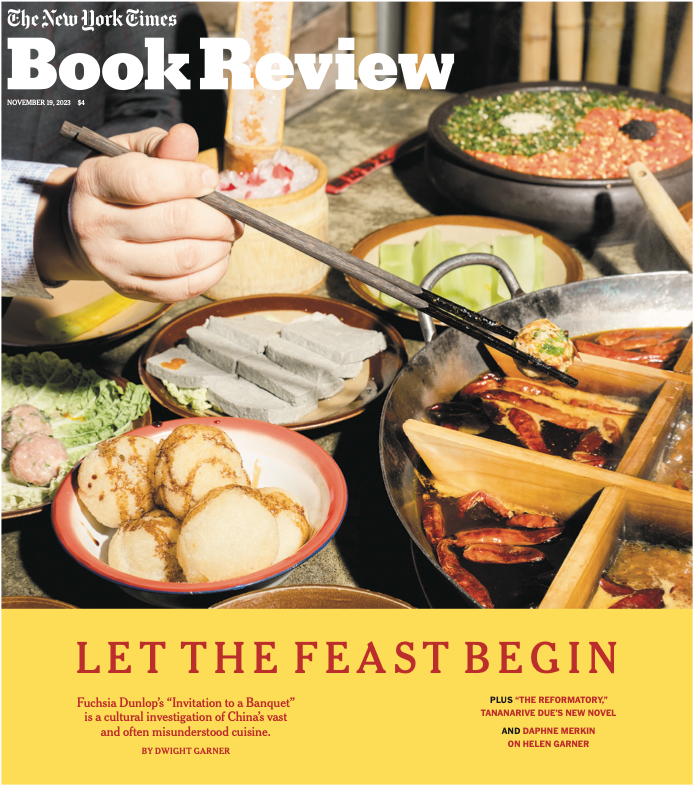
THE NEW YORK TIMES BOOK REVIEW (November 19, 2023): This week’s issue featuresFuchsia Dunlop’s seductive new exploration of Chinese cuisine, “Invitation to a Banquet”; Michael Lewis Tells His Own Story of Sam Bankman-Fried; He Carried the Bags (and the Secrets) for the Beatles – A new biography resuscitates the colorful, tragic life of Mal Evans: roadie, confidant, procurer, cowbell player…
INVITATION TO A BANQUET: The Story of Chinese Food, by Fuchsia Dunlop
“A really good cookbook,” Jan Morris wrote, “is intellectually more adventurous than the Kama Sutra.” Fuchsia Dunlop’s masterly new book, “Invitation to a Banquet: The Story of Chinese Food,” is not a cookbook per se. But it has an earthiness that calls to mind Morris’s comment.
AUDIOBOOKS
Listen to a Wellness-Culture Satire That Delves a Few Levels Deeper
In Jessie Gaynor’s debut novel, “The Glow,” read by Gabra Zackman, a P.R. rep immerses herself in the woo-woo world of a cultlike “spiritual retreat,” and its enigmatic leader.
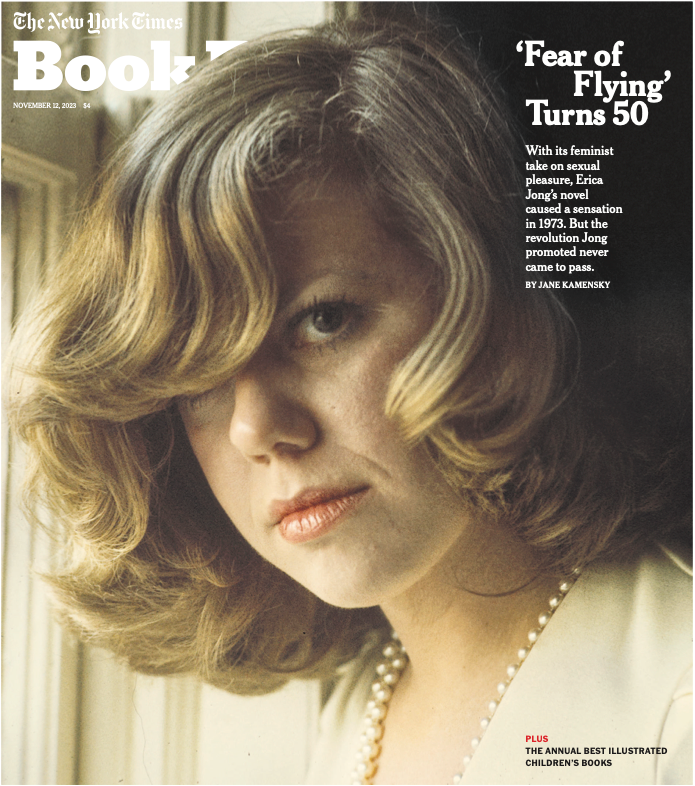
THE NEW YORK TIMES BOOK REVIEW (November 12, 2023): This week’s issue features ‘Fear of Flying’ turns 50 – With its feminist take on sexual pleasure, Erica Jong’s novel caused a sensation in 1973; The 2023 New York Times/New York Public Library Best Illustrated Children’s Books, and more…
With its feminist take on sexual pleasure, Erica Jong’s novel caused a sensation in 1973. But the revolution Jong promoted never came to pass.
By Jane Kamensky
Fifty years ago last month, Erica Jong published a debut novel that went on to sell more than 20 million copies. “Fear of Flying,” a book so sexually frank that you may have found it hidden in your mother’s underwear drawer, broke new ground in the explicitness of writing by and for women. Jong’s heroine, Isadora Wing, was a live wire. She was also a dead end, certainly for Jong, and maybe for feminism, too.
















 Boomers Daily