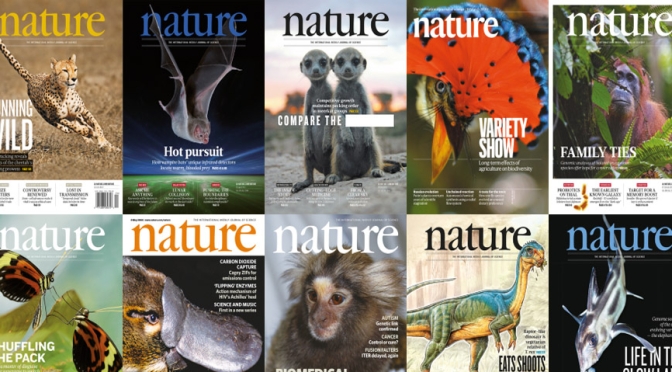
In Nature this week: The heat is on – Burning plasma marks key step towards power from nuclear fusion. Browse the full issue: https://t.co/eR1KDzin4I pic.twitter.com/kMJjsTeIDO
— nature (@Nature) January 27, 2022

Challenging the dogma of gene evolution, and how chiral nanoparticles could give vaccines a boost.
In this episode:
00:45 Genome mutations may be less random than previously thought
A long-standing doctrine in evolution is that mutations can arise anywhere in a genome with equal probability. However, new research is challenging this idea of randomness, showing that mutations in the genome of the plant Arabidosis thaliana appear to happen less frequently in important regions of the genome.
Research article: Munroe et al.
News and Views: Important genomic regions mutate less often than do other regions
13:45 Research Highlights
How hallucinogenic beer helped cement an ancient superpower’s control, and a surprisingly enormous colony of breeding fish.
Research Highlight: Drug-fuelled parties helped ancient Andean rulers to hold power
Research Highlight: Vast fish breeding colony is more than twice the size of Paris
16:11 How a left-handed nanoparticle could give vaccines a boost
The chirality of a molecule – whether it has a left- or right-handed orientation – can have significant impacts on how it works. This week, a team show that left-handed gold nanoparticles can stimulate the immune system of mice, and boost the activity of a flu vaccine.
Research article: Xu et al.
News and Views: Nanoparticle asymmetry shapes an immune response
23:04 Briefing Chat
We discuss some highlights from the Nature Briefing. This time, Tasmanian devils’ discerning diets break the rules on scavenging, and new techniques uncovering the sex of ancient human remains may rewrite our assumptions.
Cosmos: Tasmanian devils puzzle science with picky eating habits
The Observer: Archaeology’s sexual revolution
In this episode, Nature reporter Davide Castelvecchi joins us to talk about the big science events to look out for in 2022. We’ll hear about vaccines, multiple Moon missions, the push to save biodiversity, and more.
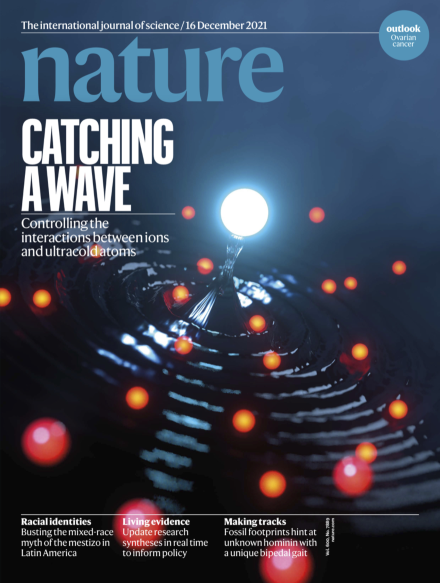
An explanation for giant ice structures on Pluto, and dismantling the mestizo myth in Latin American genetics.
In this episode:
00:46 The frozen root of Pluto’s polygonal patterns
In 2015, NASA’s New Horizons probe sent back some intriguing images of Pluto. Huge polygonal patterns could be seen on the surface of a nitrogen-ice ice filled basin known as Sputnik Planitia. This week, a team put forward a new theory to explain these perplexing patterns.
Research article: Morison et al.
06:15 Research Highlights
How Pamplona’s bull-running defies the dynamics of crowd motion, and self-healing microbial bio-bricks.
Research Highlight: Running of the bulls tramples the laws of crowd dynamics
Research Highlight: It’s alive! Bio-bricks can signal to others of their kind
09:06 How the mixed-race ‘mestizo’ myth has fostered discrimination
The term ‘mestizo’ emerged during the colonial period in Latin America to describe a blend of ethnicities – especially between Indigenous peoples and the Spanish colonizers. But this label is a social construct not a well-defined scientific category. Now researchers are challenging the mestizo myth, which they say is harmful and has a troubling influence on science.
Feature: How the mixed-race mestizo myth warped science in Latin America
17:22 Briefing Chat
We discuss some highlights from the Nature Briefing. This time, how interrupted sleep could be a route to creativity, and the development of vaccines to target respiratory syncytial virus.
New Scientist: Interrupting sleep after a few minutes can boost creativity

 Boomers Daily