


AI’s challenge of understanding the world
In thinking about the challenge of getting artificial intelligence (AI) to understand our complex world, I recalled a Twitter post from a user of Tesla’s self-driving system. The user tweeted that his car kept stopping abruptly at a particular location for no apparent reason. Then he noticed a billboard advertisement on the side of the road, featuring a sheriff holding up a stop sign. The car’s vision system had interpreted this as an actual stop sign, and slammed on the brakes.
The Scottish wildcat has been wiped out by breeding with domestic cats

After 2000 years of isolation, a few decades of interbreeding have rendered the animal “genomically extinct”
BY DAVID GRIMM
Though it lies in ruins on the northeast coast of England, Kilton Castle was once an imposing stone fortress, home to several noble families, and—it appears—at least eight cats. Archaeological excavations in the 1960s uncovered a well, at the bottom of which lay the bones of several felines dating back to the 14th century. The animals were an odd mix: Some were domestic cats, but other, larger specimens appeared to be European wildcats, a fierce, burly species that has inhabited the continent for hundreds of thousands of years.


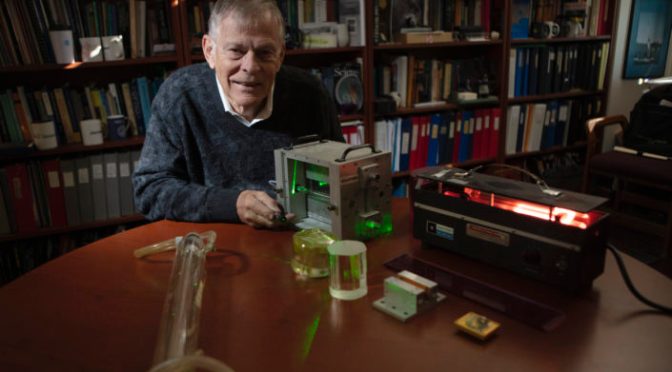
 Byer also helped develop the quietest, most stable laser in the world, called the diode-pumped YAG laser. YAG lasers are today found in everything from communications satellites to green handheld laser pointers, which Byer co-developed with two of his graduate students and cites as one of his favorite inventions (he had joined Stanford in 1969). YAG lasers also form the main beams of the gravitational wave-detecting instrument, LIGO, which in 2015 achieved the most precise measurement ever made by humans when its antenna detected the tenuous spacetime fluctuations generated by two colliding black holes 1.3 billion light-years away.
 One summer morning in 1964, Byer drove the hour from Berkeley down to Mountain View for a job interview at a California company called Spectra Physics. He walked in to find an empty lobby but could hear clapping and cheering in the back of the building. After politely waiting for several minutes, he followed the commotion to a darkened room filled with men whose jubilant faces were illuminated by a rod of red-orange light that seemed to float above an instrument-strewn table
 Boomers Daily