
Tag Archives: International Court of Justice

World Economic Forum: Top Stories- April 8, 2023

World Economic Forum (April 8, 2023) – This week’s top stories of the week include:

0:15 Vanuatu takes the World to Court – The island state pushed through a historic UN motion which calls on the International Court of Justice, the world’s highest court to establish countries’ legal duties to address the climate crisis. The ICJ will provide an ‘opinion’ on what countries can do to cut emissions and protect people and protect climate-vulnerable people. Although the opinion won’t be legally binding, it will carry huge weight and could be used in climate negotiations and future climate lawsuits.

1:43 Japanese workers just got a historic payrise – Every year, unions of major companies negotiate wages in Spring, for shorter hours and better pay. This year, the parties agreed to a 3.8% wage rise, the biggest raise since 1993. For part-time and contract workers, the raise was even larger, 5.91% per hour. A rise in the cost of living drove the agreements. Consumer prices in Japan have risen 4.2% in a year, The sharpest rise for 40 years. And the real value of wages fell 4.1% in January for the tenth consecutive month.

3:03 Latvia has the most female inventors in Europe – A new study charted the gender gap in European inventors from 1978 to today by counting the women named in patent applications. From 2010-2019, 30.6% of Latvia’s inventors were women. Portugal took second place with 26.8% and third was Croatia, where 25.8% of inventors were women. 4:39 Friends are key to reducing inequality – Researchers wanted to know why some people climb the economic ladder faster than others. So they looked at the Facebook friendships of 72 million people. Here’s what they found.

_____________________________________________

The World Economic Forum is the International Organization for Public-Private Cooperation. The Forum engages the foremost political, business, cultural and other leaders of society to shape global, regional and industry agendas. We believe that progress happens by bringing together people from all walks of life who have the drive and the influence to make positive change.
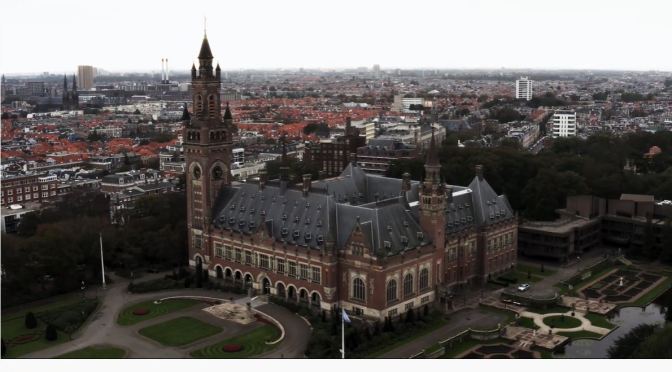
Tours: The International Court Of Justice (ICJ), The Hague, Netherlands

This virtual tour of the International Court of Justice (ICJ) leads the viewers through the rooms of the Peace Palace used by the judges in carrying out their judicial functions.

FAQ ——

What is the International Court of Justice?

The Court is the principal judicial organ of the United Nations. It was established by the United Nations Charter, which was signed in 1945 in San Francisco (United States), and began work in 1946 in the Peace Palace, The Hague (Netherlands).

The Court, which is composed of 15 judges, has a twofold role: first, to settle, in accordance with international law, legal disputes between States submitted to it by them and, second, to give advisory opinions on legal matters referred to it by duly authorized United Nations organs and specialized agencies.

The Court’s official languages are English and French.

Who may submit cases to the Court? Only States are eligible to appear before the Court in contentious cases. The Court has no jurisdiction to deal with applications from individuals, non-governmental organizations, corporations or any other private entity. It cannot provide them with legal advice or help them in their dealings with national authorities. However, a State may take up the case of one of its nationals and invoke against another State the wrongs which its national claims to have suffered at the hands of the latter; the dispute then becomes one between States.

What differentiates the International Court of Justice from the International Criminal Court and the ad hoc international criminal tribunals?

The International Court of Justice has no jurisdiction to try individuals accused of war crimes or crimes against humanity. As it is not a criminal court, it does not have a prosecutor able to initiate proceedings. This task is the preserve of national courts, the ad hoc criminal tribunals established by the United Nations (such as the International Residual Mechanism for Criminal Tribunals (IRMCT), mandated to take over residual functions from the International Criminal Tribunal for the former Yugoslavia (ICTY) and from the International Criminal Tribunal for Rwanda (ICTR)) or in co-operation with it (such as the Special Court for Sierra Leone and the Special Tribunal for Lebanon), and also of the International Criminal Court, set up under the Rome Statute.