
Tag Archives: Grand Canyon

Environment: The Grand Canyon Is Losing Its River

Long shadows are in the foreground of a view of the reddish canyon walls, which loom on either side and ahead. The sky is blue with ribbed white clouds.

The New York Times (June 6, 2023) – Down beneath the tourist lodges and shops selling keychains and incense, past windswept arroyos and brown valleys speckled with agave, juniper and sagebrush, the rocks of the Grand Canyon seem untethered from time. The oldest ones date back 1.8 billion years, not just eons before humans laid eyes on them, but eons before evolution endowed any organism on this planet with eyes.

The Grand Canyon, a Cathedral to Time, Is Losing Its River

Written and photographed by Raymond Zhong, who joined scientists on a 90-mile raft expedition through the canyon.

About half a dozen people with orange life jackets ride a blue raft on a murky, brownish and somewhat choppy Colorado River. Rust-colored canyon walls loom on either side and ahead of them. Three other rafts are in the distance.

Since 1963, the Glen Canyon Dam has been backing up the Colorado for nearly 200 miles, in the form of America’s second-largest reservoir, Lake Powell. Engineers constantly evaluate water and electricity needs to decide how much of the river to let through the dam’s works and out the other end, first into the Grand Canyon, then into Lake Mead and, eventually, into fields and homes in Arizona, California, Nevada and Mexico.


Spend long enough in the canyon, and you might start feeling a little unmoored from time yourself.

A spring that looks like a narrow waterfall cascades out of a hole in a canyon wall down into a calm part of the Colorado River. The canyon walls are rust-red.
North Canyon, and a spring at Vasey’s Paradise.

The immense walls form a kind of cocoon, sealing you off from the modern world, with its cell signal and light pollution and disappointments. They draw your eyes relentlessly upward, as in a cathedral.

You might think you are seeing all the way to the top. But up and above are more walls, and above them even more, out of sight except for the occasional glimpse. For the canyon is not just deep. It is broad, too — 18 miles, rim to rim, at its widest. This is no mere cathedral of stone. It is a kingdom: sprawling, self-contained, an alternate reality existing magnificently outside of our own.

And yet, the Grand Canyon remains yoked to the present in one key respect. The Colorado River, whose wild energy incised the canyon over millions of years, is in crisis.
Read more

Views: Grand Canyon National Park, Arizona

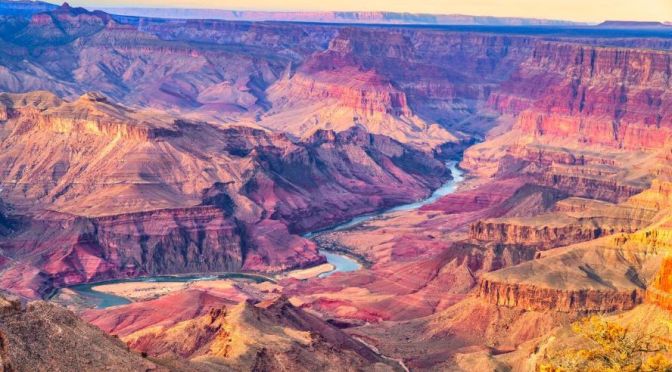
Grand Canyon National Park, in Arizona, is home to much of the immense Grand Canyon, with its layered bands of red rock revealing millions of years of geological history. Viewpoints include Mather Point, Yavapai Observation Station and architect Mary Colter’s Lookout Studio and her Desert View Watchtower. Lipan Point, with wide views of the canyon and Colorado River, is a popular, especially at sunrise and sunset. 

Winter Views: Clouds Fill Snow-Covered Grand Canyon In Arizona (Video)

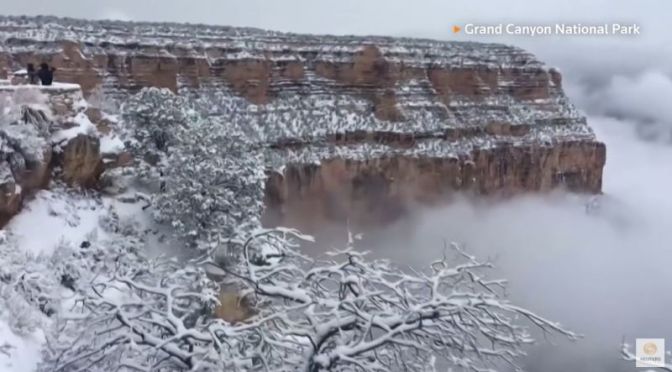
A snowy Grand Canyon was shrouded by a partial cloud inversion in Arizona.

Grand Canyon National Park, in Arizona, is home to much of the immense Grand Canyon, with its layered bands of red rock revealing millions of years of geological history. Viewpoints include Mather Point, Yavapai Observation Station and architect Mary Colter’s Lookout Studio and her Desert View Watchtower. Lipan Point, with wide views of the canyon and Colorado River, is a popular, especially at sunrise and sunset. 

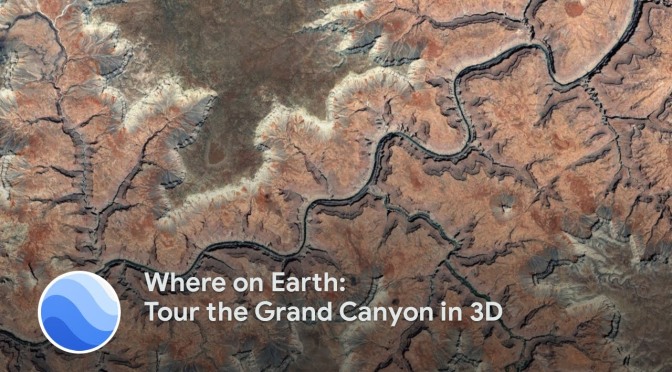
Aerial Travel: The ‘Grand Canyon – Arizona’ (Video)

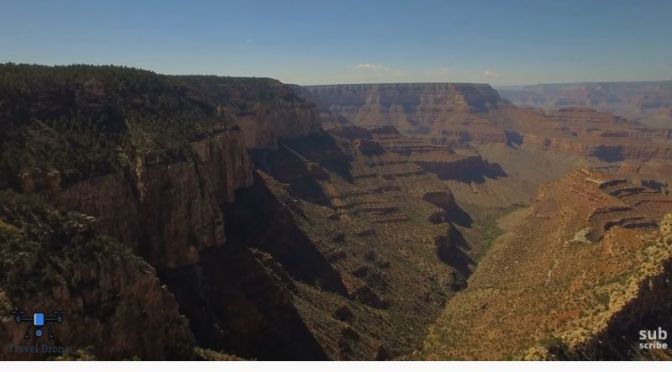
The Grand Canyon  is a steep-sided canyon carved by the Colorado River in ArizonaUnited States. The Grand Canyon is 277 miles (446 km) long, up to 18 miles (29 km) wide and attains a depth of over a mile (6,093 feet or 1,857 meters).

The canyon and adjacent rim are contained within Grand Canyon National Park, the Kaibab National ForestGrand Canyon–Parashant National Monument, the Hualapai Indian Reservation, the Havasupai Indian Reservation and the Navajo Nation. President Theodore Roosevelt was a major proponent of preservation of the Grand Canyon area and visited it on numerous occasions to hunt and enjoy the scenery.

Travel Video: Hiking The 25-Mile ‘Tonto Trail’ Of The Grand Canyon, Arizona

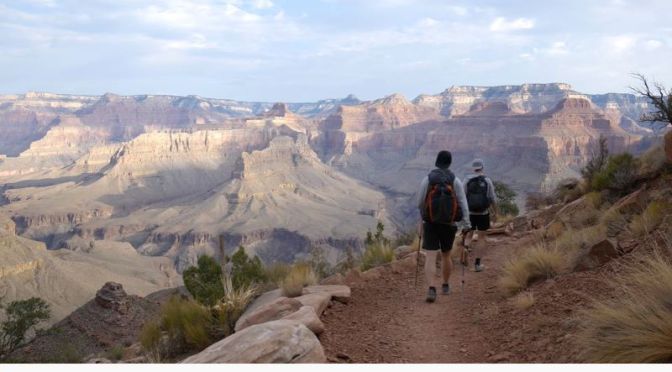
Spent two days backpacking on the Hermit’s Rest Viewpoint to Tonto Trail to Bright Angel Trailhead in the Grand Canyon.

The dynamic interplay of soft and hard layers of stone created an open benchland at the rim of the Inner Gorge called the Tonto Platform. Easily visible from several South Rim overlooks, the greenish Tonto rocks have eroded into an obvious exception to the striking vertical cliffs that characterize most of Grand Canyon.

The Tonto Trail follows this natural trans-canyon route for 95 rough, unmaintained miles, from Red Canyon on the east to Garnet
Canyon on the west. All of this makes the Tonto Trail unique among Grand Canyon pathways. Most descend from the rim towards the Colorado River, but the Tonto Trail offers passage by foot up and down the canyon, parallel to the course of the river. Because of its length, most hikers approach the Tonto Trail not as a single unit, but rather as a series of installments, breaking the route down into four or five sections defined by rim-to-river trails and the natural lay of the land.

A notable lack of reliable water makes most of the Tonto Trail a daunting, possibly dangerous, proposition, but the section between Bright Angel Trail and the Hermit Trail is blessed with three water sources hikers can count on. As a result, this segment of the Tonto Trail offers a degree of civility not found elsewhere along the trail, and it is here that most hikers get their first exposure to the unique nature of this singular trans-canyon route.

Travel Documentaries: “Passport Home” – Pete McBride Photographs The Grand Canyon (Video)

Photographer, filmmaker, and Sony Artisan Pete McBride shares this short film “Passport Home”, a glimpse of his documentary “Into the Canyon” that is nominated for Outstanding Nature Documentary at next week’s 2020 Emmy Awards.

“For years I’ve studied the world through a lens to tell the stories of others, my own, and the magic and complexity of our shared world. But after years of documenting stories I started noticing something consistent. Wherever I framed my lenses, change revealed itself before me. The places where I had ventured and worked were facing constant challenges of overuse and destruction, of being loved to a point of permanent change.”

“It was at this point that I realized my cameras were no longer just a passport for adventure, but tools to help protect the places where we adventure – those wild places we love. Now I shoot not for likes, instead I document because I want to cherish and protect the places I love…so the next person can stand in my tracks and see the magic just like I saw it. Cameras are passports to our curiosity, our creativity, our world, and they are even tools to help protect not just far away, but our own back yards.”

Learn more: https://alphauniverse.com/

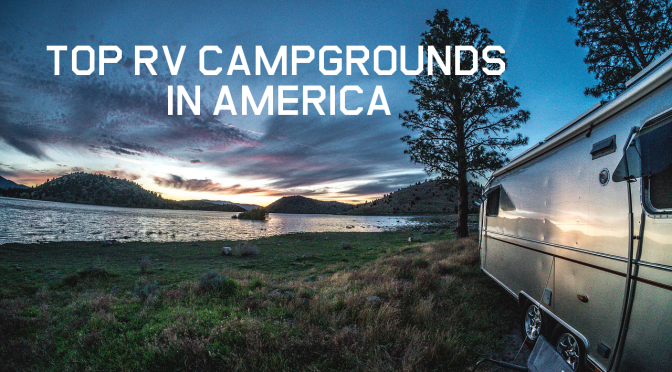
Top RV Campsites: North Rim Campground In Grand Canyon National Park

From a Fodor’s online article:

Grand_Canyon_North_Rim_Campground_Registration_Office_0097One of America’s most iconic national parks, it’s no surprise to learn that the Grand Canyon is often crowded. Most visitors, though, stick to the park’s South Rim, leaving the less populated North Rim open to campers in search of wildlife and a little tranquility. The North Rim Campground is a whopping 8,200 feet in elevation bordering the Transept Canyon, an offshoot of the main canyon, of which some sites have fantastic views. The 90-site campground, open May through October (reservations only), is located a mile south of the Grand Canyon Lodge and visitor center.
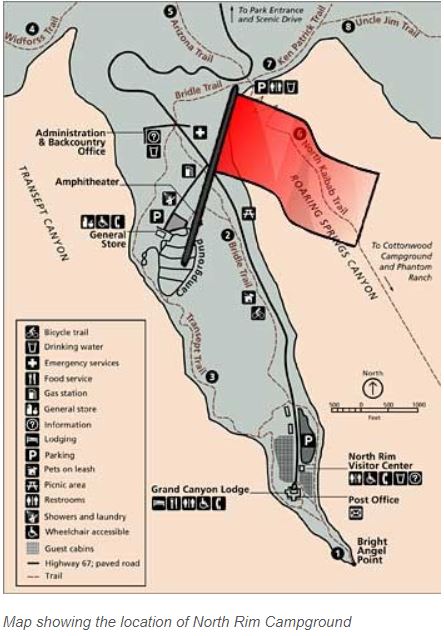
North Rim Campground Grand Canyon National Park

To read more click on the following link: https://www.fodors.com/world/north-america/usa/arizona/grand-canyon-national-park