DW Documentary (September 14, 2024): What made our ancestors evolve in such an extraordinary way? This film presents the latest scientific theories on how the human species evolved and looks at the shadow side of our unique abilities.
Some animals see, hear or smell better than humans. Others can find their way in the dark much better than we can. Some can fly. All animals communicate, some have excellent memories and others build complex structures and have highly-developed social skills. So what sets humans apart? Why have humans evolved such highly developed cognitive abilities in comparison to animals?
The documentary sheds light on this major question of human evolution — one of the mysteries that has long puzzled the world of science. What is it that makes humans so fundamentally different from other animal species? And will our extraordinary abilities ultimately lead us to self-destruction?
DW Documentary (September 10, 2023) – Mongolia. For most of us, a name that brings to mind the powerful empire of Genghis Khan. This film is a journey through Mongolian history and into modern Mongolian culture. It offers fascinating insights into the little-known central Asian nation. Mongolia, a country rich with forests, deserts and steppes, borders Russia to the north and China to the south.
But its chief influences today come from South Korea and the West. Director Robert H. Lieberman and filmmaker Deborah C. Hoard introduce novelists, journalists, politicians, activists, poets, painters and a comedian, all of whom shed light on the young republic – and its young population. Historians, archaeologists and local residents tell the story of the vast empire.
The eastern European and Asian territory captured by a fighting force of united Mongol tribes was the largest contiguous land empire in the history of the world. The film looks the beyond the figure of Genghis Khan, the notorious founder of the Mongol empire, and explores the multi-faceted legacy of the realm. It’s a legacy that still makes itself felt in the present day.
DW Documentary (August 21, 2023) – When a long-lost bronze of Alexander the Great suddenly turns up in Greece, experts are suspicious. This documentary follows archaeologist Stephan Lehmann as he follows the trail of the art forgers.
Stephan Lehmann has uncovered around 50 suspected forged artworks to date – in the marketplace, in private collections and even in museums. Now, a large bronze of Alexander the Great has resurfaced in Greece. It was owned by a British art dealer and was handed back to Greece as previously looted art. But Lehmann and other experts say it’s a fake. Due to his work, archaeologist Stephan Lehmann is not always a popular figure: in the art trade and the museum world, many people prefer to sweep the problem of forgeries under the rug.
But one anonymous Swiss collector decided to confront the issue. He sent Lehmann an allegedly ancient but highly dubious bronze depicting Emperor Augustus, which he had purchased for several hundred thousand dollars in New York. Lehmann examined it and had it X-rayed at Germany’s Fraunhofer Institute, using one of the most powerful CT scanners in the world.
Testing the material an artwork is made of can not only uncover forgeries; it can also shed light on how forgers go about their work. This documentary sets out on the trail of art forgers, uncovering a dark and concealed side of the antiquities trade. It reveals just how good forgeries can be. Fakes have even sometimes turned up among supposedly looted works being returned to states as part of the restitution process.
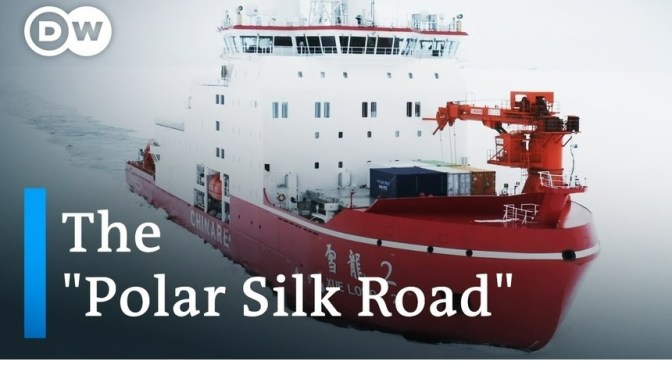
DW Documentary (April 1, 2023) – Following the rise of China’s power in Africa, are we on the verge of seeing a Chinese Arctic? Certainly, the country is seeking to expand its influence in this geopolitically important area. The US is worried, while Russia smells business.
But what are China’s plans for the region? In 2013, the “Yong Sheng” made history: It was the first Chinese cargo ship to reach Europe via the Arctic. This promising route, which Beijing soon dubbed the “Polar Silk Road,” made the “Yong Sheng” a symbol of Chinese ambitions in the far north. Increasingly self-confident, China is now expanding its sphere of influence bit by bit in the Arctic – a place of high geopolitical significance.
The country’s influence is spreading, with projects that include investments in gas resources in the Russian Arctic on the Yamal Peninsula. In January 2018, China initiated the “Polar Silk Road” project. Now, the country is pursuing a rapprochement with Iceland and Norway through businessmen. China maintains a research station on Spitsbergen and has even started to define itself publicly as a country “close to the Arctic” – a status from which China hopes to derive new rights.
The Arctic seems a long way from Beijing. But Chinese president Xi Jinping has understood how important this region is. China’s need for resources is driving Xi Jinping to negotiate with the major Arctic powers, who largely view him with suspicion. The new geopolitics of the Arctic are playing out not only in world capitals and in the media, but also on the ground: Emissaries, entrepreneurs, and mediators are traveling to the strategic region.
This group includes Chinese nationals as well as Norwegians, Icelanders, Swedes and Americans. China is expanding. After “Chinafrica,” will we now also speak of “Chinarctica”? China, it is said, has time on its side. And in the meantime it is openly dreaming of superpower status. The Americans are worried, the Europeans are hesitant and the Russians are eager for investments. But what are China’s real goals?
The Galapagos Islands are home to some of the most unspoiled nature in the world. But even here plastic waste is a problem, and biodiversity is under threat. Marine biologists and conservationists are campaigning for the expansion of protected zones. The fauna and flora of the Galapagos Islands in the Pacific Ocean is a treasure trove for marine biologists.
They still know very little about many of the fish, rays and sea turtles that can be found here. But these days, their work is focused primarily on conservation, because many of these species are endangered due to threats such as overfishing and boat strikes. Efforts to protect local wildlife include attaching tracking devices to juvenile hammerhead sharks to determine their migration routes, which can then be designated as protected areas.
Other research teams are focused on the problem of plastic waste in the Pacific – identifying where it comes from and exploring its impact on marine life. Meanwhile, local fishermen are under pressure: Large fishing fleets from China and elsewhere ply the waters near the Galapagos Islands, severely depleting fish stocks. As a result, local fishing boats are forced to move into designated conservation zones. If the delicate marine environment surrounding the Galapagos Islands is to survive, fishing needs to become more sustainable.
News, Views and Reviews For The Intellectually Curious







 Boomers Daily