Tag Archives: Culture Magazines

The New York Times Magazine- January 21, 2024

Image

THE NEW YORK TIMES MAGAZINE (January 19, 2024): The new issue features ‘The Whale Who Went AWOL’ – How do you solve a problem like Hvaldmir?; How Group Chats Rule the World – They quietly became the de facto spaces to share dumb jokes, grief or even plans for an insurrection…

The Whale Who Went AWOL

Hvaldimir escaped captivity and became a global celebrity. Now, no one can agree about what to do with him.

By Ferris Jabr

On April 26, 2019, a beluga whale appeared near Tufjord, a village in northern Norway, immediately alarming fishermen in the area. Belugas in that part of the world typically inhabit the remote Arctic and are rarely spotted as far south as the Norwegian mainland. Although they occasionally travel solo, they tend to live and move in groups. This particular whale was entirely alone and unusually comfortable around humans, trailing boats and opening his mouth as though expecting to be fed. And he seemed to be tangled in rope.

How Group Chats Rule the World

An illustration of people falling into chat bubbles.

They quietly became the de facto spaces to share dumb jokes, grief or even plans for an insurrection.

By Sophie Haigney

I am texting all the time. I am, at the very least, receiving texts all the time, a party to conversations in which I am alternately an eavesdropper and an active participant. This is because I am in a lot of group chats — constant, interlinked, text-message-based conversations among multiple friends that happen all day long. I dip into and out of these conversations, on my phone and on my computer. Sometimes I will put both away for two hours and return to find 279 new messages waiting.
The New York Times Magazine- January 14, 2024

Image

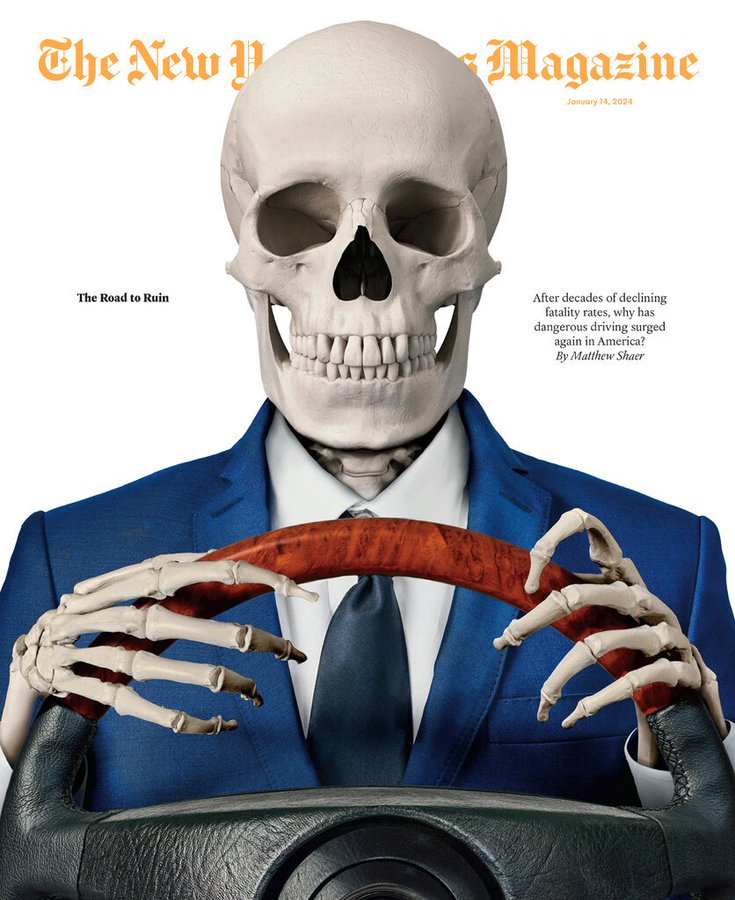
THE NEW YORK TIMES MAGAZINE (January 12, 2024): The new issue features ‘Why Are American Drivers So Deadly’ – After decades of declining fatality, dangerous driving has surged again….

Why Are American Drivers So Deadly?

A photo illustration of a skeleton in a suit driving a car.

After decades of declining fatality rates, dangerous driving has surged again.

By Matthew Shaer

In the summer of 1999, a few years after graduating from medical school, Deborah Kuhls moved from New York to Maryland, where she had been accepted as a surgical fellow at the R Adams Cowley Shock Trauma Center in Baltimore. Founded by a pioneer in emergency medicine, Shock Trauma is one of the busiest critical-care facilities in the country — in an average year, doctors there see approximately 8,000 patients, many of them close to death.

The All-Time-Great Coach Who Makes Football Fun

Andy Reid with Mahomes and other Chiefs players.

Andy Reid’s diligence and sense of mischief have made him one of the game’s best-ever coaches. Can he get his struggling Chiefs back to the Super Bowl?

By Michael Sokolove

Andy Reid, the coach of the Kansas City Chiefs, has won more than 250 games in his career, fourth all-time, which puts him high on any list of the N.F.L.’s greatest coaches. Most of the others in that pantheon are men who personify the sport’s militaristic soul — Vince Lombardi, for example, the fabled coach of the 1960s-era Green Bay Packers, or Reid’s contemporary, the grim Bill Belichick of the New England Patriots. But Reid is no Lombardi or Belichick; he’s Steve Jobs. He’s a designer, a tinkerer, a product engineer who imbues his football with creativity and even an occasional touch of whimsy.

The New York Times Magazine – January 7, 2024

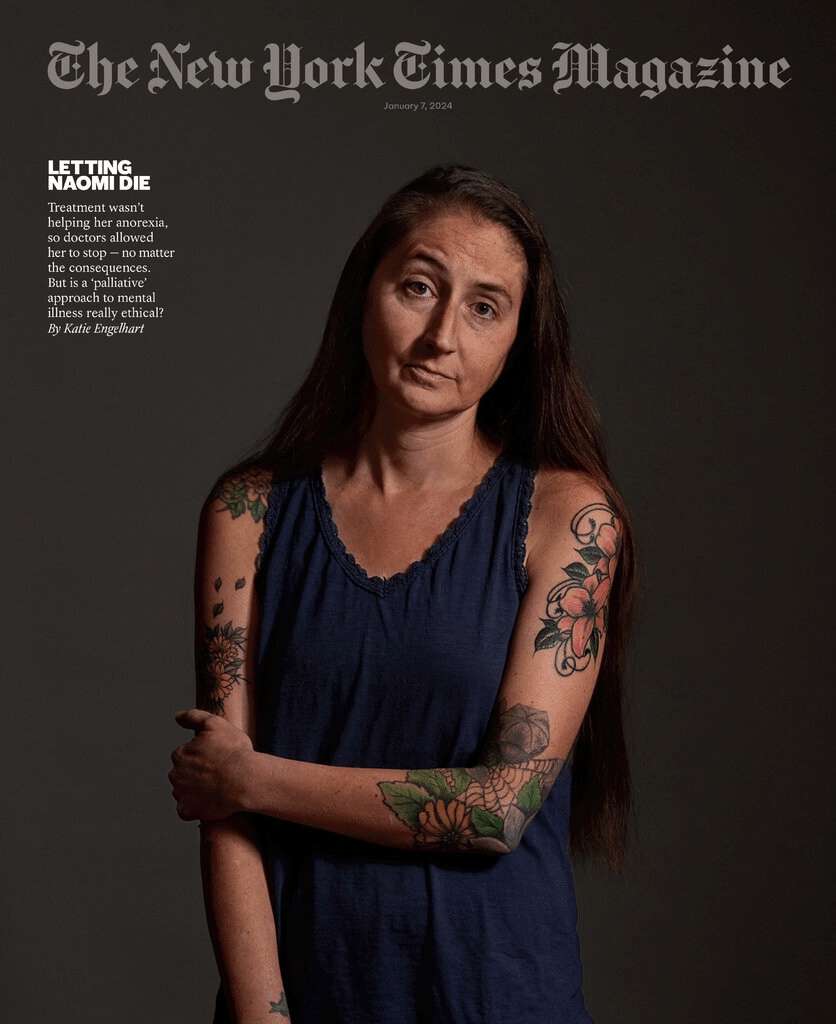
THE NEW YORK TIMES MAGAZINE (January 5, 2024): The new issue features “Letting Naomi Die” – Treatment wasn’t helping her anorexia, so doctors allowed her to stop, no matter the consequences. But is a ‘palliative’ approach to mental illness really ethical?

Should Patients Be Allowed to Die From Anorexia?

A portrait of Naomi.

Treatment wasn’t helping her anorexia, so doctors allowed her to stop — no matter the consequences. But is a “palliative” approach to mental illness really ethical?

By Katie Engelhart

The doctors told Naomi that she could not leave the hospital. She was lying in a narrow bed at Denver Health Medical Center. Someone said something about a judge and a court order. Someone used the phrase “gravely disabled.” Naomi did not think she was gravely disabled. Still, she decided not to fight it. She could deny that she was mentally incompetent — but this would probably just be taken as proof of her mental incompetence. Of her lack of insight. She would, instead, “succumb to it.”

What If People Don’t Need to Care About Climate Change to Fix It?

A photo illustration of Hannah Ritchie.

By David Marchese 

“It seems like we’ve been battling climate change for decades and made no progress,” Dr. Hannah Ritchie says. “I want to push back on that.” Ritchie, a senior researcher in the Program on Global Development at the University of Oxford and deputy editor at the online publication Our World in Data, is the author of the upcoming book, “Not the End of the World.” In it, she argues that the flood of doom-laden stats and stories about climate change is obscuring our ability to imagine solutions to the crisis and envision a sustainable, livable future.

The New York Times Magazine – Dec 31, 2023

Image

THE NEW YORK TIMES MAGAZINE (December 30, 2023):

Rosalynn Carter Was a Political Genius

Rosalynn Carter, the first lady, traveling in Texas in September 1978.

She fell in love with a future president at 17. Marriage never waylaid her dreams.

By MICHAEL PATERNITI

Three miles lie between this life and another, between their two houses, hers in downtown Plains, Ga., and his family farm in the country surrounded by peanuts planted in red clay. Three miles between the ordinary and extraordinary.

When Sinead O’Connor Unleashed Her Ghosts

Sinead O’Connor in 1990.

Uncovering the unlikely story behind the singer’s first album.

By JOHN JEREMIAH SULLIVAN

To say that Sinead O’Connor never quite regained the musical heights of her 1987 debut album, “The Lion and the Cobra,” is not to slight the rest of her output, which contained jewels. There is no getting back to a record like that first one. It was in some sense literally scary: The label had to change the original cover art, which showed a bald O’Connor hissing like a banshee cat, for the American release. In the version we saw, she looks down, arms crossed, mouth closed, vulnerable. The music had both sides of her in it.

The New York Times Magazine – Dec 24, 2023

Image

THE NEW YORK TIMES MAGAZINE (December 22, 2023):

He Was My Role Model. My Mentor. My Supplier.

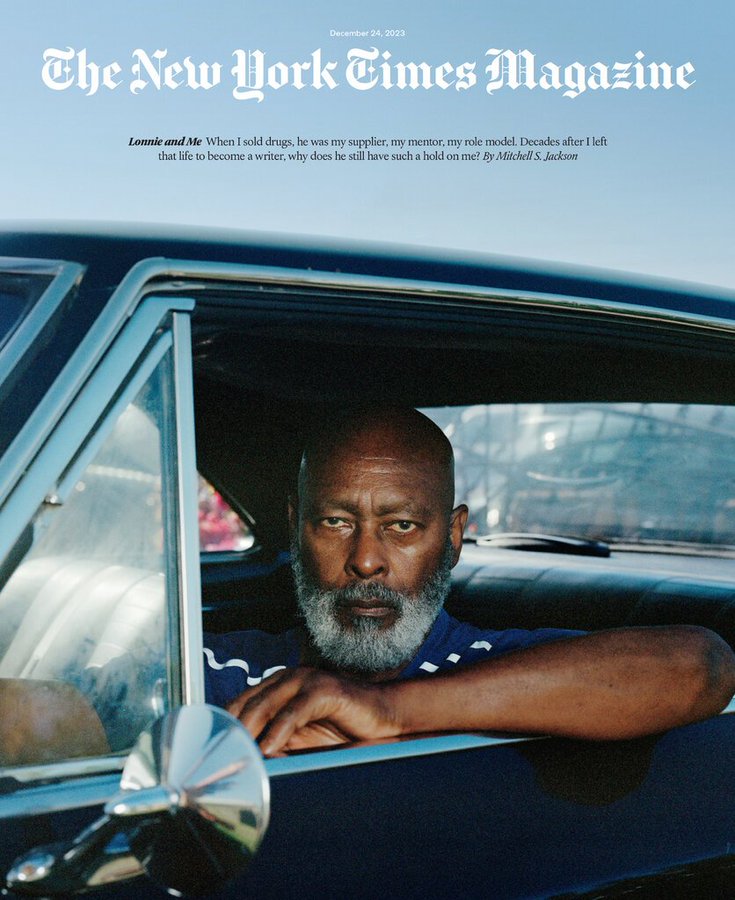
A portrait of Lonnie in a car looking into the camera.

Decades after I left hustling to become a writer, why did I seek out the man who drew me into that world?

By Mitchell S. Jackson

O.G. rings me in the a.m. to say he’s just touched down in Phoenix. It’s the day before he said he’d arrive, and while there was a time when I’d treat the seeming opacity of his plans as par, the call’s a minor surprise. He asks for my address and tells me he can drop by as soon as he grabs his rental car. “Cool,” I say, as if the call ain’t ramped my pulse, as if my crib is presentable for guests. It isn’t. So I shoot out of bed and get to cleaning and straightening the first floor, going so far as to light a candle. It’s been umpteen years since I’ve seen O.G. — Lonnie’s his name — and God forbid he judge me anything less than hella fastidious.

In Jordan, a Sprawling Palestinian Diaspora Looks Towards Gaza

The story of 2.3 million Palestinian refugees in Jordan has been shaped by generations of war and exile.Photographs

by MOISES SAMAN

How Do You Make a Movie About the Holocaust?

A photo illustration of various stills from movies about the holocaust collaged together.

With “The Zone of Interest,” Jonathan Glazer is just the latest director to confront the problem.

Poetry makes nothing happen, W.H. Auden said in 1939, when words must have seemed especially impotent; but cinema is another matter. For several decades after the end of the Second World War, what’s come to be seen as its central catastrophe — the near-total destruction of the European Jews — was consigned to the status of a footnote. The neglect was rooted in guilt: Many nations eagerly collaborated in the killing, while others did nothing to prevent it. Consumed by their own suffering, most people simply didn’t want to know, and a conspiracy of silence was established.

The New York Times Magazine – Dec 17, 2023

Image

THE NEW YORK TIMES MAGAZINE (December 15, 2023):

The Failed Promise of Police Body Cameras

U.S. taxpayers spent millions to fund what was supposed to be a revolution in accountability. What went wrong?

Provocative Sex Is Back at the Movies. But Are We Ready for It?

Alden Ehrenreich and Phoebe Dynevor in “Fair Play.”

After an awkward MeToo hiatus, ‘May December’ and other films are showing​ intimacy in messy, complicated ​ways again.

By ALEXANDRA KLEEMAN

Is the Way Men Talk About Fashion About to Undergo Another Sea Change?

How two “grown dirtbags” are reshaping men’s wear.

By T.M. BROWN

The New York Times Magazine – Dec 10, 2023

Image

THE NEW YORK TIMES MAGAZINE (December 8, 2023):

Michael Stipe Is Writing His Next Act. Slowly.

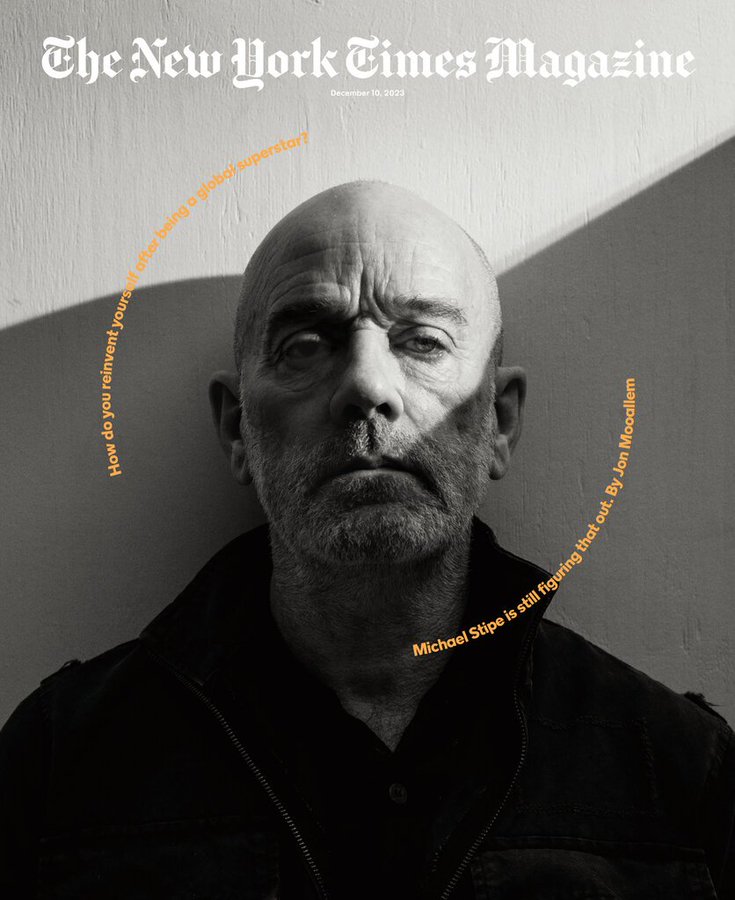
A black-and-white portrait of Michael Stipe.

How do you reinvent yourself after being a global superstar? The former R.E.M. frontman is still figuring that out.

By Jon Mooallem

When Michael Stipe was little, his parents called him Mr. Mouse. He was a scurrier. As soon as he could stand, he ran, and when he ran, he ran until he face-planted. His mother would deposit him in a baby walker, but if Stipe scrambled as fast as he could and hit the threshold of a doorway with a running start, he could topple the walker and eject himself onto the floor. Then he’d spring to his feet and run away.

The Border Where Different Rules Apply

When detained by the U.S. Coast Guard at sea, even children fleeing violence have no right to asylum — and often face an uncertain fate.

By Seth Freed Wessler

Tcherry’s mother could see that her 10-year-old son was not being taken care of. When he appeared on their video calls, his clothes were dirty. She asked who in the house was washing his shirts, the white Nike T-shirt and the yellow one with a handprint that he wore in rotation. He said nobody was, but he had tried his best to wash them by hand in the tub. His hair, which was buzzed short when he lived with his grandmother in Haiti, had now grown long and matted. He had already been thin, but by January, after three months in the smuggler’s house, he was beginning to look gaunt. Tcherry told his mother that there was not enough food. He said he felt “empty inside.”

The New York Times Magazine – Dec 3, 2023

THE NEW YORK TIMES MAGAZINE (December 2, 2023): The latest issue features Sunday Night Lights – How America’s most spectacular TV show gets made; The Chicken Tycoons vs. the Antitrust Hawks – As part of a broader campaign against anticompetitive practices, the Biden administration has taken on the chicken industry

Behind the Scenes of the Most Spectacular Show On TV

Camera operators hovering above a crowd in sports jerseys.

Months of preparation, hundreds of staff, convoys of cutting-edge gear: inside the machine that crafts prime time’s most popular entertainment.

By Jody Rosen

Arrowhead Stadium, the home of the Kansas City Chiefs, the N.F.L.’s defending champions, is a very loud place. Players say that when the noise reaches top volume, they can feel vibrations in their bones. During a 2014 game, a sound meter captured a decibel reading equivalent to a jet’s taking off, earning a Guinness World Record for “Loudest crowd roar at a sports stadium.” Chiefs fans know how to weaponize noise, quieting to a churchlike hush when the team’s great quarterback, Patrick Mahomes, calls signals but then, when opponents have the ball, unleashing a howl that can even drown out the sound of the play call crackling through the speaker inside the rival quarterback’s helmet.

The Chicken Tycoons vs. the Antitrust Hawks

A photo illustration of a chicken in a suit.

As part of a broader campaign against anticompetitive practices, the Biden administration has taken on the chicken industry. Why have the results been so paltry?

By H. Claire Brown

At Kentucky Fried Chicken, sales tend to peak at the same time every year: Mother’s Day. This has been the case since the 1960s, when the chain began to experiment with TV advertising. In a spot from that era, a man in an office answers a phone call from an anonymous male narrator who asks, “Sir, do you have any idea what your wife has to do to run your house?” Cut to a sped-up montage of an impeccably dressed 30-something as she dusts, irons, vacuums and balances the checkbook. Newly enlightened, the husband shows his appreciation by stopping at Kentucky Fried Chicken on his way home. Cut to a close-up of a happy wife biting into a drumstick. “Colonel Sanders fixes Sunday dinner seven days a week, and it’s finger-lickin’ good.”

The New York Times Magazine – Nov 26, 2023

Image

THE NEW YORK TIMES MAGAZINE (November 17, 2023): The latest issue features Was Peace Ever Possible in the Israel-Palestine Conflict?; Finding a Moral Center in This Era of War; The Beatles Are Still Charting the Future of Pop. It Looks Bleak – Their latest song points toward a future where no golden goose need ever stop laying, and more…

Was Peace Ever Possible?

Thirty years ago, a negotiated settlement of the Israeli-Palestinian conflict seemed achievable. The story of how it fell apart reveals why the fight remains so intractable today.

MODERATED BY EMILY BAZELON

Finding a Moral Center in This Era of War

By David Marchese Photograph by Mamadi Doumbouya

Phil Klay, as both a participant and a writer, has been thinking deeply about war for a long time. In his two acclaimed works of fiction, the book of short stories “Redeployment,” which won a 2014 National Book Award, and the novel “Missionaries” (2020), and in the nonfiction collection “Uncertain Ground: Citizenship in an Age of Endless, Invisible War” (2022), Klay has interrogated, to profound effect and with a deeply humane and moral sensibility, what war does to our hearts and minds, individually and collectively, here and abroad. “I’m interested in the kinds of stories that we tell ourselves about war,” says Klay, who is a 40-year-old veteran of the Iraq war. 

Everybody Knows Flo From Progressive. Who Is Stephanie Courtney?

Stephanie Courtney gets makeup for her character Flo.

A polo shirt, a white apron and a retro hairdo changed an actor’s life forever.

The New York Times Magazine – Nov 19, 2023

Image

THE NEW YORK TIMES MAGAZINE (November 17, 2023): The latest issue features How David Zaslav blew up Hollywood – The inside story of a novice movie mogul in an age of disruption, discontent and disaster ; Russell Brand’s Alternate Reality – The British entertainer built an army of fans with his conspiracy-minded podcast. Now, amid sex-assault claims against him, they’ve become his whole world; Sofia Coppola’s Subversive Search for Truth in ‘Priscilla’ – Hollywood is addicted to mythologizing biopics. ‘‘Priscilla’’ offers something different…

How David Zaslav Blew Up Hollywood

David Zaslav walking  in Manhattan.

A merger put him in the driver’s seat at Warner Brothers, one of the industry’s biggest studios. It has been a wild ride.

By Jonathan MahlerJames B. Stewart and Benjamin Mullin

It was April 2022, and David Zaslav had just closed the deal of a lifetime. From the helm of his relatively small and unglamorous cable company, Discovery, he had taken control of a sprawling entertainment conglomerate that included perhaps the most storied movie studio on the planet, Warner Brothers. The longtime New Yorker had always loved movies, and against the advice of several media peers, he had moved to Hollywood and taken over Jack Warner’s historic office, hauling the old mogul’s desk out of storage and topping it off with an old-time handset telephone. So far things were going great. He had met all the stars and players, was widely feted as the next in line to save the eternally struggling industry and was well into the process of renovating a landmark house in Beverly Hills. 

Sofia Coppola’s Subversive Search for Truth in ‘Priscilla’

A photo of illustration of actors playing famous characters in history.

Hollywood is addicted to mythologizing biopics. ‘‘Priscilla’’ offers something different.

By Rafaela Bassili

As with much of her other work, the opening of Sofia Coppola’s latest film, “Priscilla,” is all about textures. A pair of manicured feet sink into a shag carpet; a fingernail is carefully polished in red; we see the back of a prodigious black bouffant, then the dexterous painting of a dramatic cat eye with black liner. Priscilla Presley (Cailee Spaeny) paces around Graceland relentlessly. There’s nothing for her to do, and too much for her to process.