
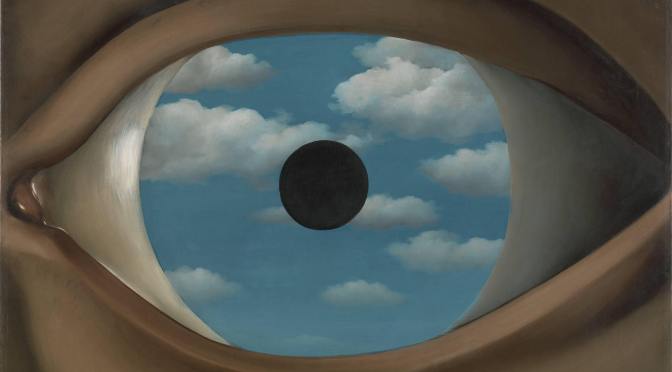
From a Christies.com online article:
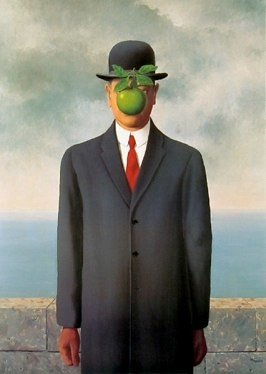
‘The creation of new objects, the transformation of known objects; a change of substance in the case of certain objects: a wooden sky, for instance; the use of words in association with images; the misnaming of an object… the use of certain visions glimpsed between sleeping and waking, such in general were the means devised to force objects out of the ordinary, to become sensational, and so establish a profound link between consciousness and the external world.’
René François Ghislain Magritte (1898-1967) was born in Lessines, Belgium. His father was a tailor and textile merchant; his mother committed suicide in 1912, drowning herself in the River Sambre.
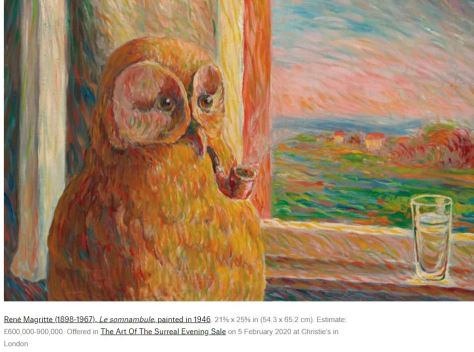
From the 1930s, Magritte sought to find ‘solutions’ to particular ‘problems’ posed by different types of objects, a method that enabled him to challenge and reconfigure the most ubiquitous and commonplace elements of everyday life. These problems obsessed him until he was able to conceive of an image to solve them.
This philosophical method had come to him after waking from a dream in 1932. In his semi-conscious state, he looked over at a birdcage that was in his room but saw not the bird that inhabited the cage, but instead an egg. This ‘splendid misapprehension’ allowed him to grasp, in his own words, ‘a new and astonishing poetic secret.’

 In our second segment, we talk about how we think about children. For thousands of years, adults have complained about their lack of respect, intelligence, and tendency to distraction, compared with previous generations. A new study out this week in Science Advances suggests
  Boomers Daily