
Tag Archives: Book Review

The New York Times Book Review- Sunday May 7, 2023

THE NEW YORK TIMES BOOK REVIEW – MAY 7, 2023

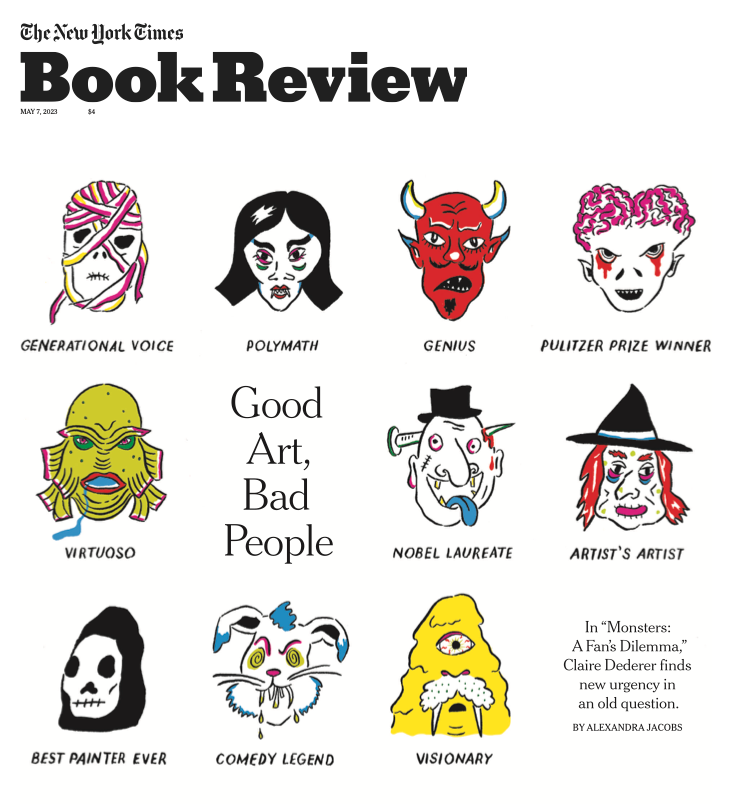
Face to Face With Culture’s ‘Monsters’

An illustration of a grid of different faces of monsters, with the labels “polymath,” “genius,” “Nobel laureate,” “virtuoso,” “Pulitzer Prize winner,” “artist’s artist,” “best painter ever,” “visionary” and “comedy legend.”

Claire Dederer’s deft and searching book surfaces a “fan’s dilemma” over such figures as Vladimir Nabokov, Woody Allen, Willa Cather and Roman Polanski.


By Alexandra Jacobs

Expanding on a popular essay published in The Paris Review a month after the exposure of Harvey Weinstein’s sexual predation, “Monsters” sustains an essayistic, sometimes aphoristic tone throughout 250-odd pages.

Dark Shadows, Dark Times

Welcome to three novels set in locales where life is exceedingly difficult.

This is an illustration in shades of red, white and blue, of two women pressing their hands against a wall and peering at each other as if through a mirror.

By Alida Becker

AT THE HOUR BETWEEN DOG AND WOLF by Tara Ison

The title comes from a French expression for twilight. Sure enough, her novel sends us to the dusk that borders the familiar and the wild, the known and the unknown. It’s where our beliefs and suspicions can cast dark shadows over our lives. And, of course, the lives of others.

One Man’s Foray Into the Heartland of the Far Right

Alarmed by the country’s political divisions, Jeff Sharlet embarked on an anguished quest to understand the rise of antidemocratic extremism. In “The Undertow,” he documents his findings.

In this color photo, a group of men and women, including a man holding a baby, an older woman in glasses, and Representative Marjorie Taylor Greene, stand alongside what appears to be the wall of a red barn, pledging allegiance to the American flag. Several people in the group hold their right hands over their hearts as they make the pledge.

By Joseph O’Neill

THE UNDERTOW: Scenes From a Slow Civil War, by Jeff Sharlet


The premise of “The Undertow,” Jeff Sharlet’s anguished new book of reportage, is that the United States is “coming apart.” The disintegration is political. It involves the rise of the autocratically inclined Donald Trump; the attempt by members of the Republican Party to overthrow the election of Joe Biden in January 2021; and, during the Biden presidency, the overturning by the Supreme Court of Roe v Wade.

The New York Times Book Review – April 30, 2023

Image

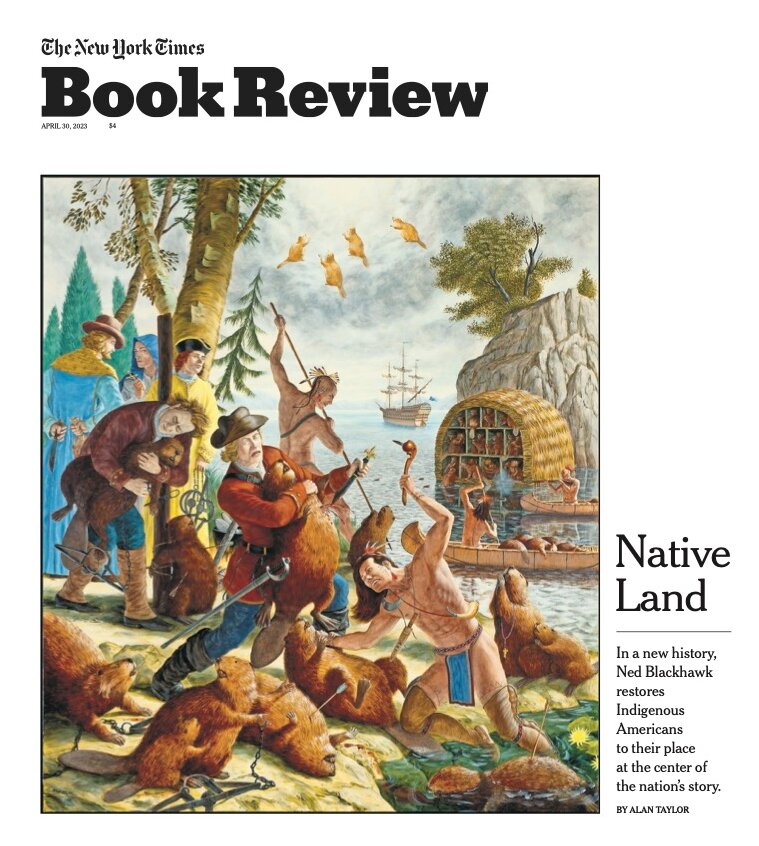
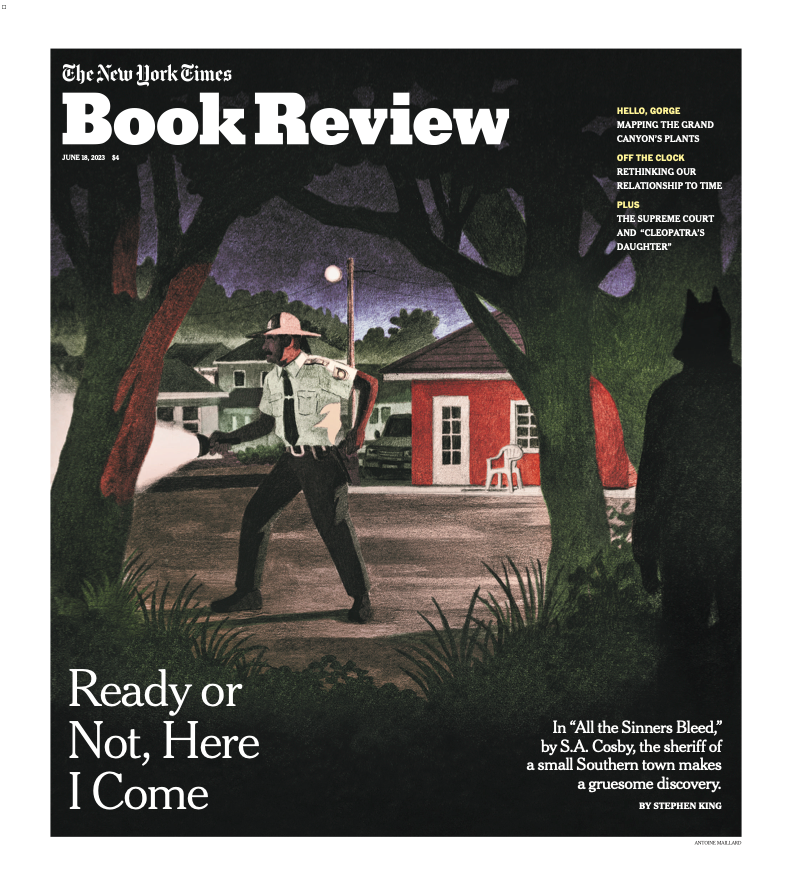
The New York Times Book Review (April 30, 2023): On the cover this week – Ned Blackhawk’s “The Rediscovery of America,” a sweeping, important, revisionist work of American history that places Native Americans front and center. Illustrating it is “Les Castors du Roi,” a 2011 painting by Kent Monkman, a Cree artist in Canada’s Dish With One Spoon Territory.

Read Your Way Through Boston

An illustration depicting a snowy street in Boston; a man in the foreground is engrossed in reading his book.
Credit…Raphaelle Macaron

Paul Theroux, the quintessential travel writer, has also enshrined his Massachusetts roots in his writing. Here are his recommendations for those who come to visit.


My father, like many passionate readers, was a literary pilgrim in his native Massachusetts, a state rich in destinations, hallowed by many of the greatest writers in the language. “Look, Paulie, this is the House of the Seven Gables — go on, count them!”

Everything, Everywhere, in One Big Book

This color photo shows a woman flipping pages of a book posed on top of a long low bookcase filled with volumes. Behind the woman, stretching to the top of the photograph are more bookshelves filled with books.
A woman consults a book at the New York Public Library on Fifth Avenue and 42nd Street in Manhattan.Credit…Ángel Franco/The New York Times

In “All the Knowledge in the World,” Simon Garfield recounts the history of the encyclopedia — a tale of ambitious effort, numerous errors and lots of paper.

In ‘Ordinary Notes,’ a Radical Reading of Black Life

The book cover for “Ordinary Notes,” by Christina Sharpe, is lilac with bold black type. A blurry photo of houses at twilight sits along the bottom edge.

The scholar Christina Sharpe’s new book comprises memories, observations, artifacts and artworks — fragments attesting to the persistence of prejudice while allowing glimpses of something like hope.

The New York Times Book Review – April 23, 2023

Image

The New York Times Book Review – April 23, 2023:

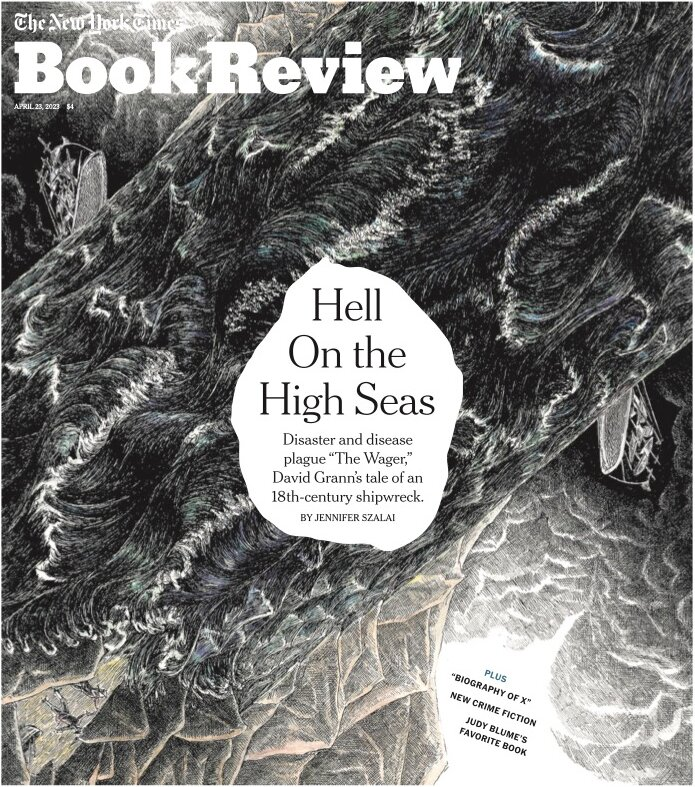
With His Tale of Shipwreck, David Grann Is Steady as He Goes

This illustration shows a sailing ship being tossed in heaving seas. The art is stylized, with mostly black, white and subtle blue lines, and the image is mirrored, so the same picture appears twice, once right-side up and the other upside down.
Credit…Naï Zakharia

The author’s latest book, “The Wager,” investigates the mysteries surrounding an 18th-century maritime disaster off Cape Horn.

There were multiple moments while reading David Grann’s new book, “The Wager,” about an 18th-century shipwreck, when it occurred to me that the kind of nonfiction narratives The New Yorker writer has become known for share something essential with a sturdy ship.

‘Biography of X’ Rewrites a Life Story and an American Century

The book jacket of “Biography of X,” by Catherine Lacey, is a deep red with a small, scrambled photograph of a woman’s face in the center.

Catherine Lacey’s new novel follows a polarizing artist through a fractured country.

The narrator of “Biography of X,” the new Catherine Lacey novel, is a journalist named C.M. Lucca who worked for a Village Voice-like newspaper in New York City during the 1980s. C.M. has a cool tone and a lonely intelligence; she’s a solitary spirit. 

These Police Chiefs Are Working to Change Perceptions

A sea of uniformed police officers throng Fifth Avenue; an American flag waves in the background.
Police officers from across the country line Fifth Avenue for the funeral of the N.Y.P.D. officer Wilbert D. Mora, 2022.Credit…Karsten Moran for The New York Times

In “Walk the Walk,” Neil Gross profiles three departments around the country experimenting with genuine reform.

WALK THE WALK: How Three Police Chiefs Defied the Odds and Changed Cop Culture, by Neil Gross

The New York Times Book Review – April 16, 2023

Image

The New York Times Book Review – April 16, 2023:

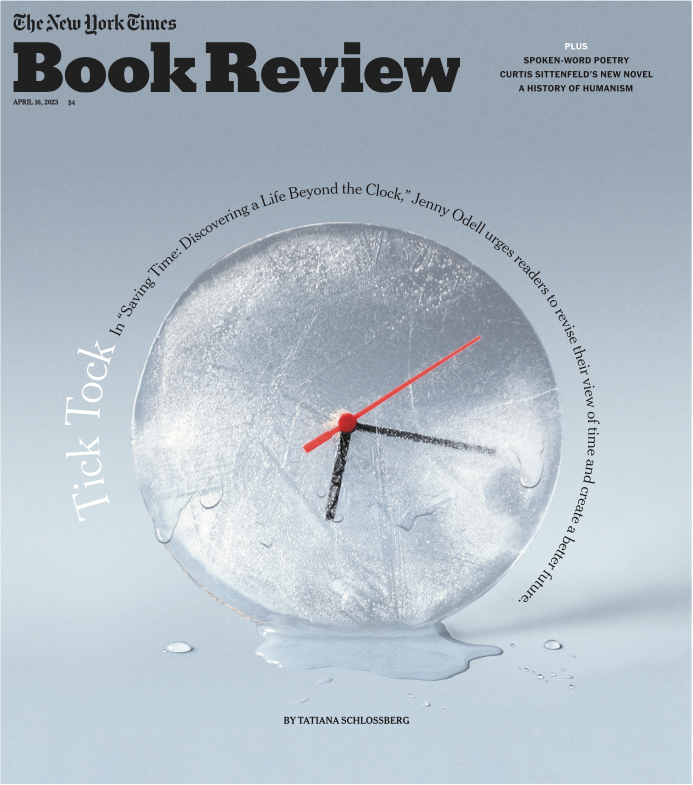
She Taught Us to Do Nothing. Now Jenny Odell Wants to Save Time.

This image shows the hands of a clock set into a circle of melting ice, suggesting time is fluid and ephemeral.
Credit…Ricardo Tomás

The author’s new book, “Saving Time: Discovering a Life Beyond the Clock,” urges readers to revise their conceptions of time and the world to nurture hope and action for a better future.

In Russia’s War in Ukraine, ‘Nature Has Also Suffered.’

This is a black-and-white photo of a series of manmade wooden columns sticking out of a tranquil body of water.
Early-1900s wooden poles used for salt mining on the Kuialnyk Estuary, on the northwest coast of the Black Sea.Credit…Yevhen Samuchenko

A book of photographs taken before February 2022 reveals formerly breathtaking landscapes that may never be the same.

A Time-Travel Novel Whose Thrills Go Beyond the Speculative

In this abstract illustration, three figures in an astral plain try to hold onto the flow of time, which is artistically rendered as a colorful, flowing stream.
Credit…Changyu Zou

In Jinwoo Chong’s debut novel, “Flux,” a time-warping discovery impacts the lives of three people coping with personal and systemic traumas.

The New York Times Book Review – April 9, 2023

Image

The New York Times Book Review – April 9, 2023:

It’s Like ‘Little Women’ — but With Basketball

This is a series of six small drawings of men and women dressed in white, standing in a hilly rural landscape.
Credit…Kristina Tzekova

In “Hello Beautiful,” Ann Napolitano puts a fresh spin on the classic story of four sisters.

“It is your God-given right as an American fiction writer,” Ursula K. Le Guin once said, to change point of view. But “you need to know that you’re doing it,” she warned, and “some American fiction writers don’t.”

Osamu Dazai, With Help From TikTok, Keeps Finding New Fans

A black-and-white photograph of the author Osamu Dazai, who is resting his chin on his hand and looking to his left.
The Japanese novelist Osamu Dazai.

The enduring appeal of a midcentury Japanese novelist who wrote of alienation and suicide.

The first thing you hear is an eerie synth tone, followed by a portentous, insinuating voice. “Tell me, Dazai,” it says. “Why is it you wish to die?”

“Let’s turn that question around,” someone earnestly replies. “Is there really any value to this thing we call … living?” Then a beat drops, accompanied by distorted shouts.

Real People, Reincarnated in the Pages of New Novels

This is an illustration featuring six coin-like drawings in orange, teal, purple in pink, layered over a monochromatic street scene.
Credit…Michelle Mildenberg

These hefty books explore the lives of a former poet, a polarizing artist and a Scottish rebel from unexpected angles.

One of the great attractions of historical fiction is its ability to approach the past from unexpected angles, allowing us to consider famous figures in surprising ways. It’s a tactic that pays off brilliantly in Stephen May’s elegantly acerbic SELL US THE ROPE (Bloomsbury, 240 pp., paperback, $18), which features a thuggish former poet who calls himself Koba. The world will later know him as Stalin.

The New York Times Book Review – April 2, 2023

Image

The New York Times Book Review – April 2, 2023:

Guerrilla Gardeners Meet Billionaire Doomsayer. Hurly-Burly Ensues.

Credit…Deena So Oteh

“Birnam Wood,” by the Booker Prize winner Eleanor Catton, is a fast-moving ecological novel and a generational cri de coeur.

Read Your Way Through Edinburgh

Credit…Raphaelle Macaron

Edinburgh calls to readers, its pearl-grey skies urging them to curl up with a book. Maggie O’Farrell, the author of “Hamnet,” suggests reading that best reflects her city.

The New York Times Book Review – March 26, 2023

Image

The New York Times Book Review – March 26, 2023:

Margaret Atwood Is Still Sending Us Notes From the Future

A photograph of Margaret Atwood, who is wearing a green scarf and green button-down shirt.
Margaret Atwood’s new book is “Old Babes in the Wood.”Credit…Arden Wray for The New York Times

Her new story collection, “Old Babes in the Wood,” offers elegiac scenes from a marriage plus a grab bag of curious fables.


There are authors we turn to because they can uncannily predict our future; there are authors we need for their skillful diagnosis of our present; and there are authors we love because they can explain our past. And then there are the outliers: those who gift us with timelines other than the one we’re stuck in, realities far from home. If anyone has proved, over the course of a long and wildly diverse career, that she can be all four, it’s Margaret Atwood.

50 Years On, ‘Wisconsin Death Trip’ Still Haunts and Inspires

Michael Lesy’s book of historical photographs and found text offers a singular portrait of American life.

Michael Lesy’s 1973 book “Wisconsin Death Trip” is an American oddity, a cult classic for a reason. In a way that few documentary texts do, it makes us leave the baggage of modernity at the trailhead. It forces us back into the inconceivably long nights in rural and small-town America before the widespread use of electricity, before radio, before antibiotics for dying children and antidepressants for anxiety bordering on mania, when events could make a family feel that some nocturnal beast had chalked its door.

The Prophetic

This illustration depicts a barren landscape, with yellow ground and, in the distance, a low brown mountain range beneath an aqua sky scattered clouds and a couple yellow stars. In the middle of the landscape stands a small figure of a woman in a long green tunic. Above her head, and connected to her body via several pink and red rays, is an enormous human eyeball. At the center of the eye, where the pupil and iris should be, there is a stormy sky: a white moon, half hidden by dark clouds, and streaks of lightning.
Credit…Nada Hayek

The first installment of an essay series on American literature and faith.

I am a child of the church. In an early memory, I am 6 years old, half-asleep in the back of my grandparents’ station wagon on the way home from a revival…

The New York Times Book Review – March 19, 2023

Image

The New York Times Book Review – March 19, 2023:

In Matthew Desmond’s ‘Poverty, by America,’ the Culprit Is Us

This illustration, in shades of red, white, blue and black, shows the silhouetted figures of a family around a table. The parents hover over a large tureen containing black liquid, while, on either side of them, smaller figures — their offspring — lean over smaller bowls filled with the same substance. In the background, red and white vertical stripes are visible, suggesting an American flag.
Credit…Ola Jasionowska

The new book by the sociologist and author of “Evicted” examines the persistence of want in the wealthy United States, finding that keeping some citizens poor serves the interests of many.

Read Your Way Through São Paulo

A woman is reading a book on a bench in a park with the cityscape of São Paulo in the background. A cat is sleeping next to her.
Credit…Raphaelle Macaron

Brazil’s ultra urban megacity overwhelms the landscape and the imagination. Paulo Scott recommends books that peel back its layers.

With Karl Lagerfeld, the Clothes Were Only Part of the Story

A photograph of Karl Lagerfeld surrounded by models, several of them in black sequined dresses. Lagerfeld is wearing sunglasses and has his hair pulled back in a white ponytail. He is in a black suit and tie, a white shirt with a high stiff collar, and is carrying an open fan in his right hand.

The fashion world’s hunger for larger-than-life figures glorified the designer. But a cozy new biography shows him to be more business whiz than artist.

Book Reviews: Politics & Free Markets (March 2023)

The Currency of Politics: The Political Theory of Money from Aristotle to Keynes by STEFAN EICH

NOBODY HAS EVER seen the economy. We can see specific markets, but my local farmers’ market looks very different from the Diamond District in Manhattan and even the street stalls I frequented in East London.

Markets are institutions with more or less physical infrastructures, but “the market” (like “the economy”) is an abstraction, no more fixed or certain than “the Left” or “nature.” If “the economy” and “the market” are often described as though they were things out there in the world to be measured and monitored while other abstractions (such as “beauty” and “joy”) are not, that tells us as much about ways of thinking as it does about the workings of the world.

Powered by this insight, the history of economic thought (and related “new histories of capitalism”) has grown over the past 20 years to become one of the most lively and popular historical subfields.

Free Market: The History of an Idea by JACOB SOLL

The recent controversy over Jacob Soll’s new book Free Market: The History of an Idea (2022) reveals just how attached some people are to their economic ideologies (no surprise there) and to their ideas about who gets to have “economic thoughts.”

In a sweeping text that ranges across 2,500 years in barely 250 pages, Soll argues that, for centuries, “free” markets were understood as existing only where strong, moral governments liberated trade from domination by selfish, moneyed merchants. Markets had to be set free—they were not born that way—and the danger has always lurked of commerce being recaptured to enrich the few rather than benefit the many.

This is a loosely “antitrust” way of describing market freedom, and it might have barely registered at all had Soll attributed it chiefly to Louis Brandeis, Frances Perkins (secretary of labor under FDR), or even Machiavelli. But by invoking the name “Adam Smith,” Soll seems to have violated the holy of holies. 

The New York Times Book Review – March 12, 2023

Image

The New York Times Book Review – March 12, 2023:

Big Money, Big Houses and Big Problems in Brooklyn Heights

This is an illustration — done in white, yellow and shades of blue — of a gaggle of fancily dressed people in a well appointed living room. Their faces aren't visible but their jewelry and hair accessories are.

In Jenny Jackson’s debut novel, “Pineapple Street,” readers get a tour of a world they might learn not to envy by the end of the book.

22 Works of Fiction to Read This Spring

Watch for reality-bending explorations of time and space, a Western horror novel from Victor LaValle and new fiction from Han Kang. Plus: Tom Hanks (yes, that Tom Hanks) releases his debut novel.

The Marquis de Sade’s Filthy, Pricey 40-Foot Scroll of Depravity

A new book by Joel Warner traces the fate of the parchment on which the infamous author wrote “120 Days of Sodom,” a trail involving scholars, aristocrats and thieves — and lots of money.