

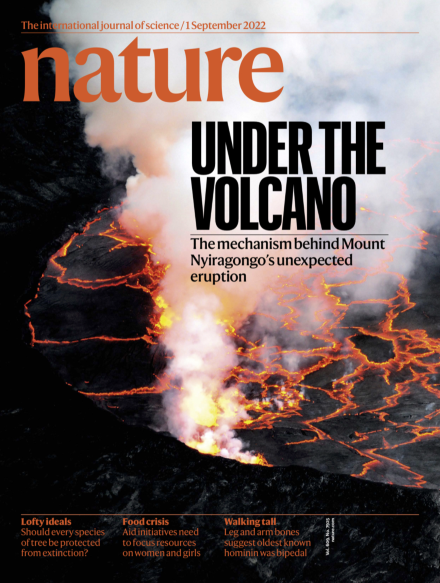
The cover shows the open lava lake of Mount Nyiragongo in the Democratic Republic of the Congo before its catastrophic drainage. The run-up to a volcanic eruption is usually characterized by geophysical and geochemical signals, which can form the basis of an early-warning system. However, as Delphine Smittarello and her colleagues discuss in this week’s issue, that was not the case for last year’s eruption of Nyiragongo.
- A heartbeat’s machinery becomes visible to the eyeScientists devise a molecule to illuminate the cardiac cells behind the organ’s reliable rhythm.
- Dogs cry with gladness when greeting their humansCanines’ weeping makes them the first non-human animal known to shed happy tears.
- Designer antiviral takes aim at one of influenza’s soft spotsInfluenza A could have trouble mutating its way past a molecule that damages a crucial structure in the viral genome.
- ‘Illusion shell’ makes objects sound like something they’re notDevice resembling a golf ball alters the acoustic waves scattered by items placed inside it.
- A restful way to feel more generous: get more sleepThree sets of data connect lack of sleep with a reduced willingness to help others.
 Boomers Daily