
Tag Archives: Walter Isaacson

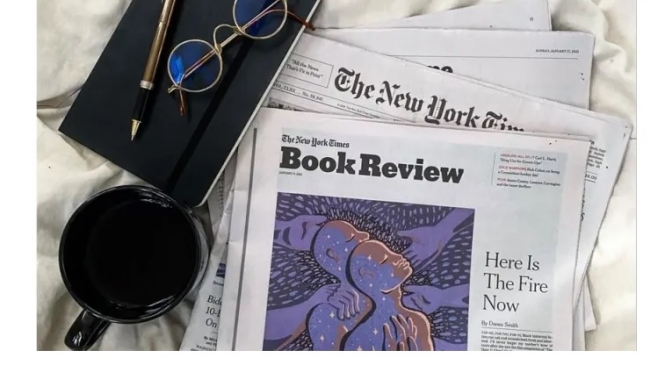
The New York Times Book Review – Sept 24, 2023

Image

THE NEW YORK TIMES BOOK REVIEW (September 24, 2023): The latest issue features Walter Isaacson’s buzzy Elon Musk biography, which has already rocketed to No. 1 on the best-seller list.  Also, gorgeous historical novels from Lauren Groff and Daniel Masona remarkable new book about road ecologythe translation of a beloved, best-selling Japanese novel; “Doppelganger,” Naomi Klein’s investigation into the online underworld of conspiracies and misinformation; and Stephen King’s latest, “Holly,” to name just a few.

Elon Musk Wants to Save Humanity. The Only Problem: People.

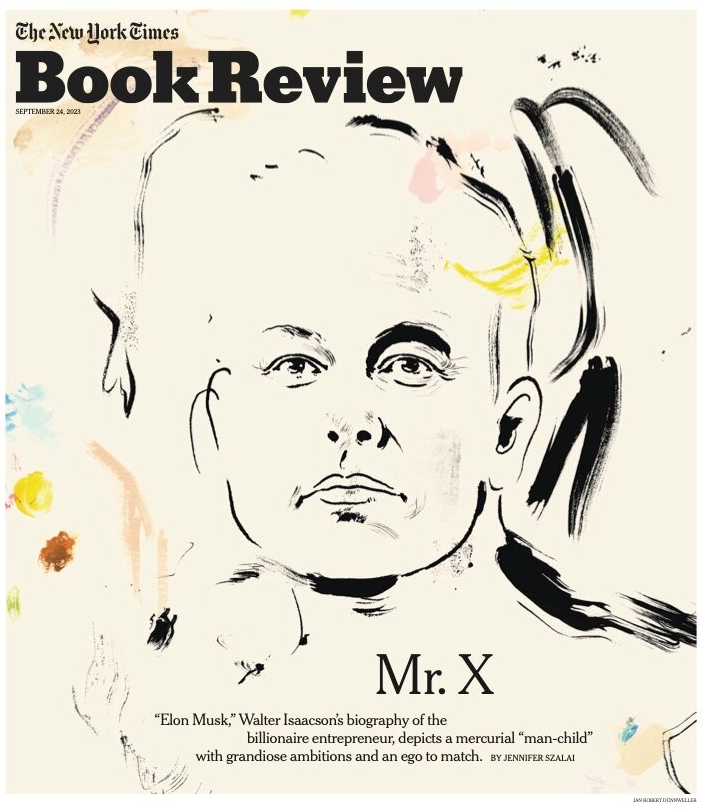
This impressionistic illustration, composed of black ink and brushstrokes with accents of yellow and pink, shows Elon Musk’s face close-up. He is gazing at the viewer, his square jaw and high forehead immediately recognizable.

Walter Isaacson’s biography of the billionaire entrepreneur depicts a mercurial “man-child” with grandiose ambitions and an ego to match.

By Jennifer Szalai

At various moments in “Elon Musk,” Walter Isaacson’s new biography of the world’s richest person, the author tries to make sense of the billionaire entrepreneur he has shadowed for two years — sitting in on meetings, getting a peek at emails and texts, engaging in “scores of interviews and late-night conversations.” Musk is a mercurial “man-child,” Isaacson writes, who was bullied relentlessly as a kid in South Africa until he grew big enough to beat up his bullies. Musk talks about having Asperger’s, which makes him “bad at picking up social cues.” As the people closest to him will attest, he lacks empathy — something that Isaacson describes as a “gene” that’s “hard-wired.”

Lauren Groff’s Latest Is a Lonely Novel of Hunger and Survival

A color illustration of a girl wearing a torn blue coat and boots with a bag strapped around her back, looking back toward a coastal settlement as she enters the woods, covered in snowfall.

“The Vaster Wilds” follows a girl’s escape from a nameless colonial settlement into the unforgiving terrain of America.

By Fiona Mozley

Jamestown, Va., the first permanent English settlement in the Americas, very nearly didn’t survive. A few years into its existence, in the early 1600s, the majority of the population had succumbed to famine and disease. The period known as the Starving Time has taken on allegorical status. Jamestown is the colony that tried too much too soon; that underestimated the harsh climate, the foreign land, its existing, Indigenous population. Pilgrims went in search of heaven and found hell.

Arts/Books: Times Literary Supplement – Sept 22, 2023

Image

Times Literary Supplement (September 22, 2023): The new issue features Playing with Fire – The limitless ambition of Elon Musk; Peter Brown in an antique land; The new New Journalism; A literary critic and murderer; John Gray’s Hobbes for liberals, and more…

The X files

Elon Musk, 2020

ELON MUSK by Walter Isaacson

Walter Isaacson’s intimate account of a tech titan

When Elon Musk was a child, his parents warned him against playing with fire. His response was to take a box of matches behind a tree and start lighting them. Scenes like this are frequent in Walter Isaacson’s new biography of Musk, who has become the world’s richest person thanks to his disdain for authority, instinct for the dramatic and “reality-bending wilfulness” (and because he has applied these traits to good ideas). Isaacson reports that the family’s motto is “Live dangerously – carefully”, but a more apt one might be the maxim quoted by Musk’s cousin Peter: “Risk is a type of fuel”.

Travels with his aunts

Peter Brown

The intellectual life of a pioneering historian of Late Antiquity

By Mary Beard

JOURNEYS OF THE MIND – A Life in History by Peter Brown

In the late 1970s, the historian Peter Brown dumped his old dinner jacket on a park bench in Berkeley, California. It was not just a minor act of charity to the local homeless, who may or may not have welcomed a cast-off “tuxedo”. Brown had recently moved from an academic career in Oxford and London to a post in the United States, and he was signalling to himself a new start in what seemed to be a more democratic, less hidebound educational system: more jeans and trainers than black tie. He has been based in America ever since.