Science Magazine – November 30, 2023:The new issue cover features a chinstrap penguin (Pygoscelis antarcticus) cares for a chick while its partner catches a quick nap.
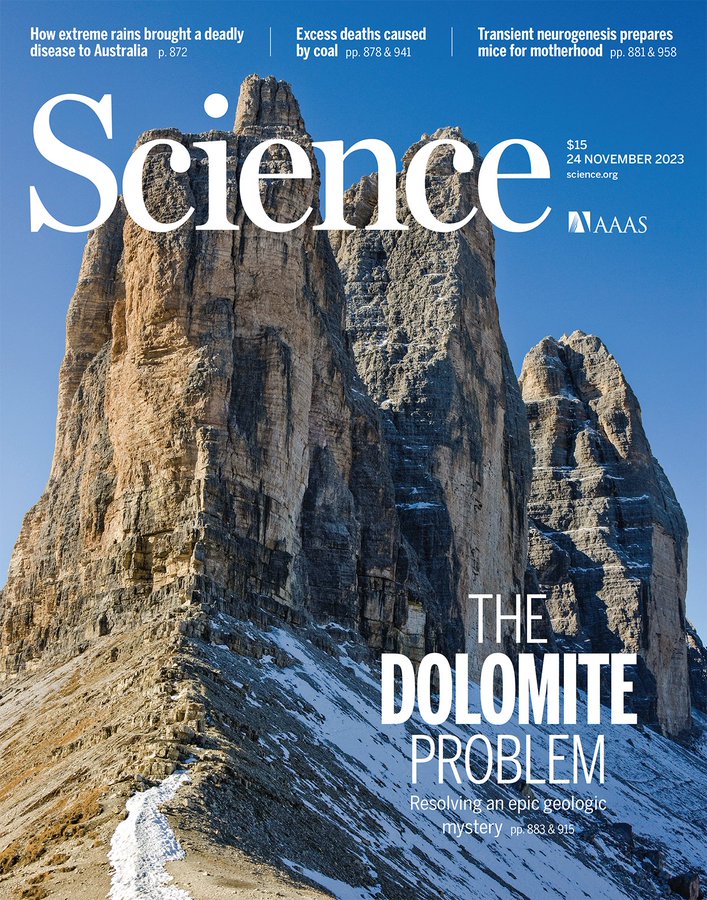
Science Magazine – November 17, 2023: The new issue features Dolomite, a key mineral in stunning geological formations, such as Drei Zinnen (shown here), Niagara Falls, and Hoodoos. Despite its natural abundance, laboratory growth of dolomite has proven impossible—a contradiction known as the “dolomite problem.”
Science Magazine – November 17, 2023:The new issue features Heaps of Warming – Municipal solid waste emits large amounts of greenhouse gases; AI is set to revolutionize weather forecasts; Rewriting DNA in the body lowers cholesterol, and more….
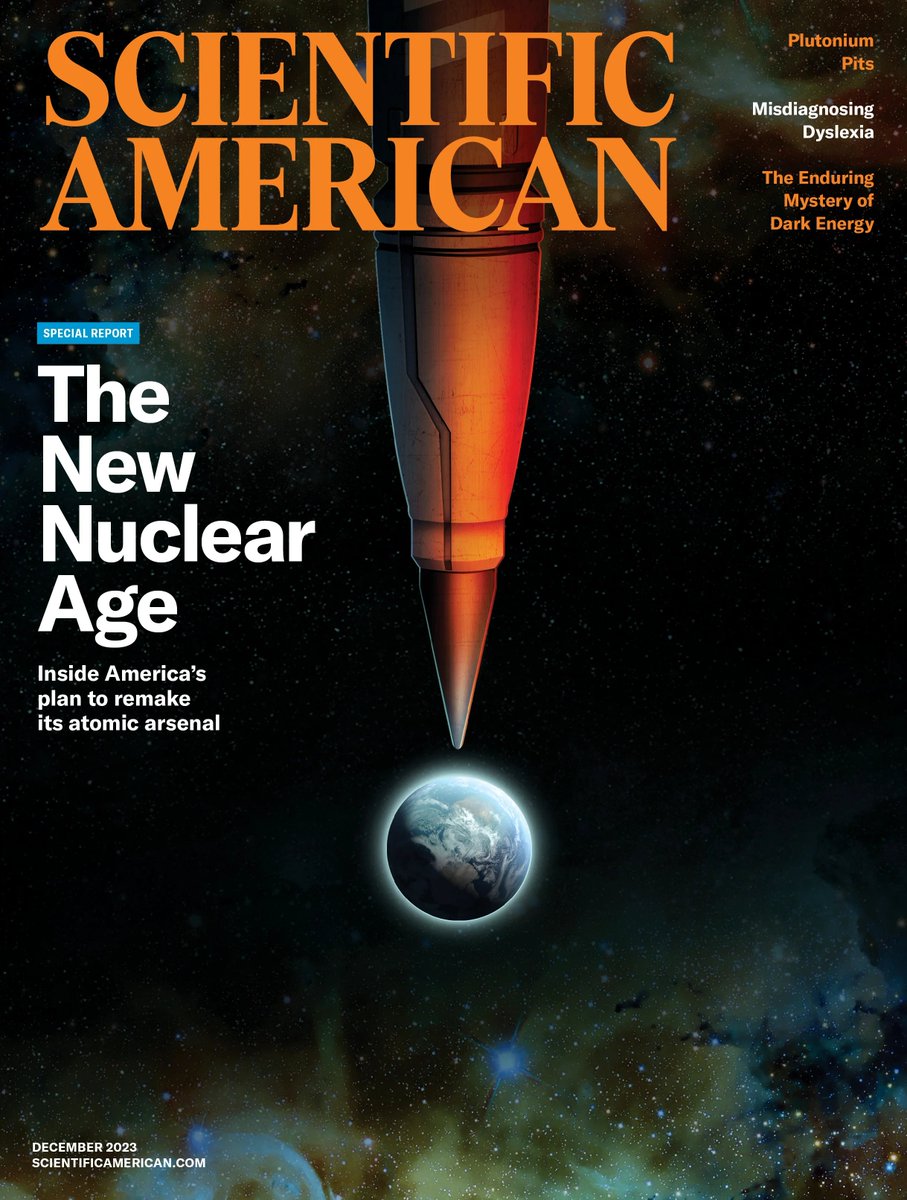
Scientific American – November 2023: The issue features The New Nuclear Age – Inside America’s plan to remake its atomic arsenal; The Most Shocking Discovery in Astrophysics Is 25 Years Old – Scientists are still trying to figure out dark energy; Behind the Scenes at a U.S. Factory Building New Nuclear Bombs – The U.S. is ramping up construction of new “plutonium pits” for nuclear weapons….
One afternoon in early 1994 a couple of astronomers sitting in an air-conditioned computer room at an observatory headquarters in the coastal town of La Serena, Chile, got to talking. Nicholas Suntzeff, an associate astronomer at the Cerro Tololo Inter-American Observatory, and Brian Schmidt, who had recently completed his doctoral thesis at the Center for Astrophysics | Harvard & Smithsonian, were specialists in supernovae—exploding stars. Suntzeff and Schmidt decided that the time had finally come to use their expertise to tackle one of the fundamental questions in cosmology: What is the fate of the universe?
The point of the thing was to forever change our concept of power. When the U.S. military assembled a team of scientists, led by physicist J. Robert Oppenheimer, to build a nuclear bomb during World War II with the hope of beating the Nazis to such a terrible creation, many of those involved saw their efforts as a strange kind of civic destiny. The Manhattan Project, wrote Richard Rhodes, Pulitzer-winning author of The Making of the Atomic Bomb, was “compelled from the beginning not by malice or hatred but by hope for a better world.” Oppenheimer himself once said, “The atomic bomb was the turn of the screw. It made the prospect of future war unendurable. It has led us up those last few steps to the mountain pass; and beyond there is a different country.”
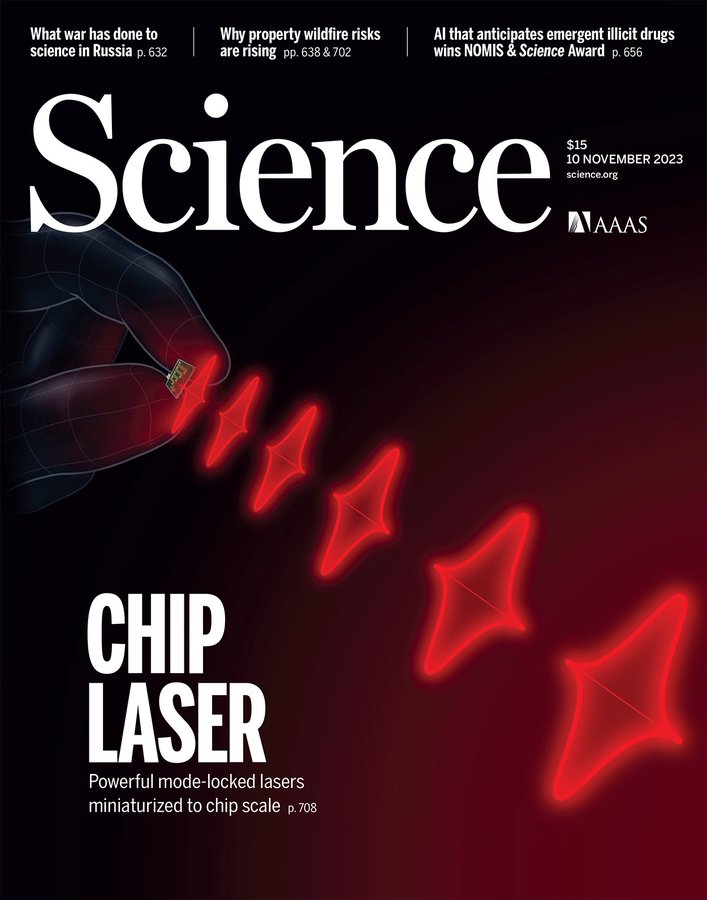
Science Magazine – November 10, 2023:The new issue features Mode-locked “chip lasers” generating intense ultrashort pulses of light have been the backbone of ultrafast sciences and technologies.
In thinking about the challenge of getting artificial intelligence (AI) to understand our complex world, I recalled a Twitter post from a user of Tesla’s self-driving system. The user tweeted that his car kept stopping abruptly at a particular location for no apparent reason. Then he noticed a billboard advertisement on the side of the road, featuring a sheriff holding up a stop sign. The car’s vision system had interpreted this as an actual stop sign, and slammed on the brakes.
Though it lies in ruins on the northeast coast of England, Kilton Castle was once an imposing stone fortress, home to several noble families, and—it appears—at least eight cats. Archaeological excavations in the 1960s uncovered a well, at the bottom of which lay the bones of several felines dating back to the 14th century. The animals were an odd mix: Some were domestic cats, but other, larger specimens appeared to be European wildcats, a fierce, burly species that has inhabited the continent for hundreds of thousands of years.
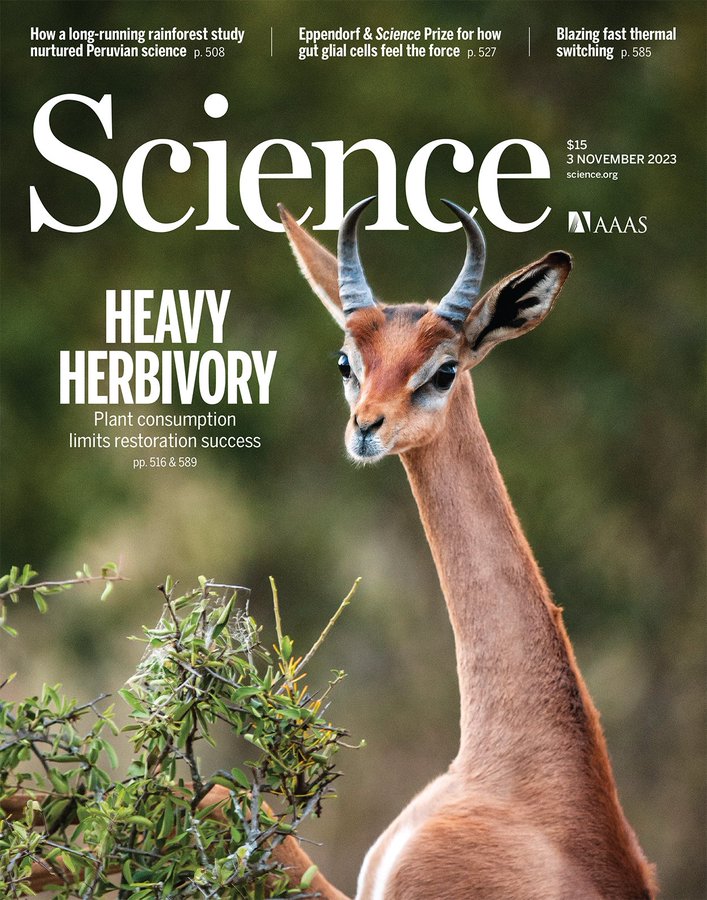
Science Magazine – November 3, 2023: The new issue features Heavy Herbivory – Plant consumption limits restoration success; How a long-running rainforest study nurtured Peruvian science; No easy way to explain cosmic expansion mystery; Ancient fish reveal the origin of the shoulder in vertebrates, and more…
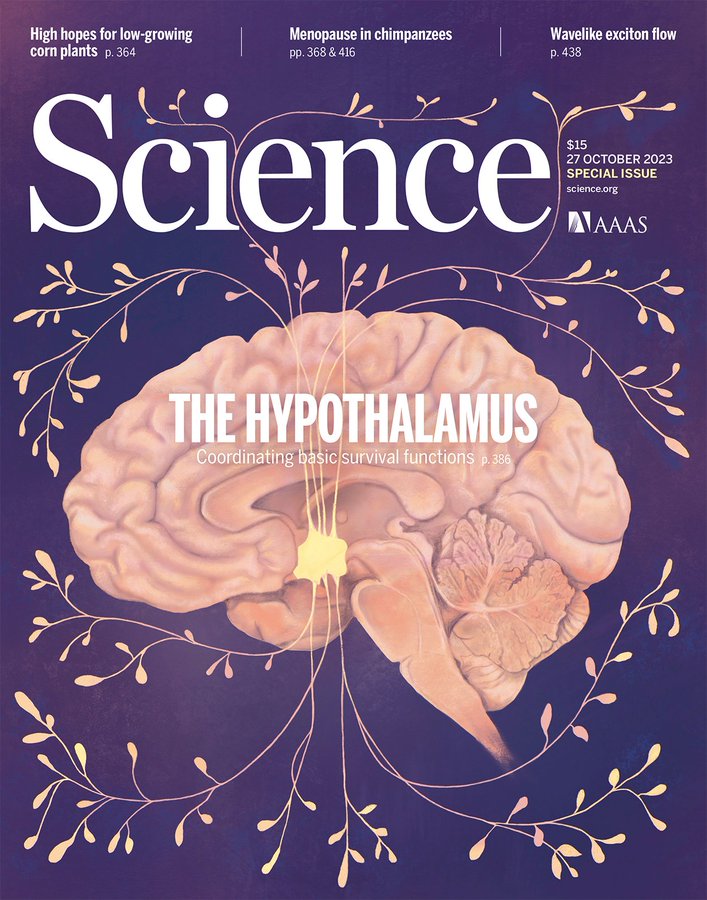
Science Magazine – October 27, 2023: The new issue features The Hypothalamus – Coordinating basic survival functions; High hopes for low-growing corn plants; A quantum process in a laser microchip….
If you pause for a second and think about the activities that occupy most of your day, presumably sleeping, eating, and engaging in social interactions are among the first that come to your mind. Perhaps surprisingly, a small area buried deep inside the brain, called the hypothalamus, is responsible for coordinating neuronal signals related to these activities. By controlling the homeostasis of the neuroendocrine, limbic, and autonomic nervous systems, the hypothalamus is a key brain region for many physiological and pathological processes. Despite its small size, the hypothalamus has a complex cellular organization and circuitry that determine its structural and functional organization. It is composed of 11 nuclei grouped by their location and has vast, mostly bidirectional connections with many neuronal and endocrine systems.
Plants bred or engineered to be short can stand up better to windstorms. They could also boost yields and benefit the environment
To an interstate traveler—or anyone lost in a corn maze—the most impressive feature of corn is its stature. Modern corn can grow twice as tall as a person, but height has drawbacks, making the plants vulnerable to wind and more difficult for farmers to tend. Plant scientists think corn can be improved by making it shorter, and leading seed companies are doing that through both conventional breeding and genetic engineering. Bayer has launched a short variety in Mexico, another company is selling its versions in the United States, and more are getting involved.
In August, the Sun rose behind the Extremely Large Telescope, under construction in Chile.
Past the halfway point, Extremely Large Telescope prepares to receive first mirrors
A web of steel girders is rising from the flattened summit of Cerro Armazones, 3000 meters above sea level in Chile’s Atacama Desert. The dome it will support will be vast—with a footprint as big as a soccer field and almost as tall as the Statue of Liberty— and unexpectedly nimble: It will smoothly rotate on rails as a giant telescope inside tracks stars through the night.
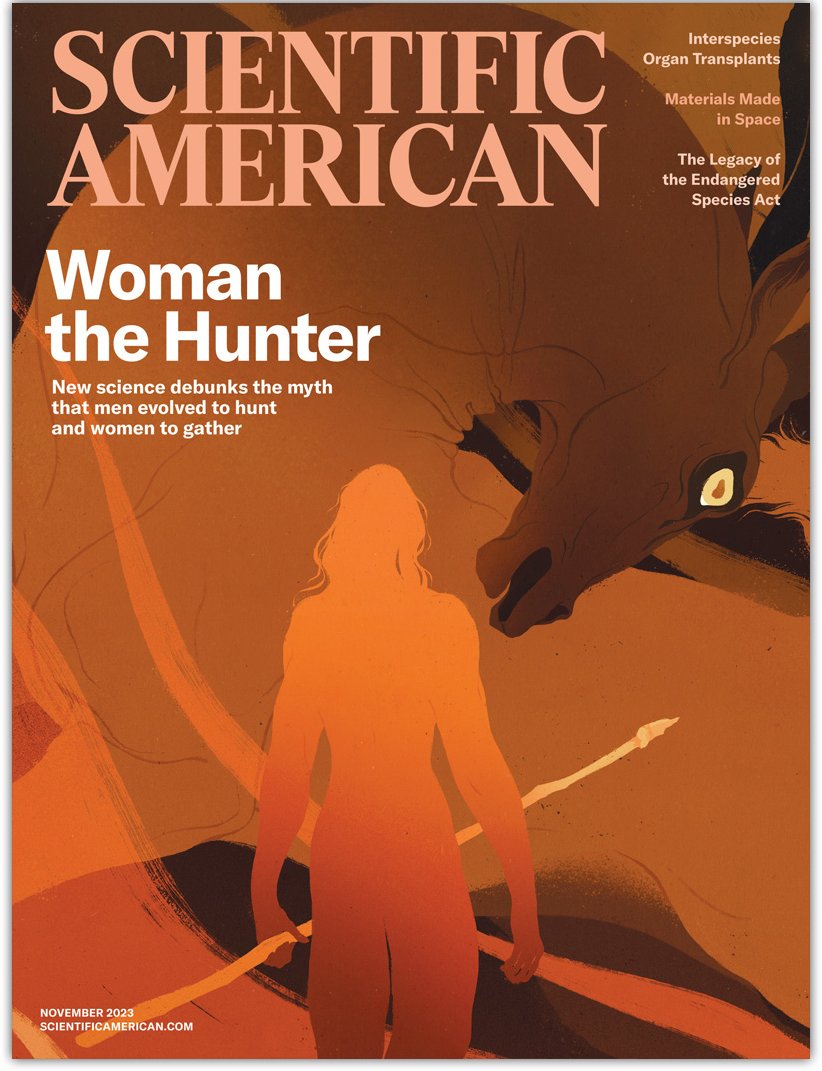
Scientific American – November 2023: The issue features Woman The Hunter – New science debunks the myth that men evolved to hunt and women to gather; Interspecies Organ Transplants; Materials Made in Space; The Legacy of the Endangered Species Act, and more…
The Endangered Species Act requires that every U.S. plant and animal be saved from extinction, but after 50 years, we have to do much more to prevent a biodiversity crisis
A cell census provides information on the source of human brain specialization
The brain is composed of multiple regions associated with distinct functions, which have become further specialized in the human lineage. To define how this specialization is implemented, how it arises during development, and how it has emerged over the course of human evolution, a detailed understanding of the cells that make up the human brain is required.
The ecology of whales in a changing climate
Some whale populations are exhibiting unexpected cycles of boom and bust
News, Views and Reviews For The Intellectually Curious











 Boomers Daily