

Scientific American (September 16, 2024): The October 2024 issue features ‘How To Go Back To The Moon’ – Inside NASA’s ambitious, controversial Artemis mission; The science of Empathy and Hope for Sickle Cell Disease…

Scientific American (September 16, 2024): The October 2024 issue features ‘How To Go Back To The Moon’ – Inside NASA’s ambitious, controversial Artemis mission; The science of Empathy and Hope for Sickle Cell Disease…

‘
To distance its science education systems from centurieslong British colonialism, India is leaning into its history and traditions—but at what cost?
The catastrophic floods that affected southern Brazil last May should serve as a warning to human societies that, despite the still widespread climate change skepticism or denial, mitigation and adaptation to cope with the ongoing climate crisis are urgently needed. The toll was 213 people killed or missing; 2.4 million people affected, including 600,000 displaced; and unprecedented losses in urban and rural infrastructure, including livestock.
Mice that witness cage mates in distress withstand future negative emotions better

‘
An ambitious strategy aims to cool the planet by dumping farmed seaweed on the sea floor. Will it work?
Focusing on temperature extremes can galvanize policy changes but risks undercounting
Building a Spanish megalith required sophisticated physics, geometry, and geology
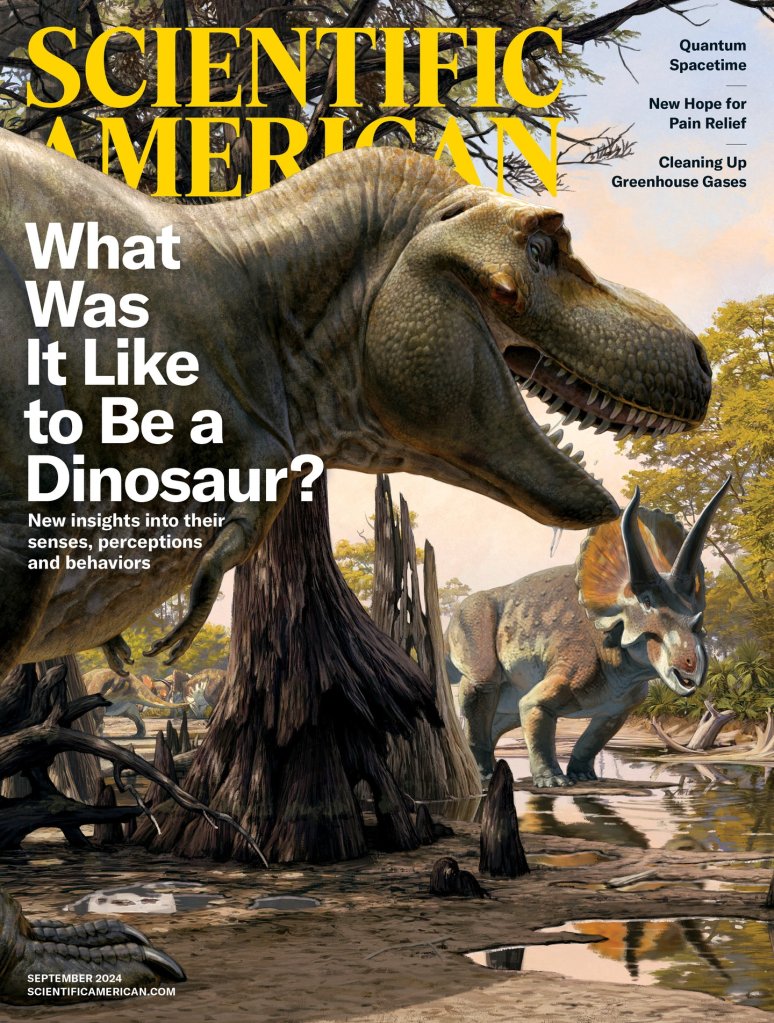
Scientific American (August 21, 2024): The September 2024 issue features ‘What Was It Like To Be A Dinosaur? – New insights into their senses, perceptions and behaviors…
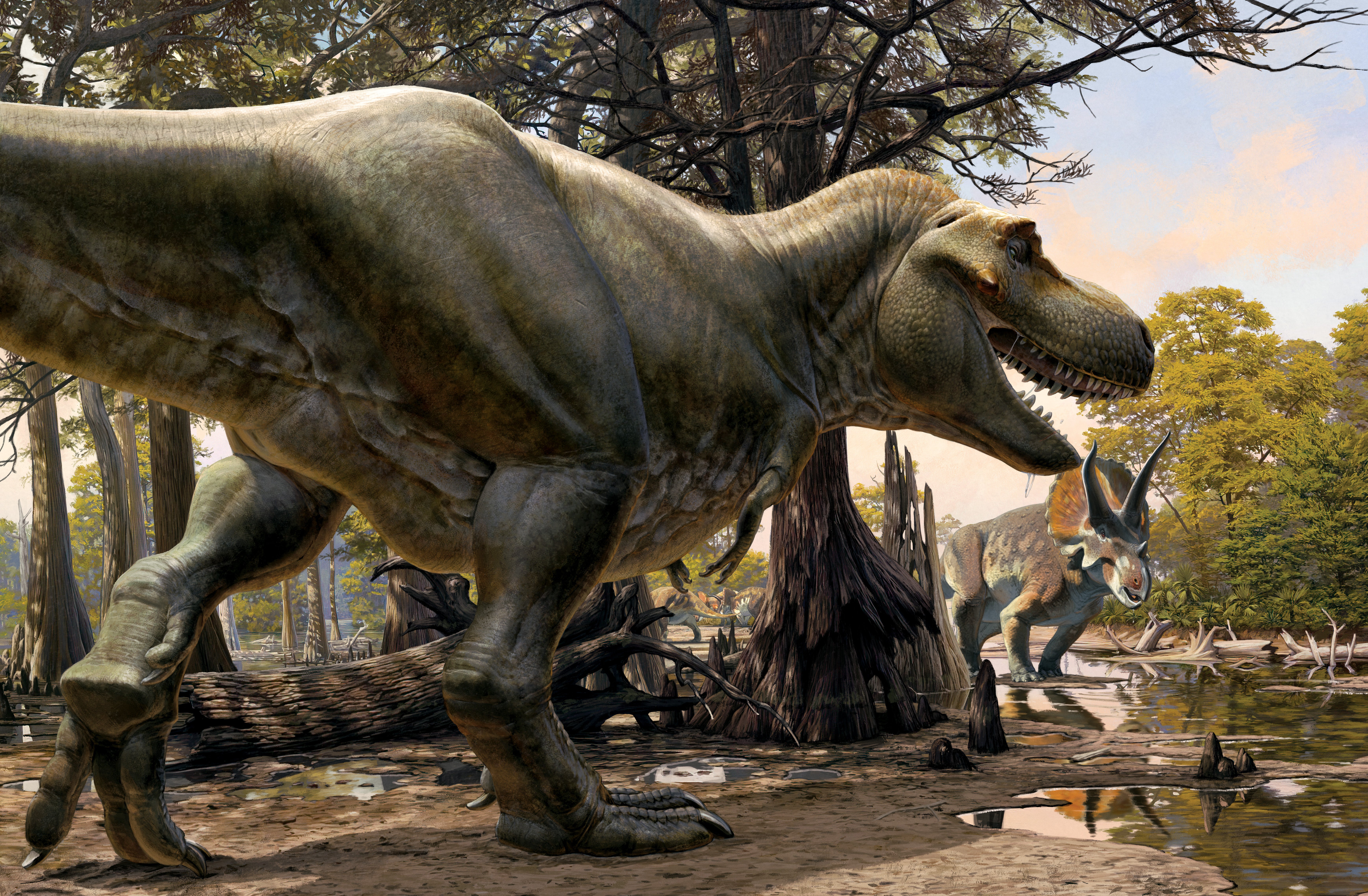
New fossils and analytical tools provide unprecedented insights into dinosaur sensory perception by Amy M. Balanoff, Daniel T. Ksepka
Alone Tyrannosaurus rexsniffs the humid Cretaceous air, scenting a herd of Triceratops grazing beyond the tree line. As the predator scans the floodplain, its vision suddenly snaps into focus. A single Triceratops has broken off from the herd and wandered within striking distance. Standing motionless, the T. rex formulates a plan of attack, anticipating the precise angle at which it must intersect its target before the Triceratops can regain the safety of the herd. The afternoon silence is shattered as the predator crashes though the low branches at the edge of the forest in hot pursuit.
T. rex has hunted Triceratops in so many books, games and movies that the encounter has become a cliché. But did a scene like this one ever unfold in real life? Would T. rex identify its prey by vision or by smell? Would the Triceratops be warned by a loudly cracking branch or remain oblivious because it was unable to locate the source of the sound? Could T. rex plan its attack like a cat, or would it lash out indiscriminately like a shark?

Dark matter has turned out to be more elusive than physicists had hoped by Tracy R. Slatyer, Tim M. P. Tait
Nick Huggett, Carlo Rovelli

‘

‘
Controversy over intentional burial by Homo naledi extends to new publishing models
Mammoth study in Chinese villages shows antibiotics that kill Helicobacter pylori reduced cancer risk
A stripped-down HIV genome can interfere with normal virus replication

‘
Scientists debate the role of humidity in rising heat deaths

‘
Atoms of element 116 show path to create element 120 and extend the periodic table
VIPER cancellation shocks planetary scientists and puts commercial lunar delivery program on edge
Culling crown-of-thorns boosted coral cover on Australia’s Great Barrier Reef
As private fleets grow, so do concerns about ozone-destroying effects of metal particles

‘
Glucagon-like peptide–1–based medicines have weight loss–independent actions
Foraging niches become more specialized toward bird range limits
Call to study glacial geoengineering stirs up “civil war” among polar scientists

‘
Feeble government response and lack of industry cooperation hamper U.S. control efforts
Scientists allege irregularities in papers on how honey bees gauge distance
Hardy zircons suggest subduction of ocean crust began 4 billion years ago
“New type of fossil” may boost efforts to bring beasts back
 Boomers Daily