
Tag Archives: Philosophy Now Magazine

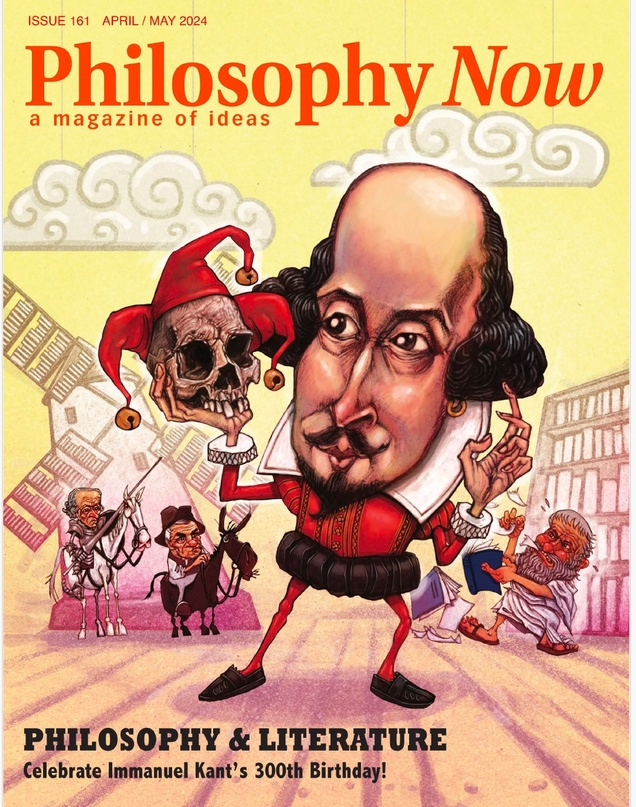
Preview: Philosophy Now Magazine April/May 2024

Image

Philosophy Now Magazine (April/May 2024)The new issue features ‘Philosophy & Literature’ – Celebrate Immanuel Kant’s 300th Birthday….

How to Have a Good Life

Meena Danishmal asks if Seneca’s account of the good life is really practical.

According to the Oxford English Dictionary, the adjective ‘stoical’ means “resembling a Stoic in austerity, indifference, fortitude, repression of feeling and the like”. This gives us some idea of what it is like to be a Stoic. Indeed, the key teaching, arguably the fundamental point, of Stoicism, is that we should focus on controlling the things that are under our control, such as our thoughts, emotions, and actions, whilst accepting those things we cannot control, such as most things that are happening in the world. How did they get there?

To consider this question let’s look at the ideas of the Roman philosopher and statesman Lucius Annaeus Seneca the Younger (4 BCE-65 CE). As a top advisor to the paranoid and murderous Emperor Nero, he probably found Stoicism a particularly practical guide to life.

As a Stoic, Seneca believed the soul (Latin: anima or animus) to be a finer form of matter than the body; but matter it is. It was also described as a spark of the fire which had consumed the original matter. With such an understanding of the soul, where does the soul reside within the body? Stoics provided a rather simple answer: everywhere. The soul was considered to be a vital force that animates the whole body. The soul was also the source of reason, virtue, and moral character, which is what Stoic philosophy is built upon, as the rational soul guides individuals towards living in accordance with nature.

For us to understand this concept further, it’s vital to grasp the Stoic conception of reality. Stoics see the universe as interconnected and interwoven, and this unified cosmos as governed by rational principles. Within this holistic perspective, the soul is seen as part of the divine rational order of the universe. This understanding forms the basis of Stoic ethics, which emphasises the importance of cultivating reason and virtue in all aspects of life. This encouragement to align thoughts, actions, and desires with principles of reason, is a way for the soul to flourish.

Preview: Philosophy Now Magazine February 2024

Image

Philosophy Now Magazine (February/March 2024)The new issue features ‘Irish Philosophy’ – Pure Philosophy, No Blarney; Steven Pinker – On Violence and Metaphors…

Steven Pinker

Steven Pinker is the Johnstone Family Professor of Psychology at Harvard University, and a popular writer on linguistics and evolutionary psychology. Angela Tan interviews him about politics, language, death, and reasons to be optimistic.

Thomas Duddy & Irish Philosophy

Tim Madigan travels through time to seek the essential nature of Irish thought.

Irish Philosophy & Me

Cathy Barry charts her journey through historical Irish thought.

Edmund Burke & the Politics of Reform

Jon Langford outlines conservative insights gained from revolutionary failures.

Philip Pettit & The Birth of Ethics

Peter Stone thinks about a thought experiment about how ethics evolved.

Preview: Philosophy Now Magazine January 2024

Image

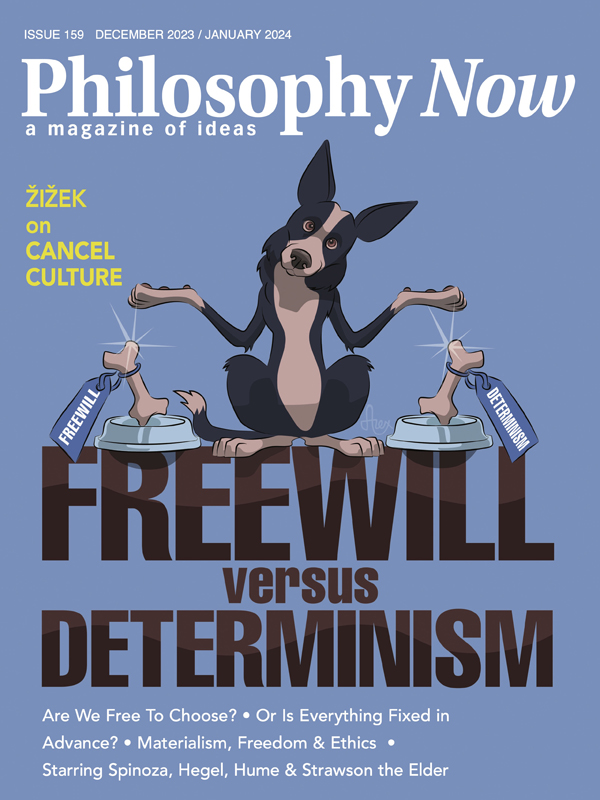
Philosophy Now Magazine (December 2023/January 2024) – The new issue features Freewill versus Determinism – Are we free to choose? Or is Everything Fixed In Advance?; Materialism, Freedom and Ethics; Žižek on Cancel Culture; Spinoza, Hume and other Determinists, and more…

Spinoza & Other Determinists

Myint Zan compares different ways of denying free will.

What Is Free Will?

Grant Bartley wants to know what the problem with freedom is all about.

Criticising Strawson’s Compatibilism

Nurana Rajabova is wary of an attempt to dismiss determinism to keep free will.

Materialism, Freedom & Ethics

Philip Badger constructs a materialist ethical theory, with the help of John Rawls.

The Will Is Not Free: You Have To Earn It

Basil Gala on what it takes to free ourselves from our formative factors.

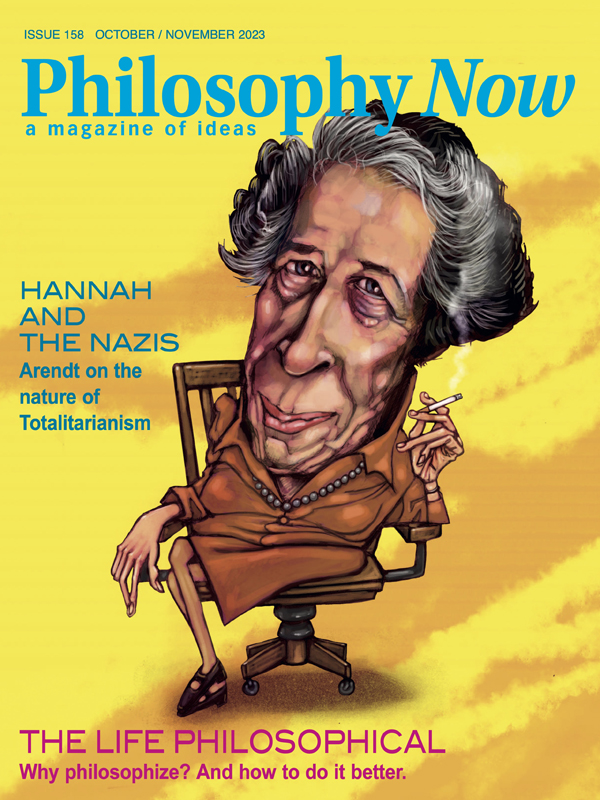
Preview: Philosophy Now Magazine Oct/Nov 2023

Image

Philosophy Now Magazine (October/November 2023) – The new issue features Hannah Arendt – the Complexities of Loving and the Banality of Evil; What Happened to Philosophy?; The Soul of the Marionette: A Short Enquiry Into Human Freedom and more…

Hannah Arendt & the Complexities of Loving

Jack Pemment considers the strange attraction between two deep minds.

Hannah Arendt & the Banality of Evil

Georgia Arkell reconsiders Arendt’s explosive report on the trial of Eichmann.

THE LIFE PHILOSOPHICAL

What is the Philosophical Experience?

Eldar Sarajlic philosophically considers what it is to do philosophy.

Is Progress Possible In Philosophy?

Mathis Bitton suggests three ways that philosophy progresses.

Why Write Philosophy?

George Sher writes some philosophy to tell us.

What Happened to Philosophy?

Alexander Jeuk says overspecialization, academic debate focusing, and simplistic argument structures, are prominent missteps in modern philosophy.

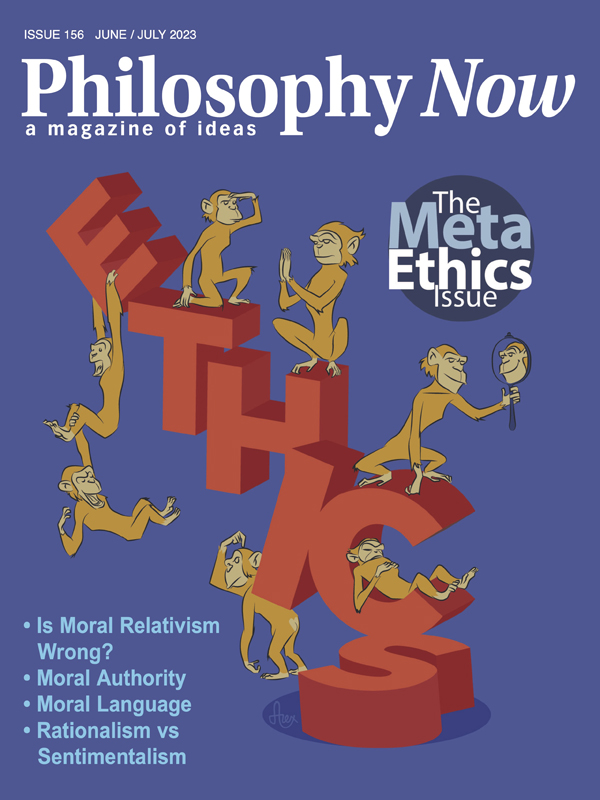
Philosophy Now Magazine June / July 2023 Preview

Image

Philosophy Now Magazine (June/July 2023) – The ‘Meta Ethics Issue’ featuring Back to the Sophists: Nana Ariel corrects the record and the modern application of Sophistry and Will the Real John Locke Please Step Forward? Hilarius Bogbinder shows how Locke’s intellectual identity changed over time.

The Cognitive Gap

Justin Bartlett explores a basic distinction between understandings of ethics.

Who’s To Say?

Michael-John Turp asks if anyone has the authority to establish moral truth.

Right & Wrong About Right & Wrong

Paul Stearns argues against moral relativism and moral presentism.

Ethical Truth in Light of Quantum Mechanics

Myles King contends that physics helps us understand ethics.

Can You Be Both A Moral Rationalist & A Moral Sentimentalist?

Andrew Kemle says that evolutionary forces give us the answer.