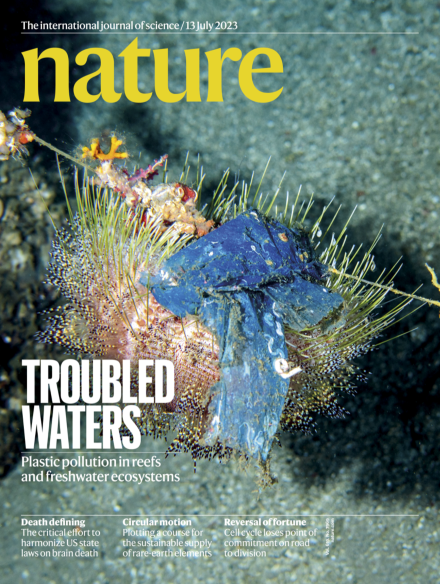
nature Magazine -July 13, 2023 issue:Usually, sea urchins procure blades of seagrass or small pieces of rubble to help them blend in with the sea floor, but the fire urchin (Asthenosoma varium) on the cover has instead appropriated the remnants of a blue plastic bag and is entangled in a discarded fishing line stuck on a reef.
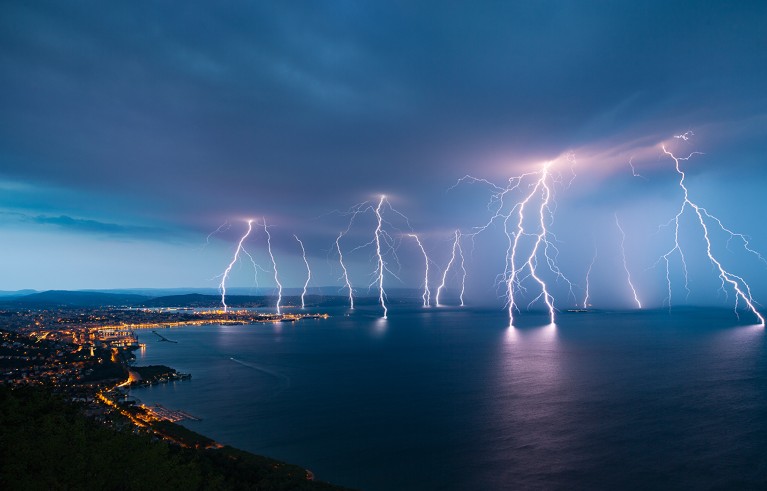
Coverage of wispy cirrus clouds is linked to episodes of electrical activity.
Lightning is typically seen when imposing cumulonimbus clouds fill the sky. But new research shows that these bolts of electricity can also be used to forecast thin and wispy clouds that warm the world by reflecting heat back to the surface.
Laser-cooled antimatter opens up new physics experiments, and the staggering economic cost of invasive species.
In this episode:
00:44 Cooling antimatter with a laser focus
Antimatter is annihilated whenever it interacts with regular matter, which makes it tough for physicists to investigate. Now though, a team at CERN have developed a way to trap and cool antihydrogen atoms using lasers, allowing them to better study its properties.
Invasive alien species are organisms that end up in places where they don’t really belong, usually as a result of human activity. These species can cause loss of biodiversity and a host of damage to their new environments. This week, researchers estimate that the economic impact of invasive species to be over US $1 trillion.
We discuss some highlights from the Nature Briefing. This time, the physics that might explain how a ship blocked the Suez Canal, and a new insight into octopuses’ sleep patterns.
About one-third of people with epilepsy are treatment resistant. Up until now, epilepsy treatments have focused on taming seizures rather than the source of the disease and for good reason—so many roads lead to epilepsy: traumatic brain injury, extreme fever and infection, and genetic disorders, to name a few. Staff Writer Jennifer Couzin-Frankel talks with host Sarah Crespi about researchers that are turning back the pages on epilepsy, trying to get to the beginning of the story where new treatments might work.
And Sarah also talks with Torsten Neurbert at the Technical University of Denmark’s National Space Institute in Kongens Lyngby about capturing high-altitude “transient luminous events” from the International Space Station (ISS). These lightning-induced bursts of light, color, and occasionally gamma rays were first reported in the 1990s but had only been recorded from the ground or aircraft. With new measurements from the ISS come new insights into the anatomy of lightning.




 About one-third of people with epilepsy are treatment resistant. Up until now, epilepsy treatments have focused on taming seizures rather than the source of the disease and for good reason—so many roads lead to epilepsy: traumatic brain injury, extreme fever and infection, and genetic disorders, to name a few. Staff Writer Jennifer Couzin-Frankel talks with host Sarah Crespi about researchers that are
  Boomers Daily