Tag Archives: Coughing

Health: ‘Why There Is No Cure For Common Colds’

The common cold is the most common human disease in the world. So, why haven’t we found a cure yet?!

Called human rhinoviruses, these respiratory viruses measure between 15 to 30 nanometers in diameter, making them some of the smallest types of viruses out there. And it’s partly thanks to the viruses’ genetic makeup that they’re so good at replicating.

Human rhinoviruses travel like most other respiratory viruses via nasal secretions, which can be released through sneezing, or through contact with fomites, which are surfaces like a keyboard or a doorknob that can help spread the virus from one person to another. From there, all it takes is for a hand to touch one of the body’s mucous membranes like the eyes, nose, or mouth and bam — the virus has gained entry.

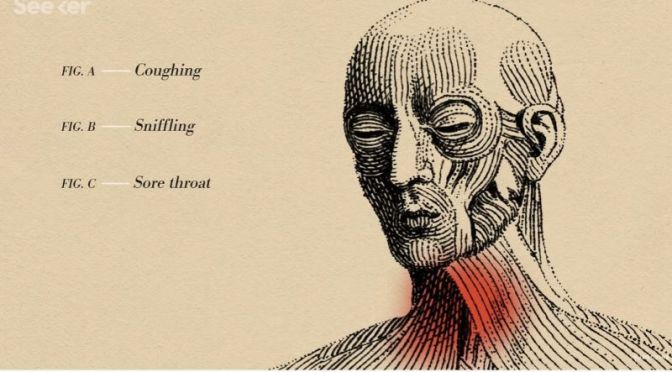
Soon after infection, coughing, sneezing, headaches, a mild fever and body aches can soon follow. And these symptoms may easily be confused with those of the flu. But unlike the flu, where symptoms start quite suddenly, it can take a couple of days for cold symptoms to fully develop. And they usually last anywhere from 7 to 14 days.
Health & Technology: New MIT AI Model Detects Asymptomatic Covid-19

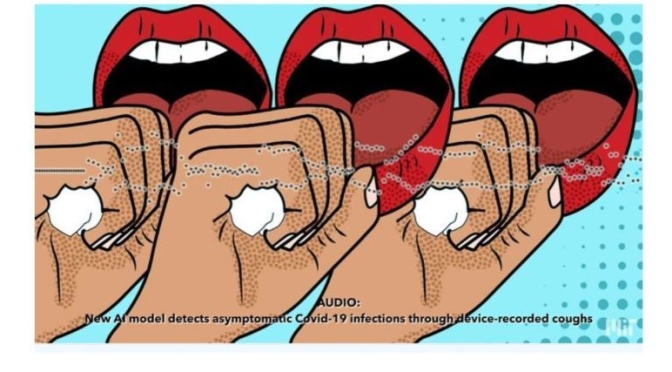
A team of MIT researchers have developed an AI model that can distinguish asymptomatic people with Covid-19 from healthy individuals without the disease through forced-cough recordings. (Learn more: http://news.mit.edu/2020/covid-19-cou…

Social Distancing: 3-D Simulation Of How Respiratory Droplets Spread Coronavirus

From The New York Times (April 14, 2020):

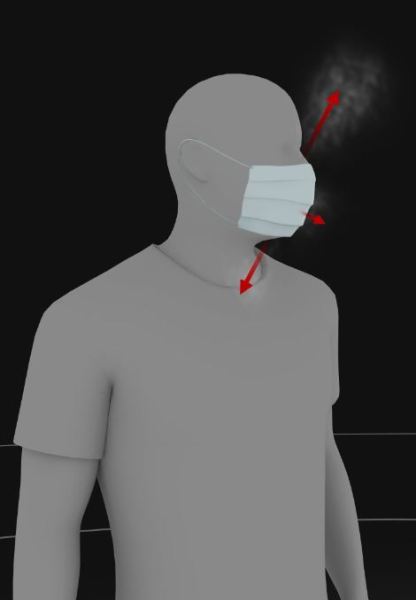
Face Mask Disrupts trajectory of cough New York Times April 14 2020

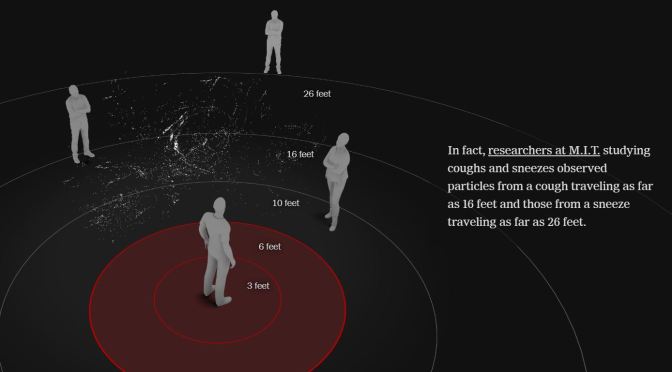
But as this simulation suggests, and scientists have argued, droplets can travel farther than six feet. And small droplets known as aerosols can remain suspended or travel through the air before they eventually settle on surfaces. This is how they could disperse over the next 20 minutes.

The Centers for Disease Control and Prevention encourages people to stay home. If you must venture out, you should stay at least six feet away from others. The World Health Organization recommends a minimum of three feet of separation.

Scientists are learning about the novel coronavirus in real time, and those who study similar respiratory illnesses say that until it is better understood, no guideline is likely to offer perfect safety. Instead, understanding the possible transmission routes for the virus can help us see why keeping our distance is so important.

View 3-D simulation