Category Archives: Critical Thinking

The Ethics of Defiance in Theology and Society

This essay was written and edited by Intellicurean utilizing AI:
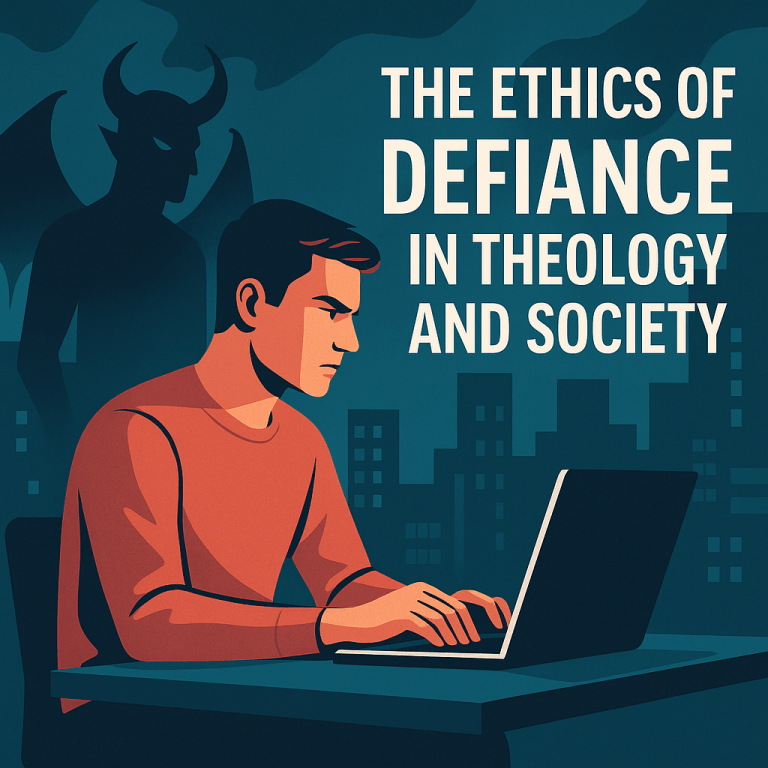
Before Satan became the personification of evil, he was something far more unsettling: a dissenter with conviction. In the hands of Joost van den Vondel and John Milton, rebellion is not born from malice, but from moral protest—a rebellion that echoes through every courtroom, newsroom, and protest line today.

Seventeenth-century Europe, still reeling from the Protestant Reformation, was a world in flux. Authority—both sacred and secular—was under siege. Amid this upheaval, a new literary preoccupation emerged: rebellion not as blasphemy or chaos, but as a solemn confrontation with power. At the heart of this reimagining stood the devil—not as a grotesque villain, but as a tragic figure struggling between duty and conscience.

“As old certainties fractured, a new literary fascination emerged with rebellion, not merely as sin, but as moral drama.”

In Vondel’s Lucifer (1654) and Milton’s Paradise Lost (1667), Satan is no longer merely the adversary of God; he becomes a symbol of conscience in collision with authority. These works do not justify evil—they dramatize the terrifying complexity of moral defiance. Their protagonists, shaped by dignity and doubt, speak to an enduring question: when must we obey, and when must we resist?

Vondel’s Lucifer: Dignity, Doubt, and Divine Disobedience

In Vondel’s hands, Lucifer is not a grotesque demon but a noble figure, deeply shaken by God’s decree that angels must serve humankind. This new order, in Lucifer’s eyes, violates the harmony of divine justice. His poignant declaration, “To be the first prince in some lower court” (Act I, Line 291), is less a lust for domination than a refusal to surrender his sense of dignity.

Vondel crafts Lucifer in the tradition of Greek tragedy. The choral interludes frame Lucifer’s turmoil not as hubris, but as solemn introspection. He is a being torn by conscience, not corrupted by pride. The result is a rebellion driven by perceived injustice rather than innate evil.

The playwright’s own religious journey deepens the text. Raised a Mennonite, Vondel converted to Catholicism in a fiercely Calvinist Amsterdam. Lucifer becomes a veiled critique of predestination and theological rigidity. His angels ask: if obedience is compelled, where is moral agency? If one cannot dissent, can one truly be free?

Authorities saw the danger. The play was banned after two performances. In a city ruled by Reformed orthodoxy, the idea that angels could question God threatened more than doctrine—it threatened social order. And yet, Lucifer endured, carving out a space where rebellion could be dignified, tragic, even righteous.

The tragedy’s impact would echo beyond the stage. Vondel’s portrayal of divine disobedience challenged audiences to reconsider the theological justification for absolute obedience—whether to church, monarch, or moral dogma. In doing so, he planted seeds of spiritual and political skepticism that would continue to grow.

Milton’s Satan: Pride, Conscience, and the Fall from Grace

Milton’s Paradise Lost offers a cosmic canvas, but his Satan is deeply human. Once Heaven’s brightest, he falls not from chaos but conviction. His famed credo—“Better to reign in Hell than serve in Heaven” (Book I, Line 263)—isn’t evil incarnate. It is a cry of autonomy, however misguided.

Early in the epic, Satan is a revolutionary: eloquent, commanding, even admirable. Milton allows us to feel his magnetism. But this is not the end of the arc—it is the beginning of a descent. As the story unfolds, Satan’s rhetoric calcifies into self-justification. His pride distorts his cause. The rebel becomes the tyrant he once defied.

This descent mirrors Milton’s own disillusionment. A Puritan and supporter of the English Commonwealth, he witnessed Cromwell’s republic devolve into authoritarianism and the Restoration of the monarchy. As Orlando Reade writes in Paradise Lost: Mourned, A Revolution Betrayed (2024), Satan becomes Milton’s warning: even noble rebellion, untethered from humility, can collapse into tyranny.

“He speaks the language of liberty while sowing the seeds of despotism.”

Milton’s Satan reminds us that rebellion, while necessary, is fraught. Without self-awareness, the conscience that fuels it becomes its first casualty. The epic thus dramatizes the peril not only of blind obedience, but of unchecked moral certainty.

What begins as protest transforms into obsession. Satan’s journey reflects not merely theological defiance but psychological unraveling—a descent into solipsism where he can no longer distinguish principle from pride. In this, Milton reveals rebellion as both ethically urgent and personally perilous.

Earthly Echoes: Milgram, Nuremberg, and the Cost of Obedience

Centuries later, the drama of obedience and conscience reemerged in psychological experiments and legal tribunals.

In 1961, psychologist Stanley Milgram explored why ordinary people committed atrocities under Nazi regimes. Participants were asked to deliver what they believed were painful electric shocks to others, under the instruction of an authority figure. Disturbingly, 65% of subjects administered the maximum voltage.

Milgram’s chilling conclusion: cruelty isn’t always driven by hatred. Often, it requires only obedience.

“The most fundamental lesson of the Milgram experiment is that ordinary people… can become agents in a terrible destructive process.” — Stanley Milgram, Obedience to Authority (1974)

At Nuremberg, after World War II, Nazi defendants echoed the same plea: we were just following orders. But the tribunal rejected this. The Nuremberg Principles declared that moral responsibility is inalienable.

As the Leuven Transitional Justice Blog notes, the court affirmed: “Crimes are committed by individuals and not by abstract entities.” It was a modern echo of Vondel and Milton: blind obedience, even in lawful structures, cannot absolve the conscience.

The legal implications were far-reaching. Nuremberg reshaped international norms by asserting that conscience can override command, that legality must answer to morality. The echoes of this principle still resonate in debates over drone warfare, police brutality, and institutional accountability.

The Vietnam War: Protest as Moral Conscience

The 1960s anti-war movement was not simply a reaction to policy—it was a moral rebellion. As the U.S. escalated involvement in Vietnam, activists invoked not just pacifism, but ethical duty.

Martin Luther King Jr., in his 1967 speech “Beyond Vietnam: A Time to Break Silence,” denounced the war as a betrayal of justice:

“A time comes when silence is betrayal.”

Draft resistance intensified. Muhammad Ali, who refused military service, famously declared:

“I ain’t got no quarrel with them Viet Cong.”

His resistance cost him his title, nearly his freedom. But it transformed him into a global symbol of conscience. Groups like Vietnam Veterans Against the War made defiance visceral: returning soldiers hurled medals onto Capitol steps. Their message: moral clarity sometimes demands civil disobedience.

The protests revealed a generational rift in moral interpretation: patriotism was no longer obedience to state policy, but fidelity to justice. And in this redefinition, conscience took center stage.

Feminism and the Rebellion Against Patriarchy

While bombs fell abroad, another rebellion reshaped the domestic sphere: feminism. The second wave of the movement exposed the quiet tyranny of patriarchy—not imposed by decree, but by expectation.

In The Feminine Mystique (1963), Betty Friedan named the “problem that has no name”—the malaise of women trapped in suburban domesticity. Feminists challenged laws, institutions, and social norms that demanded obedience without voice.

“The first problem for all of us, men and women, is not to learn, but to unlearn.” — Gloria Steinem, Revolution from Within (1992)

The 1968 protest at the Miss America pageant symbolized this revolt. Women discarded bras, girdles, and false eyelashes into a “freedom trash can.” It was not just performance, but a declaration: dignity begins with defiance.

Feminism insisted that the personal was political. Like Vondel’s angels or Milton’s Satan, women rebelled against a hierarchy they did not choose. Their cause was not vengeance, but liberation—for all.

Their defiance inspired legal changes—Title IX, Roe v. Wade, the Equal Pay Act—but its deeper legacy was ethical: asserting that justice begins in the private sphere. In this sense, feminism was not merely a social movement; it was a philosophical revolution.

Digital Conscience: Whistleblowers and the Age of Exposure

Today, rebellion occurs not just in literature or streets, but in data streams. Whistleblowers like Edward Snowden, Chelsea Manning, and Frances Haugen exposed hidden harms—from surveillance to algorithmic manipulation.

Their revelations cost them jobs, homes, and freedom. But they insisted on a higher allegiance: to truth.

“When governments or corporations violate rights, there is a moral imperative to speak out.” — Paraphrased from Snowden

These figures are not villains. They are modern Lucifers—flawed, exiled, but driven by conscience. They remind us: the battle between obedience and dissent now unfolds in code, policy, and metadata.

The stakes are high. In an era of artificial intelligence and digital surveillance, ethical responsibility has shifted from hierarchical commands to decentralized platforms. The architecture of control is invisible—yet rebellion remains deeply human.

Public Health and the Politics of Autonomy

The COVID-19 pandemic reframed the question anew: what does moral responsibility look like when authority demands compliance for the common good?

Mask mandates, vaccines, and quarantines triggered fierce debates. For some, compliance was compassion. For others, it was capitulation. The virus became a mirror, reflecting our deepest fears about trust, power, and autonomy.

What the pandemic exposed is not simply political fracture, but ethical ambiguity. It reminded us that even when science guides policy, conscience remains a personal crucible. To obey is not always to submit; to question is not always to defy.

The challenge is not rebellion versus obedience—but how to discern the line between solidarity and submission, between reasoned skepticism and reckless defiance.

Conclusion: The Sacred Threshold of Conscience

Lucifer and Paradise Lost are not relics of theological imagination. They are maps of the moral terrain we walk daily.

Lucifer falls not from wickedness, but from protest. Satan descends through pride, not evil. Both embody our longing to resist what feels unjust—and our peril when conscience becomes corrupted.

“Authority demands compliance, but conscience insists on discernment.”

From Milgram to Nuremberg, from Vietnam to feminism, from whistleblowers to lockdowns, the line between duty and defiance defines who we are.

To rebel wisely is harder than to obey blindly. But it is also nobler, more human. In an age of mutating power—divine, digital, political—conscience must not retreat. It must adapt, speak, endure.

The final lesson of Vondel and Milton may be this: that conscience, flawed and fallible though it may be, remains the last and most sacred threshold of freedom. To guard it is not to glorify rebellion for its own sake, but to defend the fragile, luminous space where justice and humanity endure.
Reclaiming Deep Thought in a Distracted Age

This essay was written and edited by Intellicurean utilizing AI:

In the age of the algorithm, literacy isn’t dying—it’s becoming a luxury. This essay argues that the rise of short-form digital media is dismantling long-form reasoning and concentrating cognitive fitness among the wealthy, catalyzing a quiet but transformative shift. As British journalist Mary Harrington writes in her New York Times opinion piece “Thinking Is Becoming a Luxury Good” (July 28, 2025), even the capacity for sustained thought is becoming a curated privilege.

“Deep reading, once considered a universal human skill, is now fragmenting along class lines.”

What was once assumed to be a universal skill—the ability to read deeply, reason carefully, and maintain focus through complexity—is fragmenting along class lines. While digital platforms have radically democratized access to information, the dominant mode of consumption undermines the very cognitive skills that allow us to understand, reflect, and synthesize meaning. The implications stretch far beyond classrooms and attention spans. They touch the very roots of human agency, historical memory, and democratic citizenship—reshaping society into a cognitively stratified landscape.


The Erosion of the Reading Brain

Modern civilization was built by readers. From the Reformation to the Enlightenment, from scientific treatises to theological debates, progress emerged through engaged literacy. The human mind, shaped by complex texts, developed the capacity for abstract reasoning, empathetic understanding, and civic deliberation. Martin Luther’s 95 Theses would have withered in obscurity without a literate populace; the American and French Revolutions were animated by pamphlets and philosophical tracts absorbed in quiet rooms.

But reading is not biologically hardwired. As neuroscientist and literacy scholar Maryanne Wolf argues in Reader, Come Home: The Reading Brain in a Digital World, deep reading is a profound neurological feat—one that develops only through deliberate cultivation. “Expert reading,” she writes, “rewires the brain, cultivating linear reasoning, reflection, and a vocabulary that allows for abstract thought.” This process orchestrates multiple brain regions, building circuits for sequential logic, inferential reasoning, and even moral imagination.

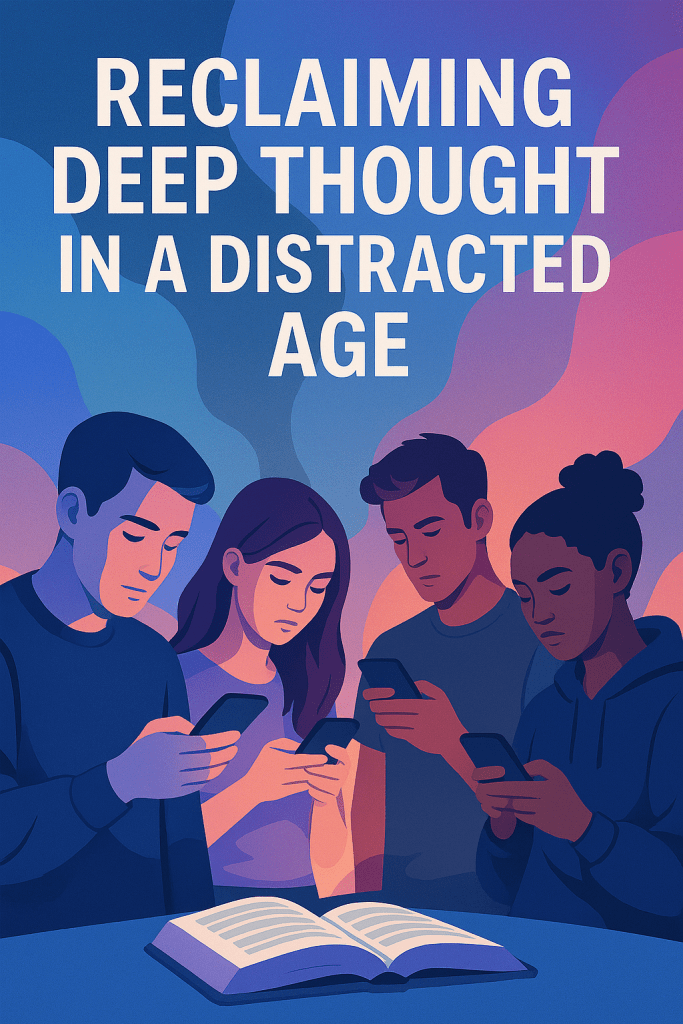
Yet this hard-earned cognitive achievement is now under siege. Smartphones and social platforms offer a constant feed of image, sound, and novelty. Their design—fueled by dopamine hits and feedback loops—favors immediacy over introspection. In his seminal book The Shallows: What the Internet Is Doing to Our Brains, Nicholas Carr explains how the architecture of the web—hyperlinks, notifications, infinite scroll—actively erodes sustained attention. The internet doesn’t just distract us; it reprograms us.

Gary Small and Gigi Vorgan, in iBrain: Surviving the Technological Alteration of the Modern Mind, show how young digital natives develop different neural pathways: less emphasis on deep processing, more reliance on rapid scanning and pattern recognition. The result is what they call “shallow processing”—a mode of comprehension marked by speed and superficiality, not synthesis and understanding. The analytic left hemisphere, once dominant in logical thought, increasingly yields to a reactive, fragmented mode of engagement.

The consequences are observable and dire. As Harrington notes, adult literacy is declining across OECD nations, while book reading among Americans has plummeted. In 2023, nearly half of U.S. adults reported reading no books at all. This isn’t a result of lost access or rising illiteracy—but of cultural and neurological drift. We are becoming a post-literate society: technically able to read, but no longer disposed to do so in meaningful or sustained ways.

“The digital environment is designed for distraction; notifications fragment attention, algorithms reward emotional reaction over rational analysis, and content is increasingly optimized for virality, not depth.”

This shift is not only about distraction; it’s about disconnection from the very tools that cultivate introspection, historical understanding, and ethical reasoning. When the mind loses its capacity to dwell—on narrative, on ambiguity, on philosophical questions—it begins to default to surface-level reaction. We scroll, we click, we swipe—but we no longer process, synthesize, or deeply understand.


Literacy as Class Privilege

In a troubling twist, the printed word—once a democratizing force—is becoming a class marker once more. Harrington likens this transformation to the processed food epidemic: ultraprocessed snacks exploit innate cravings and disproportionately harm the poor. So too with media. Addictive digital content, engineered for maximum engagement, is producing cognitive decay most pronounced among those with fewer educational and economic resources.

Children in low-income households spend more time on screens, often without guidance or limits. Studies show they exhibit reduced attention spans, impaired language development, and declines in executive function—skills crucial for planning, emotional regulation, and abstract reasoning. Jean Twenge’s iGen presents sobering data: excessive screen time, particularly among adolescents in vulnerable communities, correlates with depression, social withdrawal, and diminished readiness for adult responsibilities.

Meanwhile, affluent families are opting out. They pay premiums for screen-free schools—Waldorf, Montessori, and classical academies that emphasize long-form engagement, Socratic inquiry, and textual analysis. They hire “no-phone” nannies, enforce digital sabbaths, and adopt practices like “dopamine fasting” to retrain reward systems. These aren’t just lifestyle choices. They are investments in cognitive capital—deep reading, critical thinking, and meta-cognitive awareness—skills that once formed the democratic backbone of society.

This is a reversion to pre-modern asymmetries. In medieval Europe, literacy was confined to a clerical class, while oral knowledge circulated among peasants. The printing press disrupted that dynamic—but today’s digital environment is reviving it, dressed in the illusion of democratization.

“Just as ultraprocessed snacks have created a health crisis disproportionately affecting the poor, addictive digital media is producing cognitive decline most pronounced among the vulnerable.”

Elite schools are incubating a new class of thinkers—trained not in content alone, but in the enduring habits of thought: synthesis, reflection, dialectic. Meanwhile, large swaths of the population drift further into fast-scroll culture, dominated by reaction, distraction, and superficial comprehension.


Algorithmic Literacy and the Myth of Access

We are often told that we live in an era of unparalleled access. Anyone with a smartphone can, theoretically, learn calculus, read Shakespeare, or audit a philosophy seminar at MIT. But this is a dangerous half-truth. The real challenge lies not in access, but in disposition. Access to knowledge does not ensure understanding—just as walking through a library does not confer wisdom.

Digital literacy today often means knowing how to swipe, search, and post—not how to evaluate arguments or trace the origin of a historical claim. The interface makes everything appear equally valid. A Wikipedia footnote, a meme, and a peer-reviewed article scroll by at the same speed. This flattening of epistemic authority—where all knowledge seems interchangeable—erodes our ability to distinguish credible information from noise.

Moreover, algorithmic design is not neutral. It amplifies certain voices, buries others, and rewards content that sparks outrage or emotion over reason. We are training a generation to read in fragments, to mistake volume for truth, and to conflate virality with legitimacy.


The Fracturing of Democratic Consciousness

Democracy presumes a public capable of rational thought, informed deliberation, and shared memory. But today’s media ecosystem increasingly breeds the opposite. Citizens shaped by TikTok clips and YouTube shorts are often more attuned to “vibes” than verifiable facts. Emotional resonance trumps evidence. Outrage eclipses argument. Politics, untethered from nuance, becomes spectacle.

Harrington warns that we are entering a new cognitive regime, one that undermines the foundations of liberal democracy. The public sphere, once grounded in newspapers, town halls, and long-form debate, is giving way to tribal echo chambers. Algorithms sort us by ideology and appetite. The very idea of shared truth collapses when each feed becomes a private reality.

Robert Putnam’s Bowling Alone chronicled the erosion of social capital long before the smartphone era. But today, civic fragmentation is no longer just about bowling leagues or PTAs. It’s about attention itself. Filter bubbles and curated feeds ensure that we engage only with what confirms our biases. Complex questions—on history, economics, or theology—become flattened into meme warfare and performative dissent.

“The Enlightenment assumption that reason could guide the masses is buckling under the weight of the algorithm.”

Worse, this cognitive shift has measurable political consequences. Surveys show declining support for democratic institutions among younger generations. Gen Z, raised in the algorithmic vortex, exhibits less faith in liberal pluralism. Complexity is exhausting. Simplified narratives—be they populist or conspiratorial—feel more manageable. Philosopher Byung-Chul Han, in The Burnout Society, argues that the relentless demands for visibility, performance, and positivity breed not vitality but exhaustion. This fatigue disables the capacity for contemplation, empathy, or sustained civic action.


The Rise of a Neo-Oral Priesthood

Where might this trajectory lead? One disturbing possibility is a return to gatekeeping—not of religion, but of cognition. In the Middle Ages, literacy divided clergy from laity. Sacred texts required mediation. Could we now be witnessing the early rise of a neo-oral priesthood: elites trained in long-form reasoning, entrusted to interpret the archives of knowledge?

This cognitive elite might include scholars, classical educators, journalists, or archivists—those still capable of sustained analysis and memory. Their literacy would not be merely functional but rarefied, almost arcane. In a world saturated with ephemeral content, the ability to read, reflect, and synthesize becomes mystical—a kind of secular sacredness.

These modern scribes might retreat to academic enclaves or AI-curated libraries, preserving knowledge for a distracted civilization. Like desert monks transcribing ancient texts during the fall of Rome, they would become stewards of meaning in an age of forgetting.

“Like ancient scribes preserving knowledge in desert monasteries, they might transcribe and safeguard the legacies of thought now lost to scrolling thumbs.”

Artificial intelligence complicates the picture. It could serve as a tool for these new custodians—sifting, archiving, interpreting. Or it could accelerate the divide, creating cognitive dependencies while dulling the capacity for independent thought. Either way, the danger is the same: truth, wisdom, and memory risk becoming the property of a curated few.


Conclusion: Choosing the Future

This is not an inevitability, but it is an acceleration. We face a stark cultural choice: surrender to digital drift, or reclaim the deliberative mind. The challenge is not technological, but existential. What is at stake is not just literacy, but liberty—mental, moral, and political.

To resist post-literacy is not mere nostalgia. It is an act of preservation: of memory, attention, and the possibility of shared meaning. We must advocate for education that prizes reflection, analysis, and argumentation from an early age—especially for those most at risk of being left behind. That means funding for libraries, long-form content, and digital-free learning zones. It means public policy that safeguards attention spans as surely as it safeguards health. And it means fostering a media environment that rewards truth over virality, and depth over speed.

“Reading, reasoning, and deep concentration are not merely personal virtues—they are the pillars of collective freedom.”

Media literacy must become a civic imperative—not only the ability to decode messages, but to engage in rational thought and resist manipulation. We must teach the difference between opinion and evidence, between emotional resonance and factual integrity.

To build a future worthy of human dignity, we must reinvest in the slow, quiet, difficult disciplines that once made progress possible. This isn’t just a fight for education—it is a fight for civilization.