

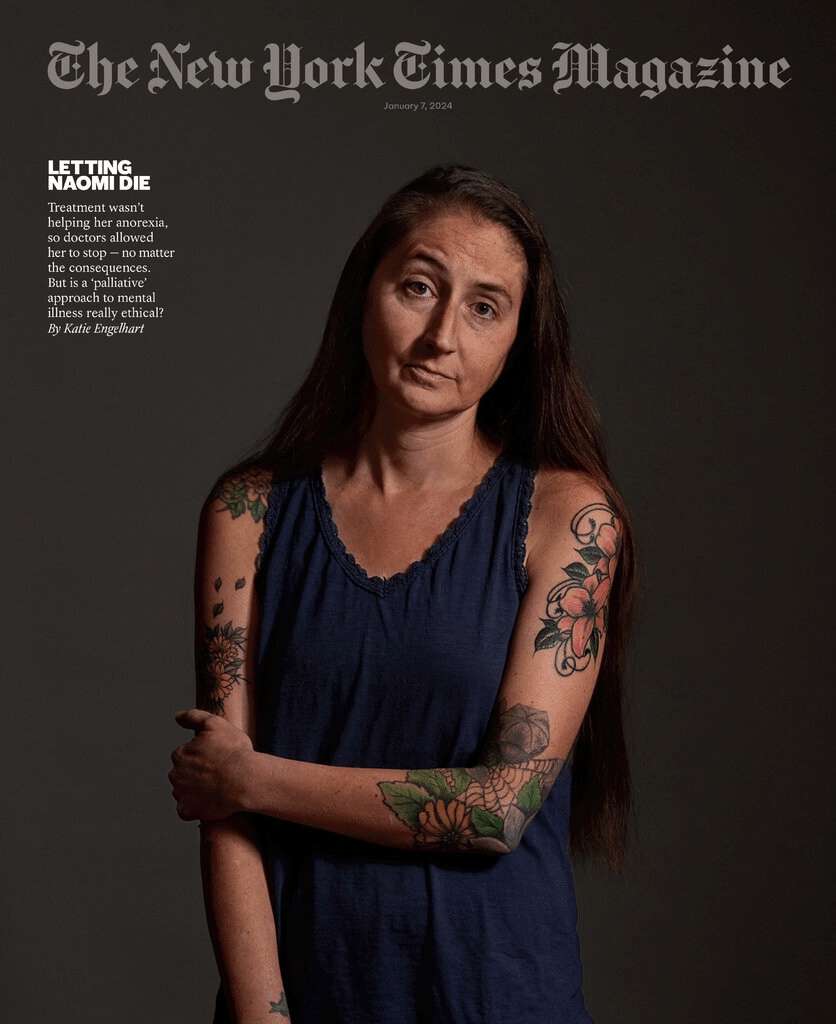

THE NEW YORK TIMES MAGAZINE (January 5, 2024): The new issue features “Letting Naomi Die” – Treatment wasn’t helping her anorexia, so doctors allowed her to stop, no matter the consequences. But is a ‘palliative’ approach to mental illness really ethical?
Should Patients Be Allowed to Die From Anorexia?

Treatment wasn’t helping her anorexia, so doctors allowed her to stop — no matter the consequences. But is a “palliative” approach to mental illness really ethical?
By Katie Engelhart
The doctors told Naomi that she could not leave the hospital. She was lying in a narrow bed at Denver Health Medical Center. Someone said something about a judge and a court order. Someone used the phrase “gravely disabled.” Naomi did not think she was gravely disabled. Still, she decided not to fight it. She could deny that she was mentally incompetent — but this would probably just be taken as proof of her mental incompetence. Of her lack of insight. She would, instead, “succumb to it.”
What If People Don’t Need to Care About Climate Change to Fix It?

By David Marchese
“It seems like we’ve been battling climate change for decades and made no progress,” Dr. Hannah Ritchie says. “I want to push back on that.” Ritchie, a senior researcher in the Program on Global Development at the University of Oxford and deputy editor at the online publication Our World in Data, is the author of the upcoming book, “Not the End of the World.” In it, she argues that the flood of doom-laden stats and stories about climate change is obscuring our ability to imagine solutions to the crisis and envision a sustainable, livable future.
 Boomers Daily