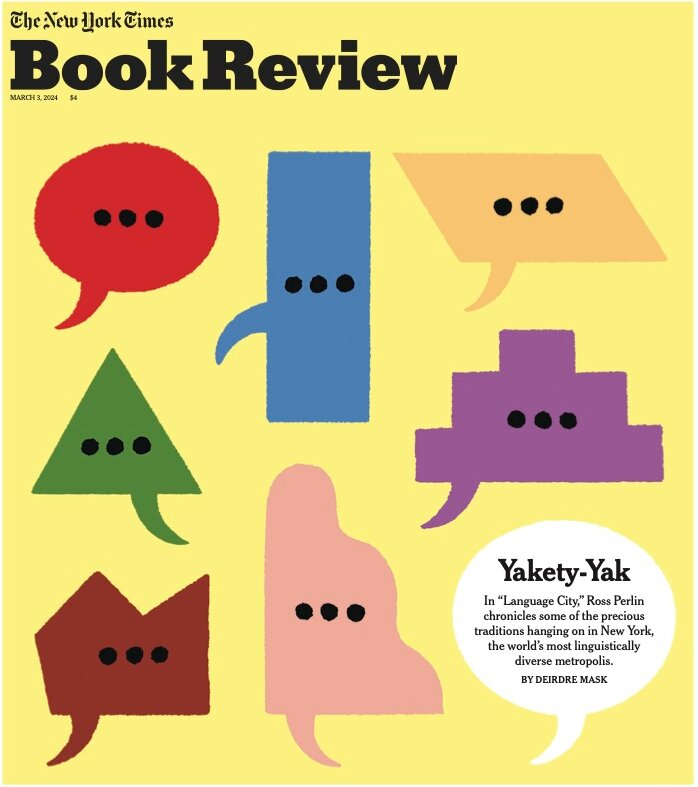
THE NEW YORK TIMES BOOK REVIEW (March 1, 2024): The latest issue features ‘Yakety-Yak’ – In “Language City”, Ross Perlin chronicles some of the precious traditions hanging on in New York, the world’s most linguistically diverse metropolis…
The feisty title character of her new book, “Ferris,” has a sharp eye for detail, and so, its author hopes, does she. Meanwhile, she is on an Alice McDermott reading jag.
In “Language City,” the linguist Ross Perlin chronicles some of the precious traditions hanging on in the world’s most linguistically diverse metropolis.
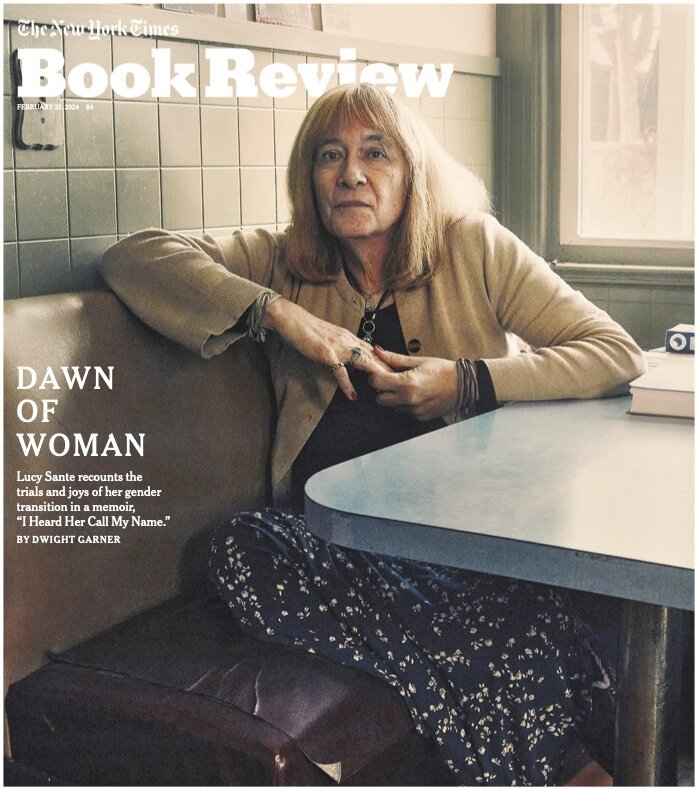
THE NEW YORK TIMES BOOK REVIEW (February 23, 2024): The latest issue features ‘Dawn of Woman’ – Lucy Sante recounts the trials and joys of her gender transition in a memoir, “I Heard Her Call My Name”…
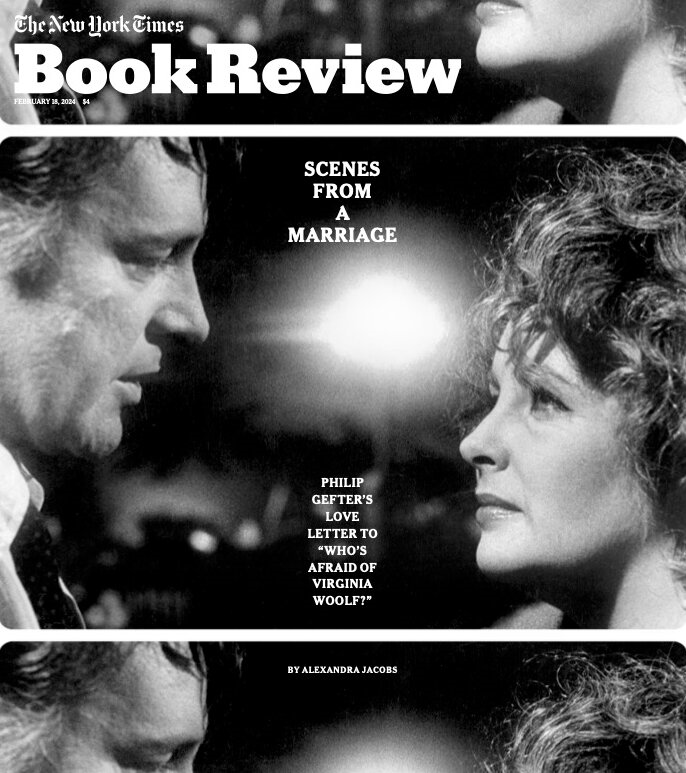
THE NEW YORK TIMES BOOK REVIEW (February 16, 2024): The latest issue features ‘Philip Gefter’s sizzling, “unapologetically obsessive” new book, “Cocktails With George and Martha: Movies, Marriage and the Making of ‘Who’s Afraid of Virginia Woolf?’” Our critic Alexandra Jacobs calls it “a shot glass filled with one work that, alongside contemporaneous books like Richard Yates’s novel ‘Revolutionary Road’ and Betty Friedan’s polemic ‘The Feminine Mystique,’ showed how the ‘cartoon versions of marriage’ long served up by American popular culture always came with a secret side of bitters.”
With Burton and Taylor as stars and a writer and director feuding, adapting the scabrous play wasn’t easy. “Cocktails With George and Martha” pours out the details.
‘Neighbors’ Opens the Door to a Literary Career Cut Short
A story collection from Diane Oliver, who died at 22, locates the strength in Black families surviving their separate but equal surroundings.
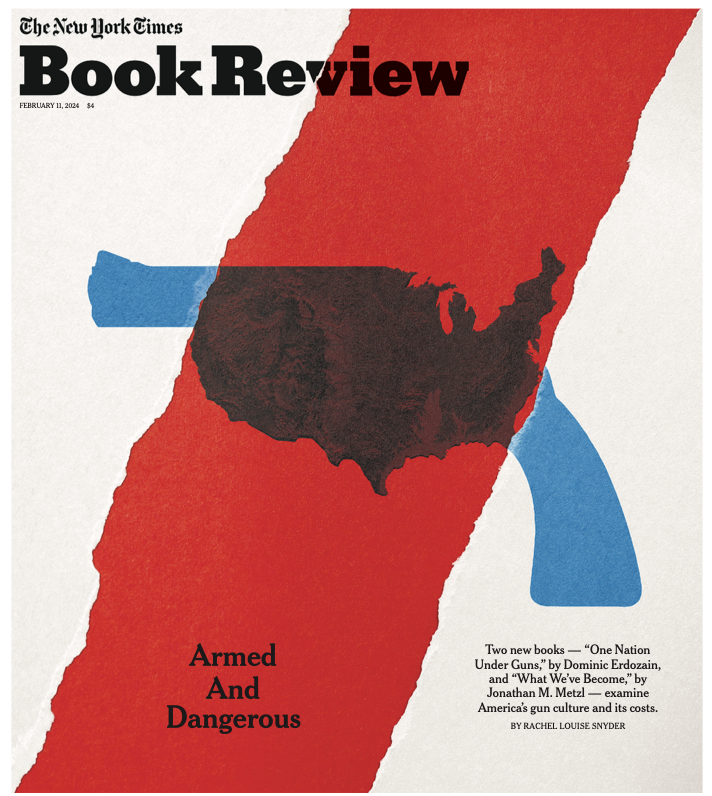
THE NEW YORK TIMES BOOK REVIEW (February 9, 2024): The latest issue features ‘Armed And Dangerous’ – Two new books – “One Nation Under Guns”, by Dominic Erdozain, and “What We’ve Become”, by Jonathan M. Metzl – examine America’s gun culture and its costs…
Two new books consider how the country’s obsession with firearms has become an existential threat.
By Rachel Louise Snyder
ONE NATION UNDER GUNS: How Gun Culture Distorts Our History and Threatens Our Democracy, by Dominic Erdozain
WHAT WE’VE BECOME: Living and Dying in a Country of Arms, by Jonathan M. Metzl
Last year, a friend from Brunei visited me in the United States. She is American but was raised in Sudan and has lived in Cambodia and Scotland, among other places. We were talking about the rise in anxiety among teenagers in America when another friend texted me; her daughter had just arrived home from school, where she’d spent the afternoon in lockdown. “Of course your kids have anxiety,” my Brunei friend said. “They’re being raised in a war zone.”
In Margot Livesey’s new novel, “The Road From Belhaven,” a 19th-century farm girl’s life and maturity are complicated by her uncontrollable visions of accident and disaster.
By Daisy Lafarge
Lizzie Craig has a gift: She sees “pictures” of events before they take place. It happens first when she’s 10, with a vision in which her grandfather’s scythe slips from a whetstone and injures his leg. It’s the tail end of the 19th century in Fife, rural Scotland, where Lizzie is brought up by her grandparents on Belhaven Farm. Her pictures, more often than not, are premonitions of accidents and disasters: a hurt leg, a wheel coming off a cart, a tree hit by lightning. They tend to arrive “a few weeks before the accident,” giving Lizzie time to prepare, and sometimes, intervene accordingly.
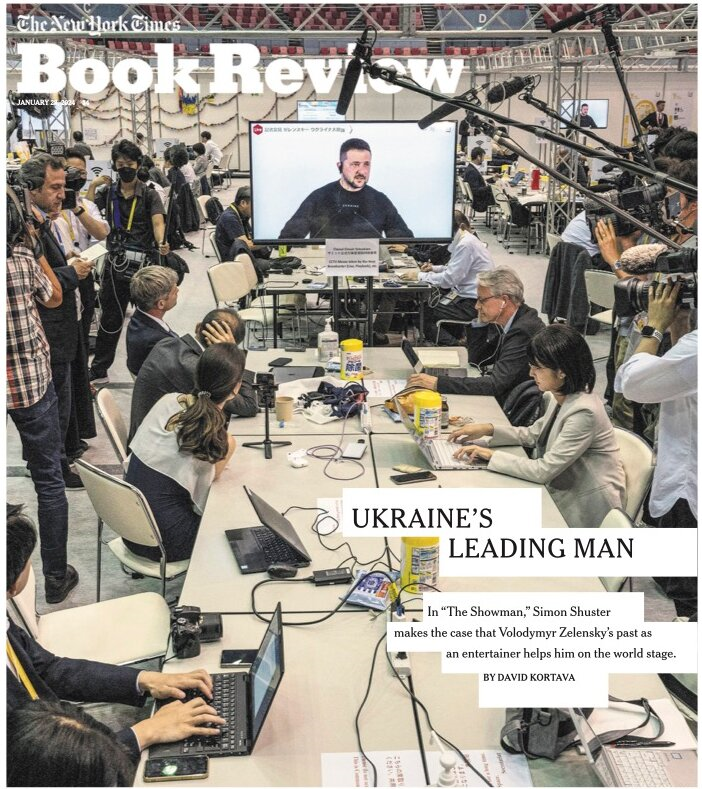
THE NEW YORK TIMES BOOK REVIEW (January 26, 2024): The latest issue features ‘Ukraine’s Leading Man’ – In “The Showman”, Simon Shuster makes the case that Volodymyr Zelensky’s past as an entertainer helps him on the world stage…
In “The Showman,” the journalist Simon Shuster trails the entertainer-turned-wartime president as he rallies the world for support.
By David Kortava
THE SHOWMAN: Inside the Invasion That Shook the World and Made a Leader of Volodymyr Zelensky, by Simon Shuster
Nine months into Russia’s full-scale invasion of Ukraine, in 2022, the Time magazine correspondent Simon Shuster caught a ride on a presidential train that few, if any, journalists had seen from the inside. In a private carriage, with the blinds drawn, Volodymyr Zelensky was fueling up on coffee during a trip to the frontline. He’d been reading about Winston Churchill, but with Shuster he’d sooner discuss another key World War II figure: Charlie Chaplin.
“He used the weapon of information during the Second World War to fight against fascism,” Zelensky said. “There were these people, these artists, who helped society. And their influence was often stronger than artillery.”
Mightier — and Meaner — Than the Sword
Emily Cockayne’s “Penning Poison,” a history of anonymous letters, reveals the ways we’ve been torturing one another, verbally, for centuries.
The Rise and Fall and Rise of San Francisco
Two books — “The Longest Minute,” by Matthew J. Davenport, and “Portal,” by John King — examine the City by the Bay’s resiliency from very different angles.
THE NEW YORK TIMES BOOK REVIEW (January 19, 2024): The latest issue features the excitement over advance copy reviews of a January novel, Kaveh Akbar’s “Martyr!” …“You’ve got to read this,” one editor said. “One of the most electric novels I’ve read in a long while,” another said. This kind of thing — everyone thrilled by the same book — is unusual at the TBR, and explains why “Martyr!,” about a grieving young man’s search for meaning, graces our cover this week.
In “Martyr!,” the poet Kaveh Akbar turns a grieving young man’s search for meaning into a piercing family saga.
Martyr!, by Kaveh Akbar
Reviewed by By Junot Díaz
Cyrus Shams, the aching protagonist at the heart of Kaveh Akbar’s incandescent first novel, is a veritable Rushdiean multitude: an Iranian-born American, a “bad” immigrant, a recovering addict, a straight-passing queer, an almost-30 poet who rarely writes, an orphan, a runner of open mics, an indefatigable logophile, a fiery wit, a self-pitying malcontent. But above all else Cyrus is sad; profoundly, inconsolably, suicidally sad.
Here are the books discussed in this week’s episode:
“Knife,” by Salman Rushdie
“James,” by Percival Everett
“The Book of Love,” by Kelly Link
“Martyr,” by Kaveh Akbar
“The Demon of Unrest,” by Erik Larson
“The Hunter,” by Tana French
“Wandering Stars,” by Tommy Orange
“Anita de Monte Laughs Last,” by Xochitl Gonzalez
“Splinters,” by Leslie Jamison
“Neighbors and Other Stories,” by Diane Oliver
“Funny Story,” by Emily Henry
“Table for Two,” by Amor Towles
“Grief Is for People,” by Sloane Crosley
“One Way Back: A Memoir,” by Christine Blasey Ford
“The House of Hidden Meanings: A Memoir,” by RuPaul
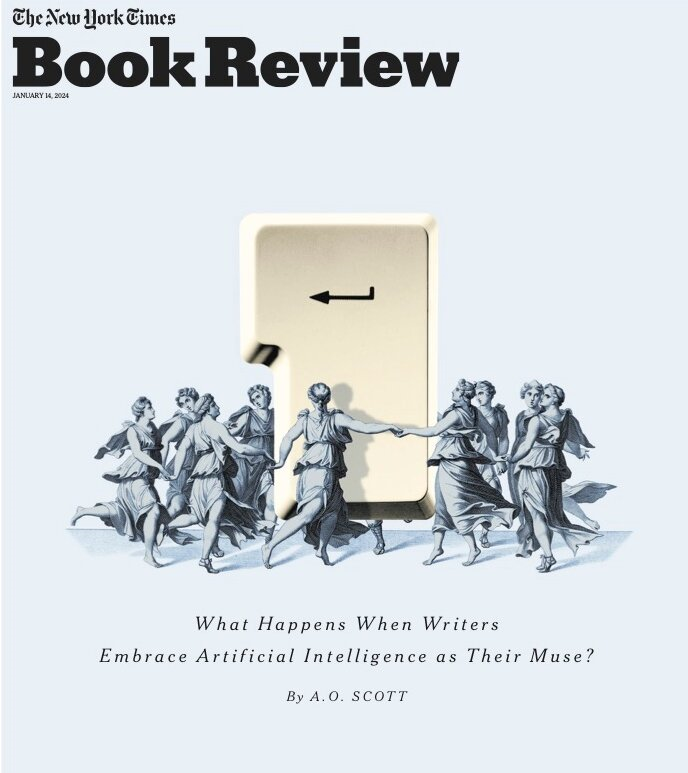
THE NEW YORK TIMES BOOK REVIEW (January 12, 2024): The latest issue features ‘What Happens When Writers Embrace Artificial Intelligence as Their Muse? by A.O. Scott…
The robots of literature and movies usually present either an existential danger or an erotic frisson. Those who don’t follow in the melancholy footsteps of Frankenstein’s misunderstood monster march in line with the murderous HAL 9000 from “2001: A Space Odyssey,” unless they echo the siren songs of sexualized androids like the ones played by Sean Young in “Blade Runner” and Alicia Vikander in “Ex Machina.”
We fantasize that A.I. programs will seduce us or wipe us out, enslave us or make us feel unsure of our own humanity. Trained by such narratives, whether we find them in “Terminator” movies or in novels by Nobel laureates, we brace ourselves for a future populated by all kinds of smart, possibly sentient machines that will disrupt our most cherished notions of what it means to be human.
For Álvaro Enrigue, a novelist fascinated with historical detail, the first meeting of the Aztecs and Spanish conquistadors is the obsession of a lifetime. He brings it to life in “You Dreamed of Empires.”
By Benjamin P. Russell
The Aug. 13, 2021 edition of The New York Times failed to mention the 500th anniversary of the fall of Tenochtitlan, the erstwhile Aztec capital out of which Mexico City was born. Álvaro Enrigue noticed. Of course.
The 54-year-old Enrigue, who grew up in Mexico City, believes that early meeting between Europe and the Americas changed the trajectory of global commerce, urbanism, industry and much else besides. Modernity itself, he argues, was born in the moment the Aztec emperor Moctezuma and Hernan Cortés, the Spanish conquistador, first looked each other in the eye in 1519, a clash of empires that set in motion the city’s capture two years later.
THE NEW YORK TIMES BOOK REVIEW (January 5): The latest issue features ‘Read This And Learn’ – For decades, Juan Rulfo’s novel, “Pedro Páramo,” has cast an uncanny spell on writers. A new translation may bring it broader appeal.
For decades, Juan Rulfo’s novel, “Pedro Páramo,” has cast an uncanny spell on writers. A new translation may bring it broader appeal.
By Valeria Luiselli
Readers of Latin American literature may have heard one of the many versions of this story:
It is 1961 and Gabriel García Márquez has just arrived in Mexico City, penniless but full of literary ambition, trying desperately to work on a new novel. One day, he is sitting in the legendary Café La Habana, where Fidel Castro and Che Guevara were said to have plotted the Cuban Revolution. Julio Cortázar walks in, carrying a copy of Juan Rulfo’s novel “Pedro Páramo.” With a swift gesture, as if he’s dealing cards, Cortázar throws the book on García Márquez’s table. “Tenga, pa que aprenda,” he says. “Read this and learn.”
Early in 1935, a blizzard blew through New York City. The storm was so fierce, it virtually emptied Central Park. But Willa Cather spent her morning there, sledding with the violin prodigy Yehudi Menuhin and his sisters.
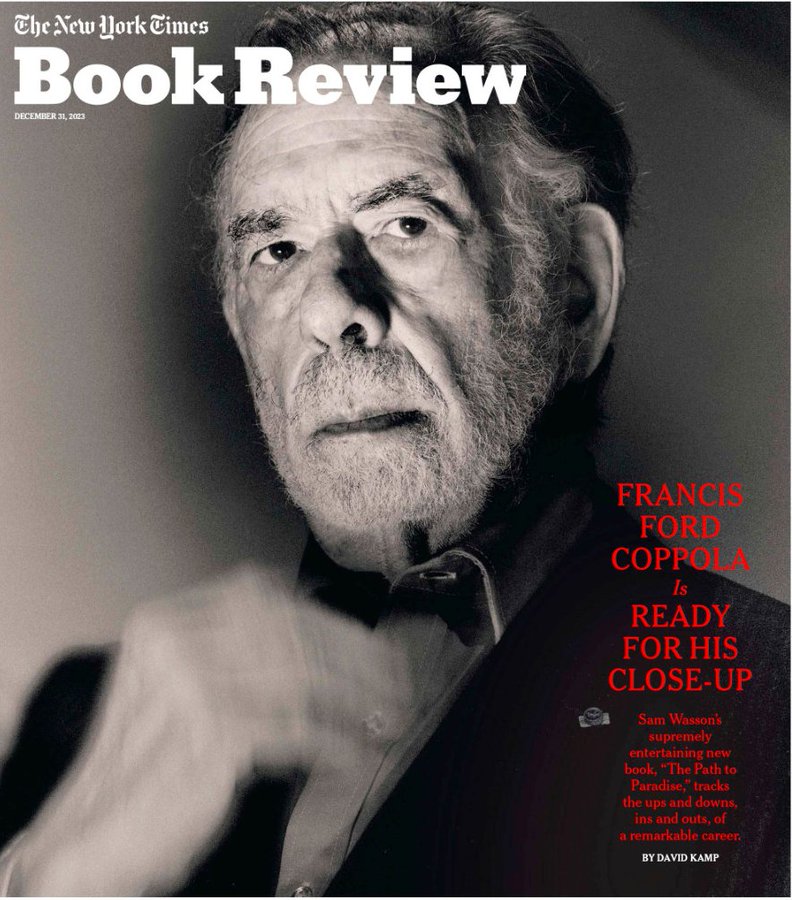
THE NEW YORK TIMES BOOK REVIEW (December 31, 2023): The latest issue features Francis Ford Coppola Is Ready For His Close-Up – Sam Wasson’s supremely entertaining new book, “The Path to Paradise”, tracks the ups and downs, ins and outs, of a remarkable career.
When the billionaire entrepreneur Elon Musk sat down for his profanity-laced interview at The New York Times’s DealBook Summit in late November, his petulant dropping of F-bombs received a lot of attention. Less noticed but far more revealing was his evident disdain for a humble word beginning with the letter T. “You could not trust me,” Musk said, affecting an air of tough-guy indifference in his shearling-collared flight jacket and shiny black boots. “It is irrelevant. The rocket track record speaks for itself.”
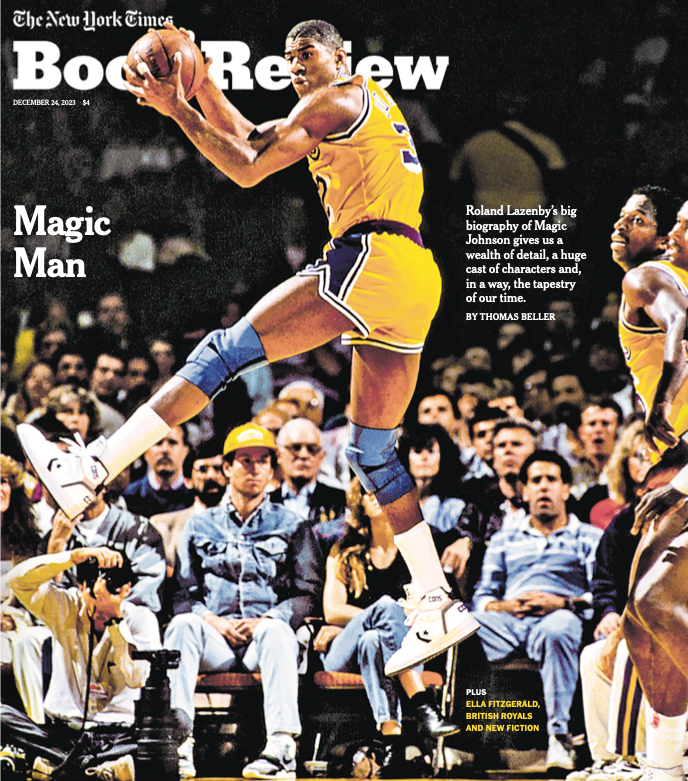
THE NEW YORK TIMES BOOK REVIEW (December 22, 2023): The latest issue features MAGIC: The Life of Earvin “Magic” Johnson, by Roland Lazenby; My Jewish Charlie Brown Christmas – The Peanuts special is the most overtly Christian TV holiday classic. So why does it speak to me so deeply?; Seven Fishes (Not Seven Dishes) for Christmas Eve – A modern Italian American take on the Feast of the Seven Fishes offers a streamlined menu any family can pull off….
Roland Lazenby’s big biography of Magic Johnson gives us a wealth of detail, a huge cast of characters and, in a way, the tapestry of our time.
By Thomas Beller
MAGIC: The Life of Earvin “Magic” Johnson, by Roland Lazenby
I once asked a portrait photographer why no one ever smiled in her pictures, and she replied, “A smile is a mask.”
I thought of this aphorism as I read Roland Lazenby’s 800-page biography of Magic Johnson. Sports Illustrated declared his smile to be one of the two greatest smiles of the 20th century. (The other was Louis Armstrong’s.) As Missy Fox, the daughter of his high school coach, says in the book, “That is the one thing he’s always had, that smile.”
My Jewish Charlie Brown Christmas
The Peanuts special is the most overtly Christian TV holiday classic. So why does it speak to me so deeply?
“A Charlie Brown Christmas” was a one-of-a-kind wonder when it premiered in 1965 and remains so almost 60 years later. Unlike the other jingle-belled baubles that TV throws down the chimney each year, it is melancholy and meditative. The animation is minimalist and subdued, full of grays and wafting snowflakes. I could wrap myself in the Vince Guaraldi jazz score like a quilt.
And then there’s the speech.
News, Views and Reviews For The Intellectually Curious
















 Boomers Daily