Tag Archives: The Guardian Weekly

Politics: The Guardian Weekly – January 5, 2024

Image

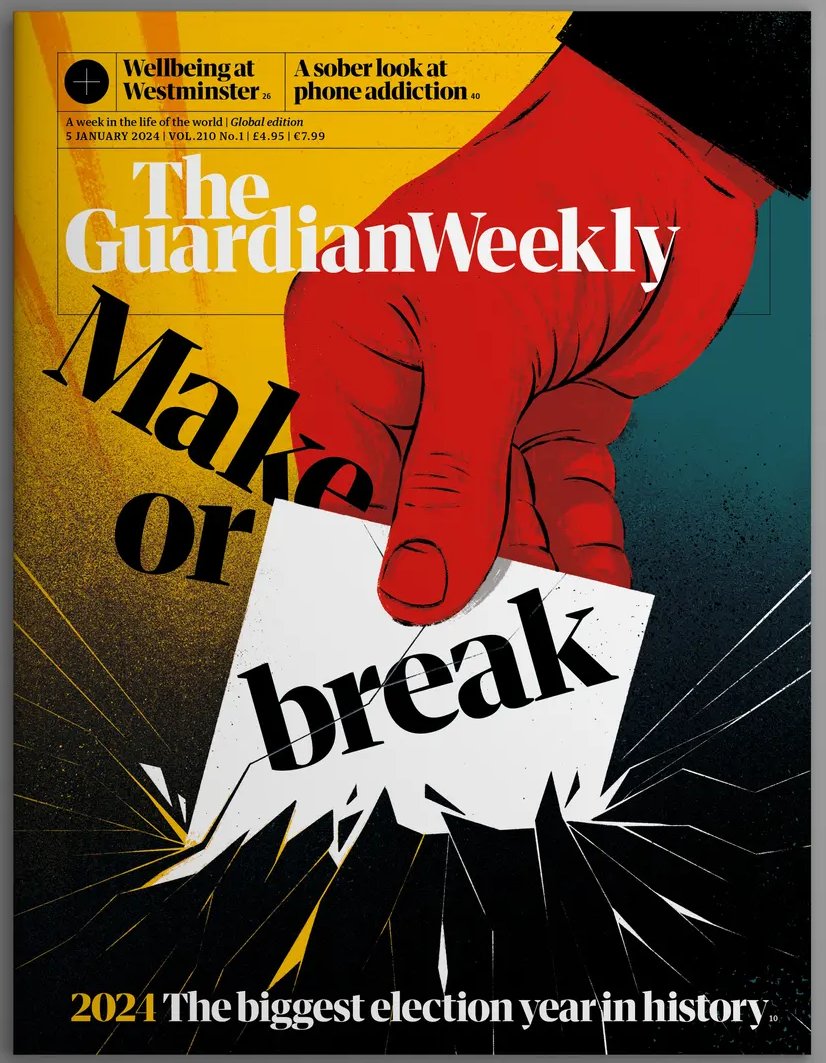
The Guardian Weekly (January 4, 2024) – The new issue features ‘Make or Break 2024’ – The biggest election year in history.

About 2 billion people have the opportunity to cast their ballots in polls that span the globe from the United States to Taiwan, and India to Mexico in 2024. The outcomes, as our analysts and correspondents explain in our big story, have implications for us all.

Washington bureau chief David Smith looks at the likely rerun of 2020’s Biden v Trump contest in November and explores what has changed and what has not in the US as the old adversaries square up. It is an almost foregone conclusion that Narendra Modi will be back for a third term as Indian prime minster, reports Hannah Ellis-Petersen from Delhi where analysts fear his victory will further imperil the country’s Muslim minority. And while Vladimir Putin will certainly continue as president in Russia, Pjotr Sauer explains why the man about to become fifth-time president might allow other candidates onto the ballot list. From Taiwan’s poll on 13 January to the 27-state European elections in June, how citizens vote will influence the geopolitical landscape for us all, while the conduct of campaigns will reveal how vulnerable democracies now are to misinformation and cyber interference from malign actors.

Politics: The Guardian Weekly – December 22, 2023

Image

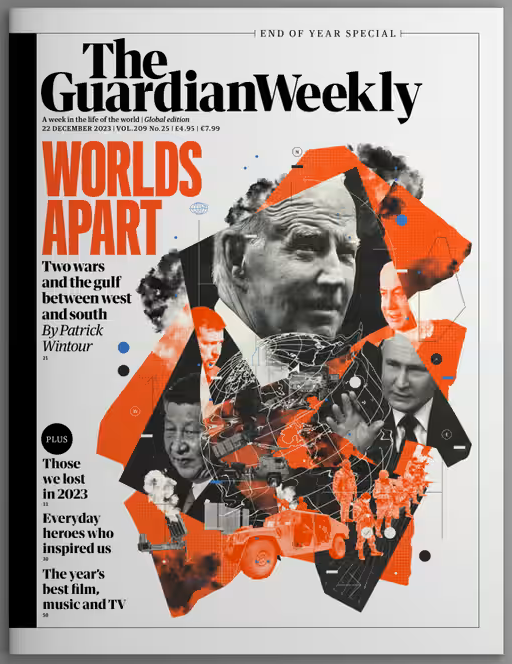
The Guardian Weekly (December 20, 2023) – The new issue features Two wars and a growing divide between the global west and south. Plus: Best culture of 2023.

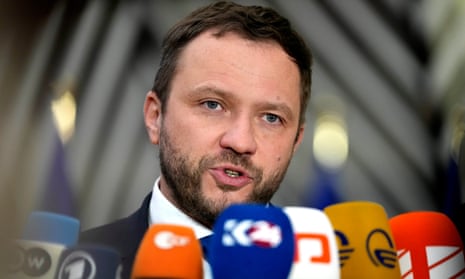
World risks new age of empires where might makes right, warns Estonian foreign minister

Margus Tsahkna

International institutions seem powerless in face of Russia’s invasion of Ukraine, writes Margus Tsahkna, arguing they ‘cannot survive unchanged’

The international rules-based system needs urgent and fundamental change if it is not to collapse, the Estonian foreign minister has said, calling for “a new global conversation” to begin on how to reform the UN and the international criminal court.

Writing in the Guardian on Wednesday, Margus Tsahkna says Russia’s invasion of Ukraine has highlighted flaws in the system that risk fatally undermining people’s faith in it.

_______________________________

Elsewhere, we shouldn’t forget there are plenty of reasons for hope. Having been expected to deliver little, the Cop28 climate summit turned out to be full of surprises – but was the final deal on fossil fuels just a ruse, asks environment editor Fiona Harvey.

Writers from the Guardian’s global development team reflect on the inspirational figures they met in 2023, from leaders to dancers to dads, who proved that humanity still has much to give. And leading conservationists and scientists tell us about the mysteries of the planet they wish they better understood.

The review of 2023 continues with the Observer’s selection of those we lost, recalled with affection by their friends. There’s also a dazzling range of images courtesy of the Guardian agency photographers of the year.

Last but not least, the Guardian critics’ top 10 rundowns of the best film and music of 2023, topped off with the Guardian Weekly team’s now-legendary television selections of the year.

Politics: The Guardian Weekly – December 1, 2023

Image

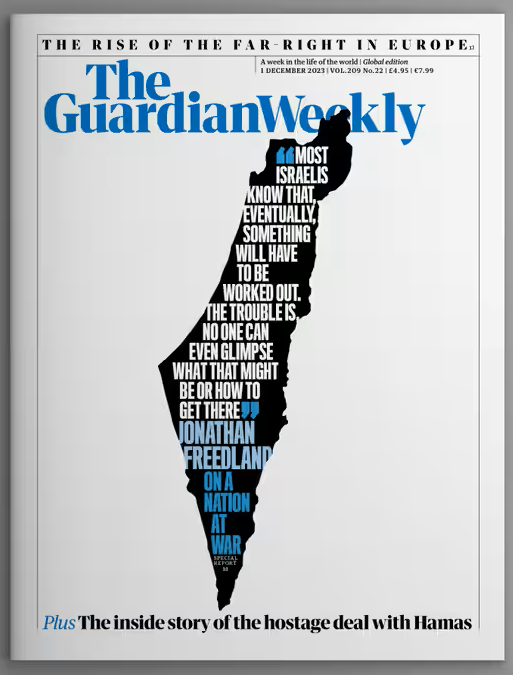
The Guardian Weekly (November 29, 2023) – The new issue features the ceasefire between Israel and Hamas may have been weeks in the making – as detailed this week by Julian Borger and Ruth Michaelson – and led to the release of dozens of hostages on either side, but behind the scenes there was little expectation that it would lead to a longer-term pause in hostilities.

In a special report, almost two months after the deadliest attack on Israel in its 75-year history and as the world focuses on its retaliatory bombardment of Gaza that has seen around 14,000 people killed, Jonathan Freedland finds a country still convulsed with rage and sorrow, unable to see the pain of its Palestinian neighbours as it faces an uncertain future. As one senior Israeli military figure remarked: “It’s not yet post-traumatic stress disorder. We’re still in it.”

The far-right politician Geert Wilders stunned onlookers by finishing well ahead of the field in the Dutch election last week. But race riots in Ireland, a country previously thought immune to such extremism, were equally shocking. Rory CarrollLisa O’Carroll and Jon Henley report on contrasting manifestations of the rise of the far right across Europe.

Politics: The Guardian Weekly – November 3, 2023

Image

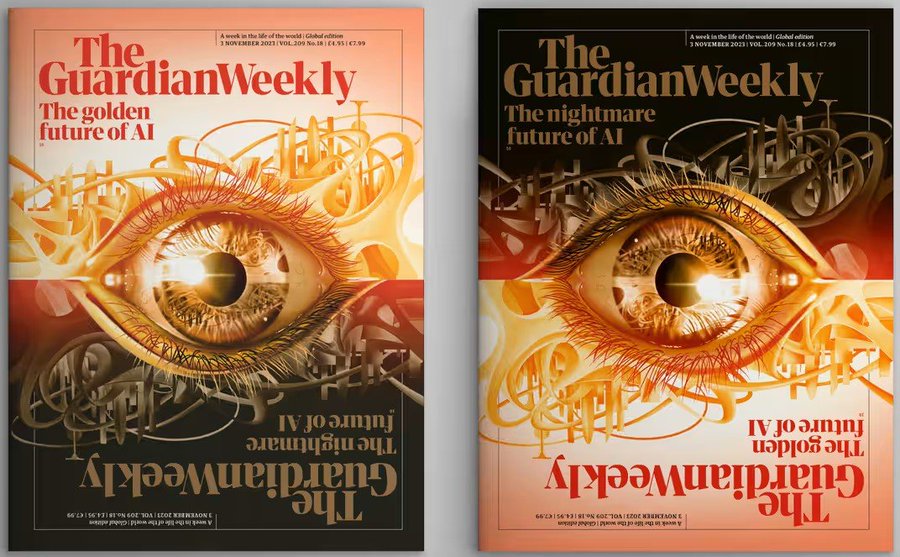
The Guardian Weekly (November 3, 2023) – The new issue features Bletchley Park, the main center of allied second world war codebreakers, and it’s no coincidence that the English country house was chosen as the venue for this week’s landmark summit on safety in artificial intelligence. The age of AI brings opportunities but also significant risks, as a number of experts in the field outlined in an open letter last week.

Global technology editor Dan Milmo discusses the pros and cons with one of the technology’s leading thinkers, Demis Hassabis, the CEO of Google DeepMind, who says the rise of AI must be thought of as seriously as the climate crisis. Then, Observer columnist Sonia Sodha argues that calling for AI to be reined in is not simply a sign of luddism.

As Israeli forces entered Gaza this week, Bethan McKernan and Rory Carroll report for us on the increasingly unbearable nature of life in the besieged enclave, and there’s expert analysis and commentary from Julian BorgerPeter Beaumont and Jason Burke.

Politics: The Guardian Weekly – October 27, 2023

Image

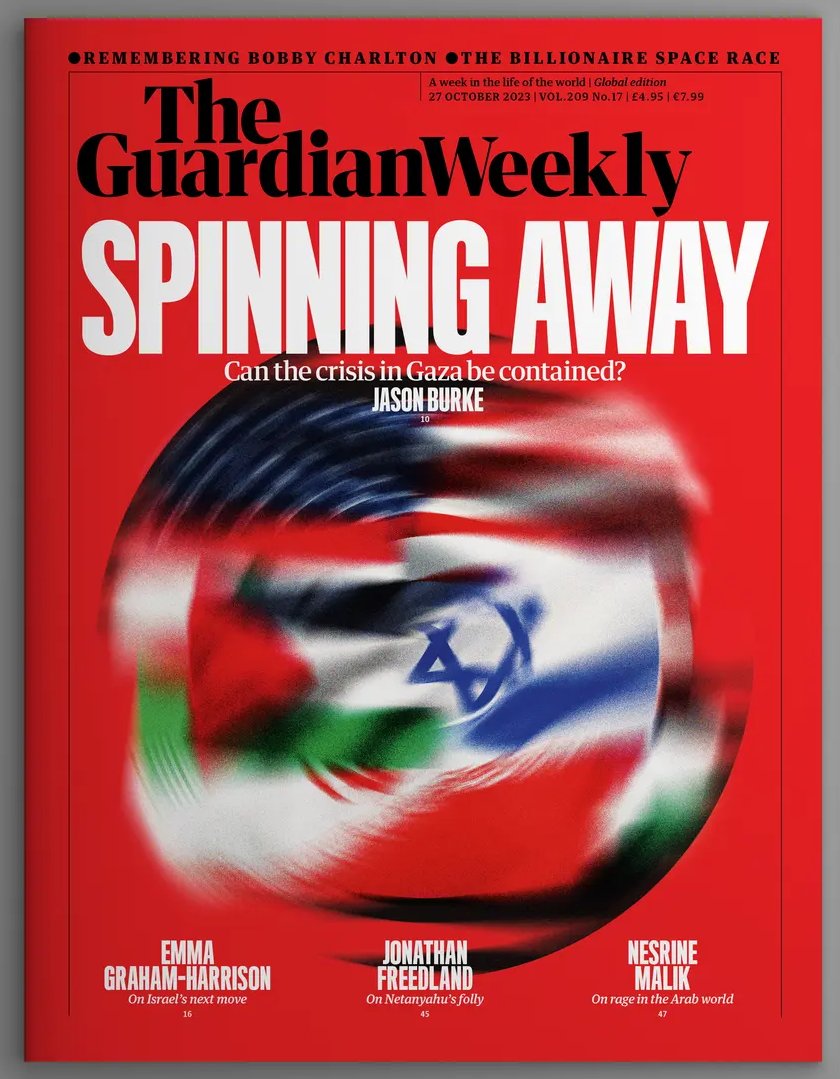
The Guardian Weekly (October 27, 2023) – The new issue features International security corespondent Jason Burke traceing the possible route to a wider war or, in the other direction, to at least a pause in hostilities.

Elsewhere, Ruth Michaelson and Julian Borger hear from terrified Gazans who have been pushed south, while Emma Graham-Harrison, Julian and Ruth consider the likely consequences of a “victorious” Israeli ground offensive.

There’s also a report on rising antisemitism against Jewish people across Europe since the 7 October Hamas terror attack on Israel and the subsequent Israeli bombardment of Gaza. And in the Opinion section, Jonathan Freedland and Nesrine Malik offer powerful perspectives on the conflict.

With much attention ranged on the Middle East, the war in Ukraine has fallen a little from the spotlight. Pjotr Sauer reports from Belgrade, where some young Serbs have been signing up to fight for Russia despite the risk of prosecution at home.

Tributes were paid this week after the death of Sir Bobby Charlton, the former Manchester United and England footballing legend. The Observer’s former football correspondent Paul Wilson remembers a player who became virtually synonymous with the English game.

Politics: The Guardian Weekly – October 20, 2023

Image

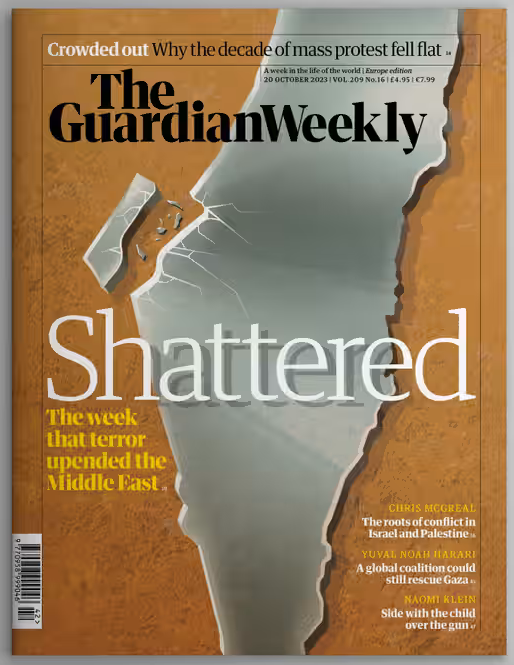
The Guardian Weekly (October 20, 2023) The new issue features escalating events in Israel and Gaza that continue to cause deep distress and alarm, with several thousand people known to be dead or wounded on either side of the border. US president Joe Biden was expected to visit Israel this week, amid growing expectations of a ground invasion of Gaza and fears of a wider regional escalation.

Also, a primer on the historical background to events by Chris McGreal, while on the opinion pages the Israeli author and historian Yuval Noah Harari and Guardian US columnist Naomi Klein provide thoughtful and grounded perspectives.

There was sadness for many Aboriginal Australians after a move to recognise Indigenous people in the country’s constitution was rejected in a referendum, as Sarah Collard and Elias Visontay report. Also from Oceania, Henry Cooke examines what aspects of Jacinda Ardern’s political legacy might survive after New Zealand elected a new conservative government.

From Egypt to Hong Kong, the 2010s were a decade when mass protest movements looked set to change the world. But in most cases, the hope embodied by many massive street demonstrations was soon crushed by authoritarian regimes. Vincent Bevins asks organisers and others who were there where it all went wrong.

Politics: The Guardian Weekly – October 13, 2023

Image

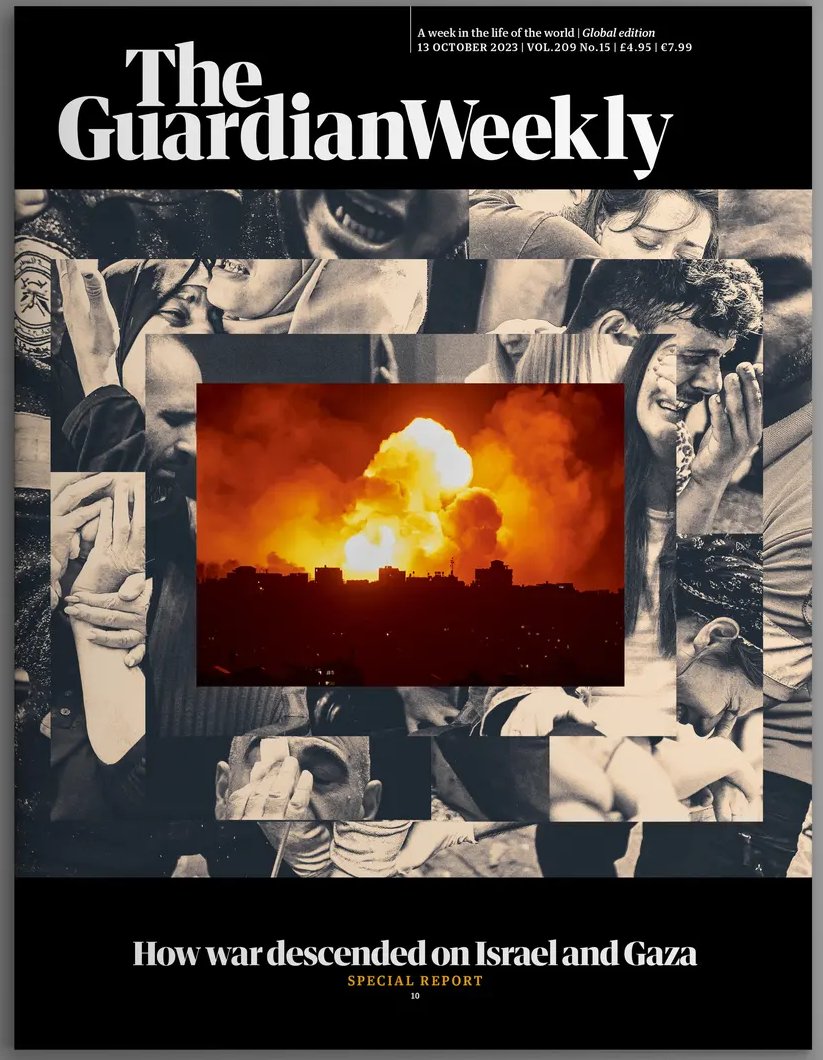
The Guardian Weekly (October 13, 2023) The new issue features Hamas militants’ devastating incursion into Israel  from Gaza resulting in thousands of deaths, provoking a declaration of war and upending the fragile diplomacy of the Middle East.

The swirling composite of images on the magazine’s cover this week tries to encapsulate the human chaos and grief of civilians, both in Israel and Gaza, caught in the chaos of war. The central image shows a vast explosion filling the sky above Gaza City, an ominous portent of many violent acts still to come.

As the region faces its worst conflict for 50 years, Bethan McKernan reports from a kibbutz ransacked by militants and finds shocked residents still struggling to process events. Guardian correspondents Harriet SherwoodPatrick Wintour and Peter Beaumont provide context and analysis, while international affairs commentator Simon Tisdall argues that the ultimate blame lies with Benjamin Netanyahu, Israel’s controversial prime minister.

Ahead of this weekend’s elections in Poland that could give the ruling nationalist Law and Justice (PiS) party an unprecedented third term in office, Shaun Walker goes on the campaign trail with Donald Tusk whose centre-right Civic Coalition is hoping to reverse the country’s slide away from democratic norms. And Brussels correspondent Lisa O’Carroll reports on the EU’s Granada summit where Hungary’s Viktor Orbán accused fellow leaders of attempting to impose a “diktat” with a proposal on a bloc-wide agreement on migration.

With global temperatures for September described as “gobsmackingly bananas” by leading climatologist Zeke Hausfather, our interview with the president of Cop28 could not be more timely. Sultan Al Jaber explains to environment editor Fiona Harvey how he believes he can square his job as the chief of the United Arab Emirates’ national oil company with leading a global conference focused on net zero carbon emissions.

Politics: The Guardian Weekly – Sept 22, 2023

Image

The Guardian Weekly (September 22, 2023) The new issue features How disaster struck Libya. Plus: Populism in Europe, and the unifying power of cheese.

Two separate natural disasters in north Africa have dominated the news recently. But Moroccan emergency responses to an earthquake that killed about 3,000 people seemed rapid and efficient in contrast to the chaos at the deluged Libyan port of Derna, where many thousands more lost their lives after the town was deluged following a double dam burst caused by Storm Daniel.

While logistical and administrative challenges have made access to Derna incredibly difficult, Observer reporter Kaamil Ahmed has gathered the testimonies of several local Libyan journalists who witnessed scenes they are still struggling to process. Diplomatic editor Patrick Wintour explains why the disaster can be seen as a culmination of the climate crisis descending upon a failed state, while Rupert Neate and Peter Beaumont discuss the differing responses to the two situations.

From Europe, Jon Henley previews three upcoming elections that could have profound consequences for the region’s political future. Indeed, as the Guardian launches a new Europe-focused digital edition, editor-in-chief Katharine Viner outlines why now is the right time for us to expand our reporting across the continent.

Politics: The Guardian Weekly – Sept 15, 2023

Image

The Guardian Weekly (September15, 2023) The issue features  Amy Hawkins looking under the lid of China’s economy and asks if it has peaked?

Desperate searches for survivors continued in Morocco’s Atlas mountains after last Friday’s 6.8-magnitude earthquake, which killed thousands of people. Peter Beaumont reports from remote villages devastated by the country’s deadliest quake in six decades.

A worse disaster still appeared to be unfolding further along the north African coast in Libya, where up to 10,000 people were feared missing after flooding caused by the collapse of two dams. Details were only just emerging at the time of the Weekly going to press on Tuesday, but you can find the latest updates here.

First there were the bewildering DNA test results, then the long-forgotten fertility blog. Jenny Kleeman tells the remarkable tale of a discovery that would change the lives of two American families for ever.

Also in Features is American author Elif Batuman’s entertaining account of what happened when she asked the AI chatbot ChatGPT for assistance with a quote from Proust, leading her down a digital rabbit hole she never could have foreseen.

Politics: The Guardian Weekly – September 8, 2023

Image

The Guardian Weekly (September 8, 2023) The issue features Alexandria Ocasio-Cortez’s progressive vision for US politics, graduate jobs market pressured by artificial intelligence, migrants in North Africa Spanish enclave of Melilla, and more…

Alexandria Ocasio-Cortez’s explosive entrance on to the US political scene at the age of 29, as the youngest woman ever to be elected to the House of Representatives, was a beacon of hope for the progressive left during the dark days of the Trump presidency.

Five years on, AOC is established as an influential figure in the Democratic party, known for her advocacy of green policies and efforts to engage marginalised groups. In a wide-ranging interview, she talks to Washington bureau chief David Smith about the climate crisis, misogyny in US politics and the potential – one day – for a presidential run of her own.

For those with an eye farther afield, on the graduate jobs market, Hibaq Farah and Tom Ambrose consider the future careers most likely to withstand the coming onslaught of artificial intelligence.

In Features, Matthew Bremner’s investigation into the massacre of migrants in the north African Spanish enclave of Melilla is a sobering but important read. Jay Owens changes the pace somewhat with an exploration of dust, and what it reveals about the world around us.