Tag Archives: The Guardian Weekly

Politics: The Guardian Weekly – June 14, 2024

Image

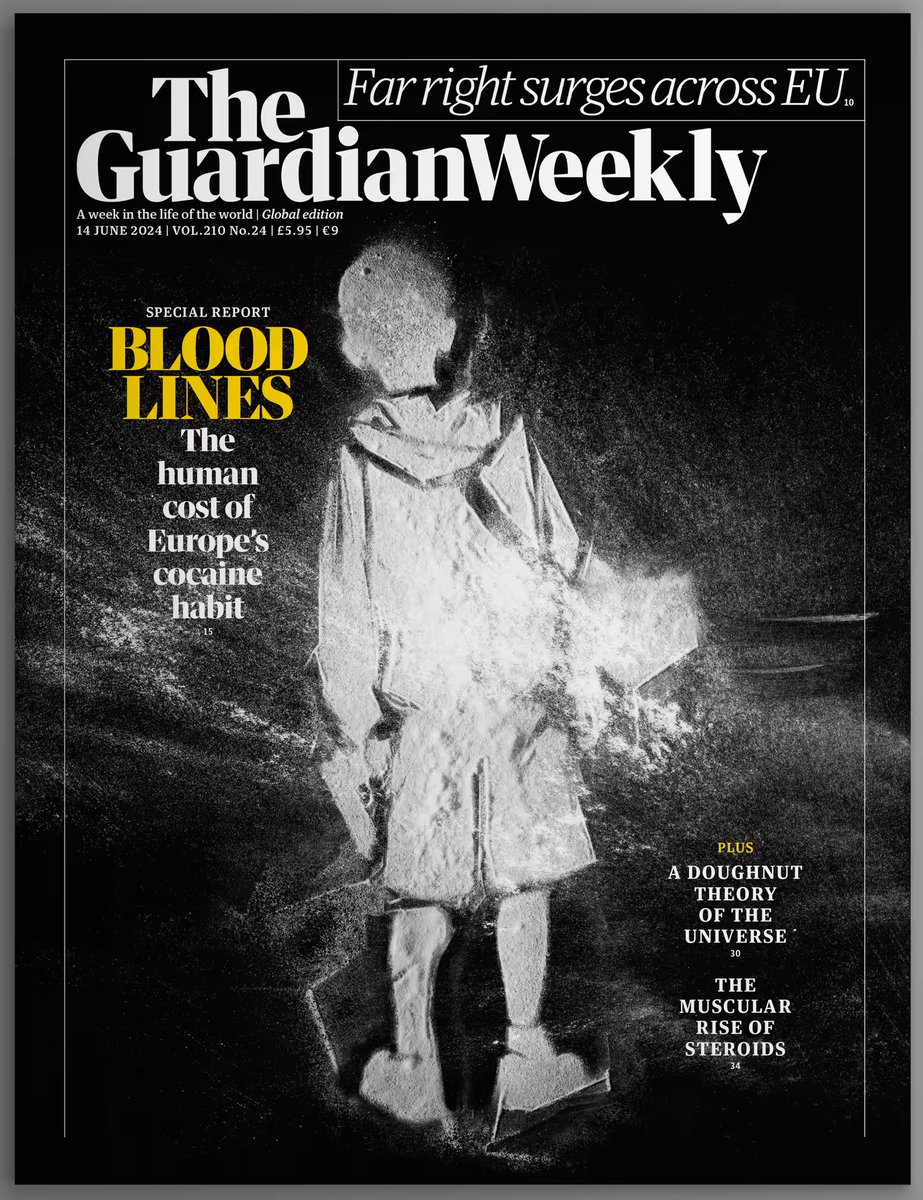
The Guardian Weekly (June 13, 2024) – The new issue features ‘Blood Lines’ – The human cost of Europe’s cocaine habit’; The Far Rights surges across EU; A doughnut theory of the universe; The muscular rise of steroids…

In a week when much of the attention in Europe was on far-right political gains in the parliamentary elections, the Guardian Weekly’s cover shines a light on another of the continent’s disturbing undercurrents.

A Guardian investigation has found that hundreds of unaccompanied child migrants across Europe are being forced to work for increasingly powerful drug cartels to meet the continent’s soaring appetite for cocaine.

In cities including Paris and Brussels, gangs are exploiting the “unlimited” supply of vulnerable African children at their disposal, using brutal means to control their victims, including torture and rape if they fail to sell enough drugs, as they seek to expand Europe’s $13bn cocaine market.

Mark Townsend reveals the plight of the illegal trade’s child foot soldiers, while Annie Kelly explains the growing problem of cocaine use in Europe. And from Ecuador, Tom Phillips reports on how death and destruction follow the drug on its complex journey across the Atlantic.

Politics: The Guardian Weekly – May 10, 2024

The Guardian Weekly (May 8, 2024) – The new issue features ‘Nowhere to call home’ – Inside Europe’s housing crisis…

Elections for the European parliament are less than a month away and far-right parties are predicted to make significant gains in many of the bloc’s 27 member states. The dire shortage of housing, leading to rising rents and property prices, is becoming a unifying focus for voters’ discontent with their current political leaders.

The issue has sparked protests from Amsterdam to Prague and Milan, as the Guardian’s Europe correspondent, Jon Henley, reports. The data is undeniably worrying as young Europeans spend up to 10 times an average salary on rent and mortgage payments, and big cities from the Baltic states to the Iberian peninsula have registered average property price rises of close to 50%. As a result more EU residents live with their parents for longer and put off life-decisions later into adulthood.

While housing does not fall within MEPs’ remit, it is a visible locus for the sense of social unease that has beset the whole bloc and has become a pivot for the far right to turn on racialised minorities. But as European community affairs correspondent Ashifa Kassam discovers, it is those communities that are doubly penalised through discrimination from landlords who, research has shown, turn away potential renters with “foreign” surnames. The political and social ramifications of the housing crisis in Europe is mirrored elsewhere across the globe and is a subject we will return to in the Guardian Weekly in this year of elections.

Politics: The Guardian Weekly – April 5, 2024

Image

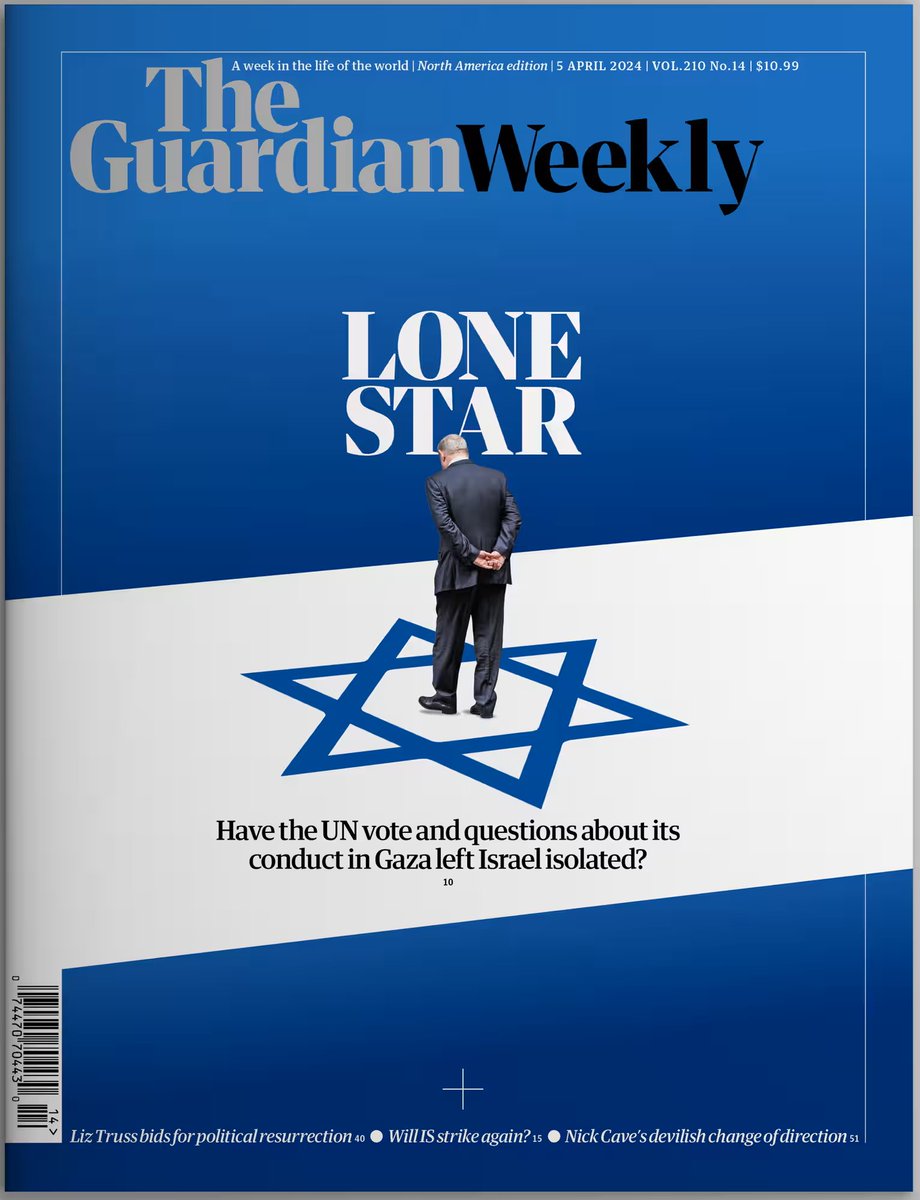
The Guardian Weekly (April 5, 2024) – The new issue features ‘Lone Star’ – Have the UN vote and questions about its conduct in Gaza left Israel isolated?; Liz Truss bids for political resurrection; Will IS strike again?; Nick Cave’s devilish change of direction…

Spotlight | IS affiliates could launch new wave of terror on the west

Islamic State has stalled in Iraq and Syria but officials believe it has been planning new attacks on the west for years, reports Jason Burke; while Angelique Chrisafis writes that France’s interior minister has met intelligence services to assess the terrorist threat to the country ahead of this summer’s Olympic Games

Environment | True cost of a city built from scratch

Nusantara is billed as a state-of-the-art capital city that will coexist with nature – but not all residents of Borneo’s Balikpapan Bay are happy, find. By Rebecca Ratcliffe and Richaldo Hariandja

Feature | 49 days later

Liz Truss trashed the economy as Britain’s shortest-serving prime minister. But she is back, launching a new conservative movement and spreading her ideology across the world. You just can’t keep a bad politician down, argues David Runciman

Culture | The devil in the details

In the past nine years, Nick Cave has lost two sons – an experience he explores in a deeply personal new ceramics project. He discusses mercy, forgiveness, making and meaning with Simon Hattenstone

Architecture | A Māori-built environment

A new wave of Indigenous architects are behind a series of stunning buildings embracing tribal identity in Aotearoa New Zealand, Oliver Wainwright discovers

Politics: The Guardian Weekly – March 8, 2024

Image

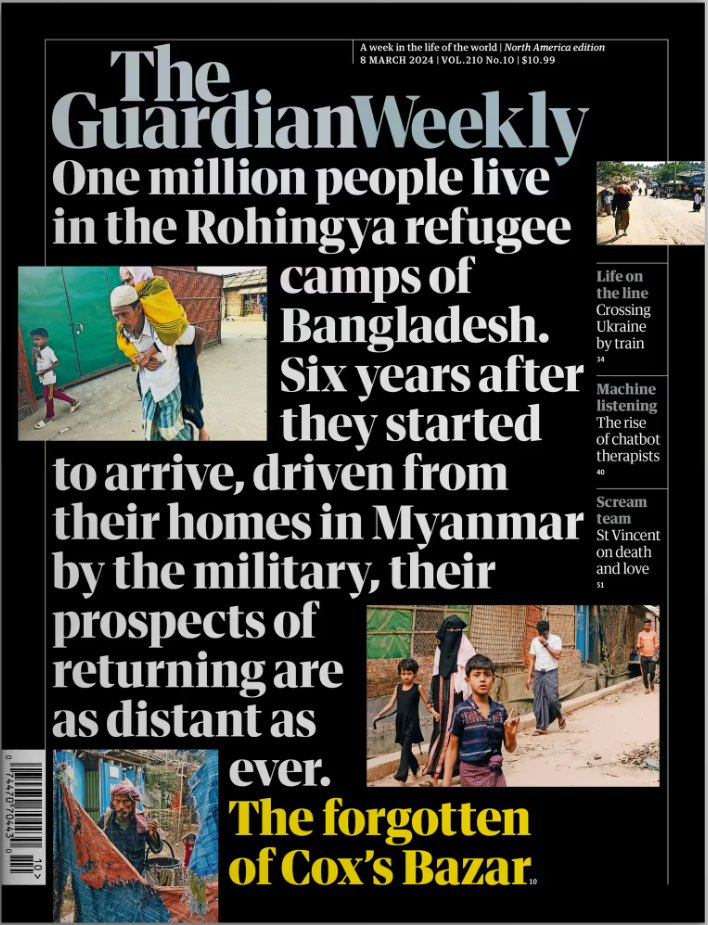
The Guardian Weekly (March 7, 2024) – The new issue features Faint hope of return for Rohingya people. Plus: a journey through Ukraine

It was August 2017 when the world really started to take note of Myanmar’s Rohingya people. Descendants of Arab Muslims who speak a different language to most other people in Myanmar, the Rohingya had up to that point lived mainly in the northern Rakhine state, coexisting uneasily alongside the majority Buddhist population.

But the Rohingya were reviled by many as illegal immigrants and treated by the then government as stateless people. In 2017, when violence broke out in the north of the state, security forces supported by Buddhist militia launched a “clearance operation” that forced more than 1 million Rohingya people to flee their homes and the country, actions that many onlookers saw as ethnic cleansing. Most Rohingya were driven into vast refugee camps in the Cox’s Bazar region of Bangladesh, where they have remained ever since.

The Guardian global development reporter Kaamil Ahmed has been covering the Rohingya crisis for almost a decade, making multiple trips to the region. For this week’s Big Story, Kaamil returned to Cox’s Bazar where, in two moving reports, he details how disease and illness are widespread in the ramshackle camps, and how the desperation to escape has resulted in rich business for people traffickers.

And, with Myanmar now controlled by a military junta and introducing a deeply unpopular conscription drive (as Rebecca Ratcliffe and Aung Naing Soe report), the prospect of any Rohingya people being able to return home to Rakhine state remains as distant as it did in 2017.

Politics: The Guardian Weekly – February 23, 2024

Image

The Guardian Weekly (February 22, 2024) – The new issue features ‘Ukraine’s Lonely Road’ – After two years, is there a way out of Putin’s war?…

Shaun Walker reports on this week’s big story, the fall of the strategic town of Avdiivka to Russian troops has come at a grim time for Ukraine’s president, Volodymyr Zelenskiy. While the army is struggling to hold ground, war fatigue is setting in among parts of the population and disagreements among the leadership have been spilling into the open.

At the same time, the death of the jailed Russian critic Alexei Navalny last week – widely seen as another political assassination – appears to emphasise the strengthening hand of Vladimir Putin, who is expected to secure another six-year term as Russia’s president in tightly controlled elections next month. Amid a familiar wave of international outrage, our Russia affairs reporter Pjotr Sauer asks what Putin might do next.

Coupled with the possibility of a Donald Trump victory in the US elections later this year, it all makes for a deeply worrying outlook for Ukraine, reflected in the Kyiv-based illustrator Sergiy Maidukov’s haunting cover artwork for the magazine this week.

“This war is the hardest test of my life, similar to an endless ultramarathon,” writes Sergiy. “It is good to try to not think about the finish when running long distance. This is important knowledge to endure.”

Politics: The Guardian Weekly – February 9, 2024

Image

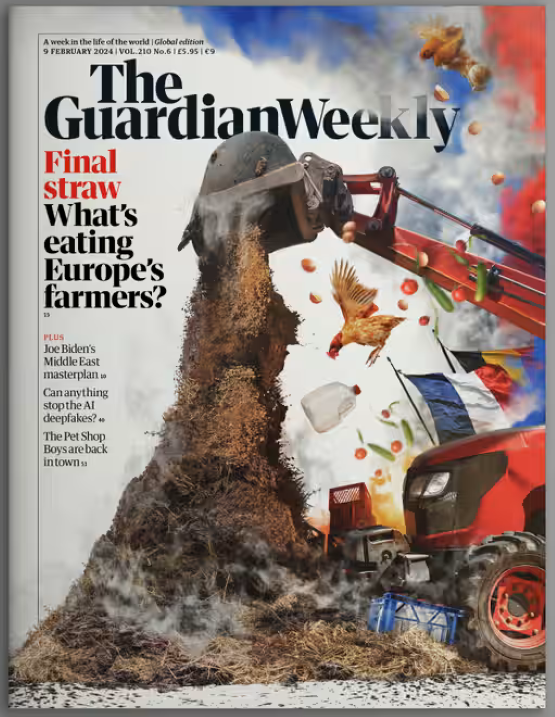
The Guardian Weekly (February 8, 2024) – The new issue features ‘Final Straw’ – What’s eating Europe’s Farmers?; Joe Biden’s Middle East masterplan; Can anything stop the AI deepfakes? and The Pet Shop Boys are back in town…

If you live in France, Germany, Belgium, the Netherlands, Poland or Greece, you may well have already run into one of the numerous roadblocks or protests formed in recent weeks by furious farmers. If you’re in Spain and Italy, take cover – because they are coming to you soon, if not already.

In this week’s cover story, we explore what has proved to be the final straw for Europe’s farmers. A combination of rising costs, environmental rules and grievances over EU policies, coupled with more localised complaints, seem to be the factors driving the convoys of tractors. But far-right and anti-establishment parties, who could make major gains in forthcoming European parliament elections, have also picked up on the protests as part of their agenda against EU influence.

Paris correspondent Angelique Chrisafis and Europe correspondent Jon Henley delve into the protests (if not the piles of steaming dung being dumped on the continent’s roads, as illustrated wonderfully by Neil Jamieson on this week’s cover), and ask what can be done to placate them.

Politics: The Guardian Weekly – February 2, 2024

Image

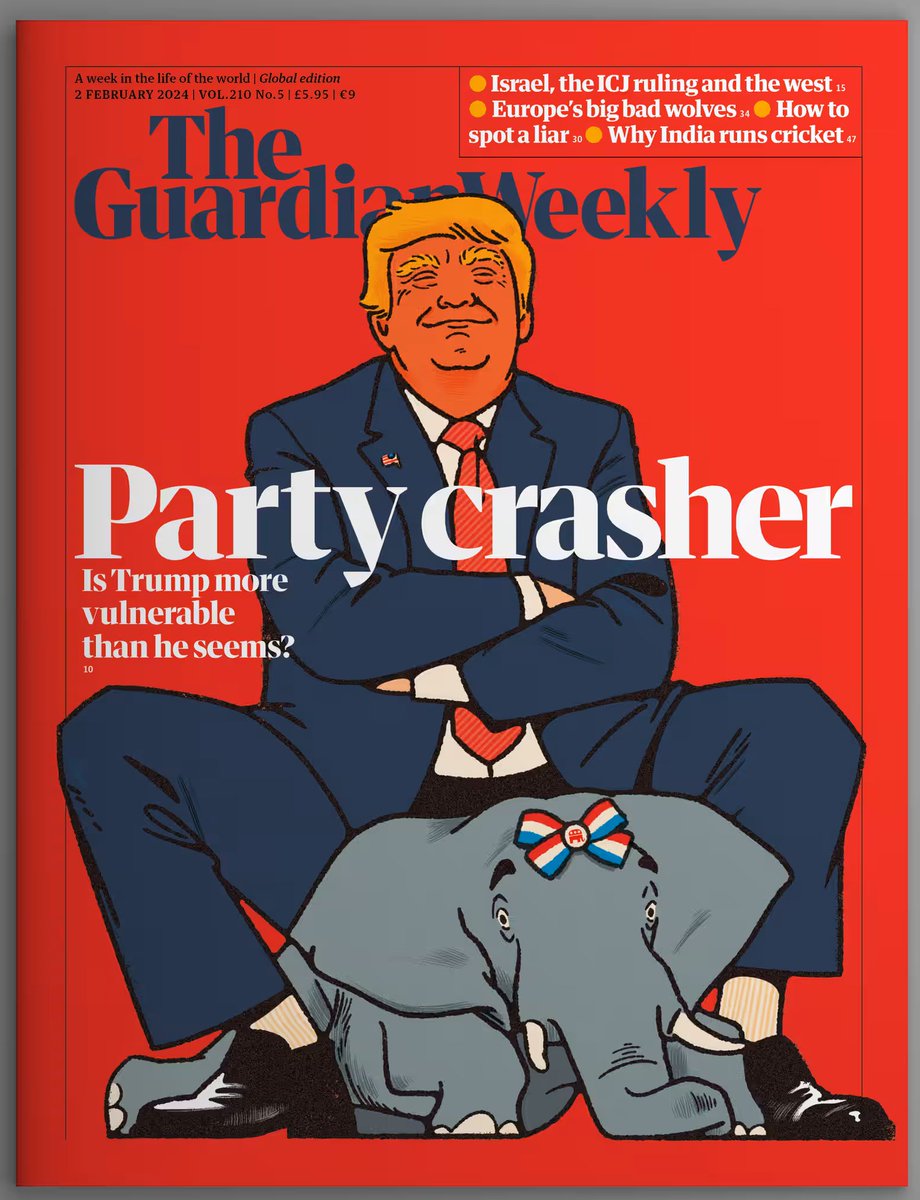
The Guardian Weekly (February 1, 2024) – The new issue features ‘Party Crasher’ – Is Trump more vulnerable than he seems?; Israel, the ICJ ruling and The West; Europe’s Big Bad Wolves and more….

It had all seemed like business as usual for Donald Trump in the aftermath of last week’s New Hampshire Republican primaries, where he scored a comfortable victory over his only remaining challenger, Nikki Haley. And yet … was there something in his subsequent outburst towards Haley that suggested all was not well in Trumpworld?

Barring the mother of all reversals, Trump will soon be confirmed as the Republican presidential nominee. But, as David Smith and Jonathan Freedland outline in this week’s big story, Trump remains a deeply polarising figure in American politics, not least within his own party.

And his petulant irritation at Haley over her refusal to concede the race was a visible reminder to American floating voters of the unhinged personality that lurks beneath the orange veneer, something his campaign team will be desperate to avoid more of.

“The shadow of Trump is long, and his return seems closer than ever,” explains illustrator Alberto Miranda on his cover art for this week’s Guardian Weekly. “He is a controversial figure with a dangerous side and, at the same time, has an utterly comical aspect. That’s why we wanted to portray his influence in the Republican party in an almost grotesque manner.”

Politics: The Guardian Weekly – January 26, 2024

The Guardian Weekly (January 25, 2024) – The new issue features ‘True Colours’ – What the AFD really wants for Germany; The fading hopes for Middle East Peace; Trump’s victory and DeSantis’s doomed campaign…

Events in the Middle East continue to unfold at a bewildering pace, with pockets of conflict opening up across the region. Diplomatic editor Patrick Wintour rounds up a week of flashpoints and assesses increasingly slim hopes for controlling the situation. And Oliver Holmes provides a revealing profile of Yemen, one of the most unchanging and least visited countries in the Middle East.

The Weekly went to press before news of Donald Trump’s victory in the New Hampshire Republican primary on Tuesday night, but you can catch up with all the latest Guardian coverage and reaction here. In the magazine, David Smith delivers a postmortem on Ron DeSantis’s doomed campaign, while Jonathan Freedland argues that Trump’s march to the White House can still be stopped.

Our long-read features take somewhat divergent paths this week. First, Charlotte Edwardes meets Gary Lineker, the former England footballer turned TV presenter whose penchant for regularly airing his liberal worldviews has made him public enemy No 1 for Britain’s anti-woke brigade.

Then, Chananya Groner unearths a remarkable story of factionalism and messianic fervour within New York’s Hasidic Jewish community, stretching back 30 years, which led to secret tunnels recently being discovered beneath a Brooklyn synagogue.

And in Culture, Charlotte Higgins meets the classical musicians Dalia Stasevska and Joshua Bell, who are resurrecting a long-forgotten Ukrainian concerto as a gesture of defiance to Russia.

Finally, we’re on the lookout for your best photographs of the world around us. For a chance for your picture to feature in the magazine, send us your best shot, telling us where you were in the world when you took it and why the scene resonated with you at that particular time.

Politics: The Guardian Weekly – January 19, 2024

Image

The Guardian Weekly (January 18, 2024) – The new issue features ‘State Of Emergency’ – How drug cartels upended Ecuador; Why Houthi anger could spread war; Are aliens already among us?…

Not long ago, Ecuador was chiefly known for its volcanoes, wildlife and eco-tourism. It’s an image that may now need some rehabilitation after chaos and bloodshed sparked by the prison escape last week of Adolfo Macías, the country’s most notorious gang leader and drug lord.

With cartels from Peru and Colombia routinely funnelling narcotics through Ecuador’s ports en route to Europe, Latin America correspondent Tom Phillips reports on a rising problem that threatens to tear apart the once-peaceful Andean state.

In the Middle East, Yemen’s Houthi rebels could stymie the increasingly slim chances of preventing a regional war. With the US and UK bombing Houthi bases in response to attacks on commercial shipping, diplomatic editor Patrick Wintour recounts the Houthis’ rise and why military strikes against them may not lead to the desired outcome.

Politics: The Guardian Weekly – January 11, 2024

Image

The Guardian Weekly (January 10, 2024) – The new issue features ‘Middle East on the brink’ – The threat of a regional war. Also, Inside the Post Office Horizon IT scandal…

The assassination of a Hamas chief in Lebanon. A terror attack on mourners of an Iranian former general. Commercial shipping in the Red Sea targeted by Yemeni rebels, and a US airstrike in Iraq. All were separate events in the Middle East last week but all were linked, in one way or another, to the presence of autonomous but Iranian-backed militia forces in the region.

When asked to visualise the threat of war engulfing the Middle East, for this week’s cover, illustrator Carl Godfrey took a literal approach. “I wanted to convey the tense and unpredictable situation,” says Carl, “and there’s nothing more tense than looking down the barrel of a gun. Especially when those barrels are pointing in all directions, and the risk of war is expanding in all directions.”