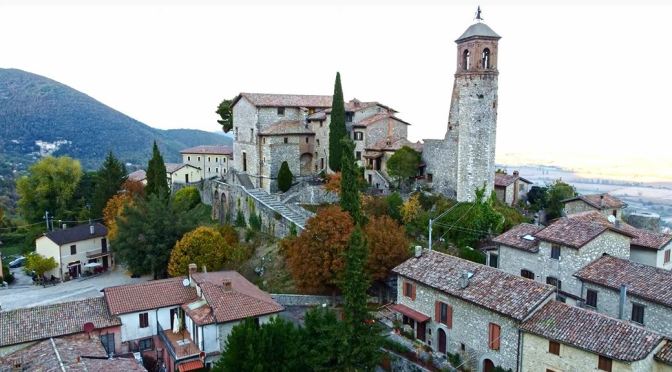
Greccio is an old hilltown and comune of the province of Rieti in the Italian region of Lazio, overhanging the Rieti valley on a spur of the Monti Sabini, a sub-range of the Apennines.
Greccio was founded, according to tradition, by a Greek colony or family, who fled or exiled from their homeland following wars and destruction who fell in love with the amenity of the place and the comfort of natural defense it offered, and settled there. Hence the name Greece, Grece, Grecce and finally Greccio. The first certain information dates back to the 10-11th century. when the fragmentary possessions of the Abbey of Farfa were reunited and the fortification of the curtis proceeded. The Benedictine monk Gregorio da Catino (1062-1133) refers to the locality of Greccio (curte de Greccia) in his work “Regesto Farfense”.
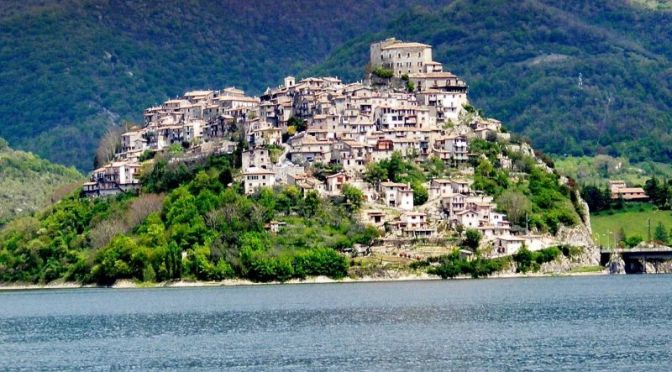
Castel di Tora is a comune in the Province of Rieti in the Italian region Lazio, located about 50 kilometres northeast of Rome and about 20 kilometres southeast of Rieti. Castel di Tora borders the following municipalities: Ascrea, Colle di Tora, Pozzaglia Sabina, Rocca Sinibalda, Varco Sabino.
The first historical evidence of this village dates back to 1035, when in some chronicles there is talk of a Castrum Vetus de Ophiano, and up to 1864 in fact the village had Castelvecchio as its name. The current name was intended to be linked to an ancient Roman settlement called Tora, where in 251 AD. the martyrdom of Santa Anatolia took place. For centuries it was called “Castelvecchio”, a name changed after the unification of Italy in 1864 to that of Castel di Tora, in memory of an ancient Roman Sabine pagus called Thora Thiora. The Abbey of Farfa owned the territory of Castel di Tora. Subsequently the property belonged to the Buzi – Brancaleoni and then to the Mareri, to whom it was confiscated in 1241 by Frederick II of Swabia. In 1440 the fief of Castelvecchio passed to the Orsini and from 1558 to 1570 to the Estouteville and then passed to the Borghese. From this period there remains the testimony of a painting (1601) by the Flemish painter Paul Bril, with a harsh landscape with two castles guarding the gorge formed by the Turano. In the years 1935-38 the Posticciola dam was built and the Turano artificial lake was created which submerged the most fertile soils of the valley, causing a strong emigration of the local population. In recent years, there has been a complete transformation of the local economy, which from agriculture and pastoralism is progressively transforming and moving towards the tertiary sector of trade and tourism.
News, Views and Reviews For The Intellectually Curious

 Boomers Daily