Tag Archives: Research

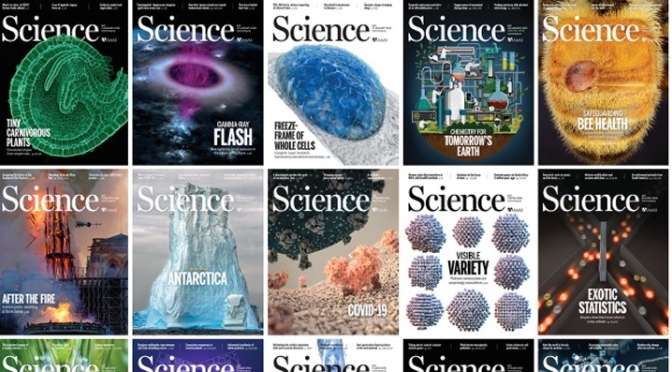
Science Magazine —- January 24, 2025 Preview

Science issue cover

SCIENCE MAGAZINE (January 23, 2025): The latest issue features ‘Maniforld Males’ – Genetic orchestration of breeding morphs in ruffs…

Private fusion firms put bold claims to the test

Amid skepticism, companies bet that speed and innovation can realize fusion’s promise

The parting of water

Green hydrogen is key to decarbonizing the world. But the costly, finicky devices that make it need dramatic improvement

Misreported meals skew nutrition research data

Survey-based studies linking diet patterns to health may be fatally flawed, paper suggests

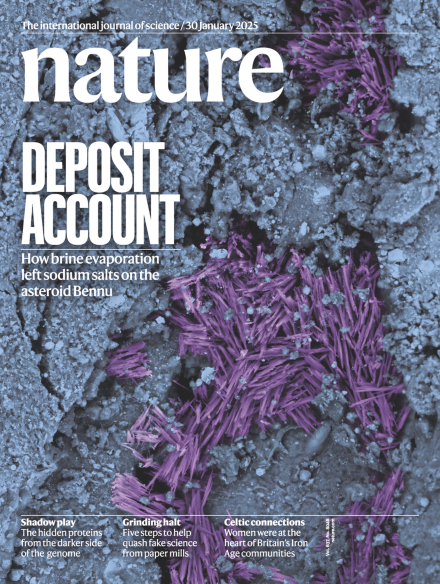
Science: Nature Magazine —- January 23, 2025 Preview

Volume 637 Issue 8047

NATURE MAGAZINE (January 22, 2025): The latest issue features ‘Net Gains’ – Small-scale fisheries make major contribution to sustainable food, nutrition and livelihoods…

Mines for a clean-energy metal have a surprise climate effect

Vegetation clearing to extract nickel, which is used in renewable technologies, leads to greater carbon emissions than realized.

Hidden tattoos on mummy skin emerge under a laser’s light

Blurry markings more than 1,000 years old become clear again thanks to scanning method.

Got flu? Promising drug shortens symptoms

Influenza viruses have not evolved resistance to suraxavir marboxil, which relieves cough, fever and other symptoms.

Voter turnout drives margins of victory ― if elections are fair

Model that predicts the spread of winning margins could be used to detect electoral interference.

Scientific American Magazine – February 2025

Scientific American

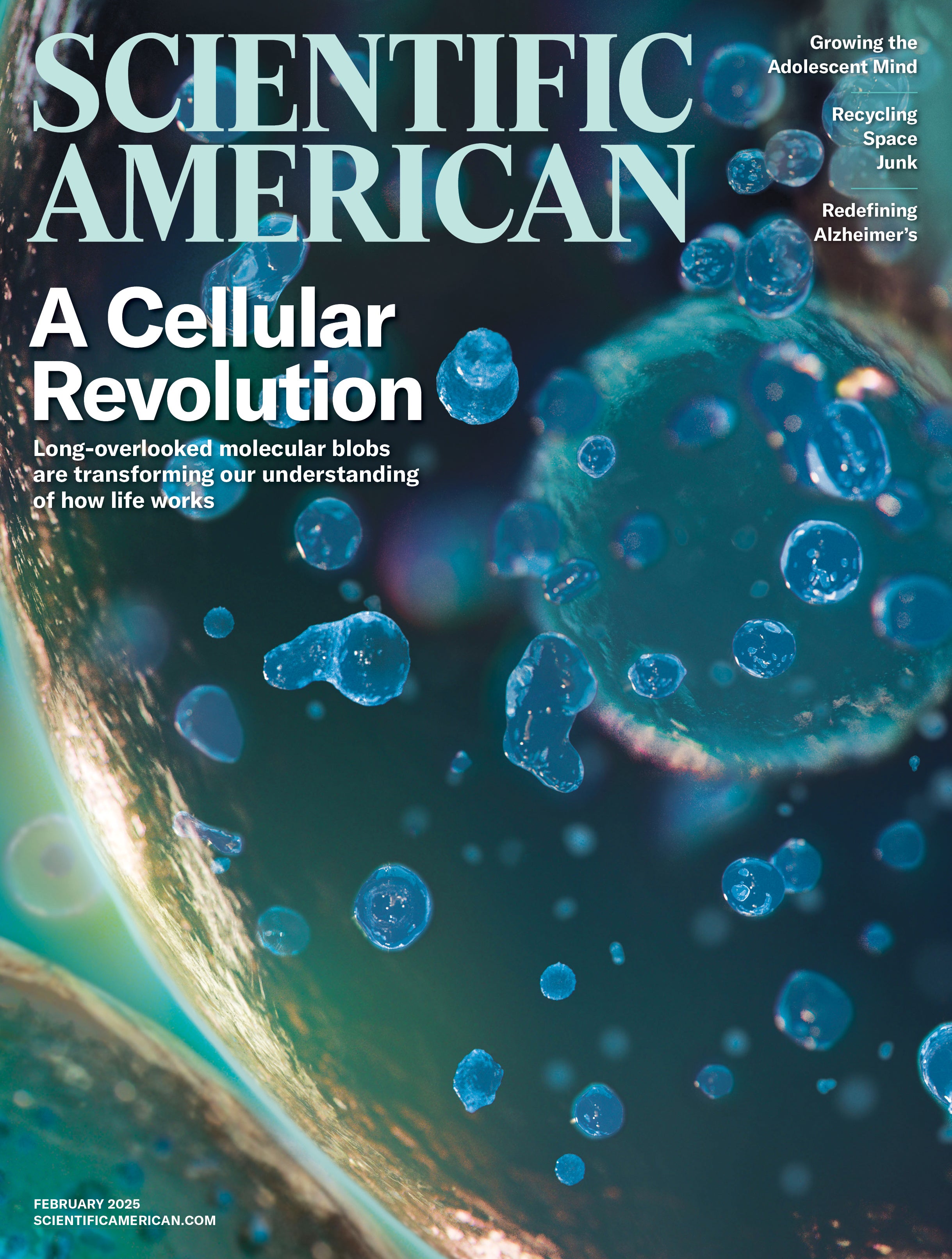
SCIENTIFIC AMERICAN MAGAZINE (January 21, 2025): The latest issue features ‘A Cellular Revolution’ – Long-overlooked molecular blobs are transforming our understanding of how life works….

Mysterious Blobs Found inside Cells Are Rewriting the Story of How Life Works

Tiny specks called biomolecular condensates are leading to a new understanding of the cell

Why We Need to Reduce, Reuse and Recycle in Space

Crushed Rocks Could Be the Next Climate Solution

How Neandertal DNA May Affect the Way We Think

Transcendent Thinking May Boost Teen Brains

Controversial New Guidelines Would Diagnose Alzheimer’s before Symptoms Appear

Science: Nature Magazine – January 16, 2025 Preview

Volume 637 Issue 8046

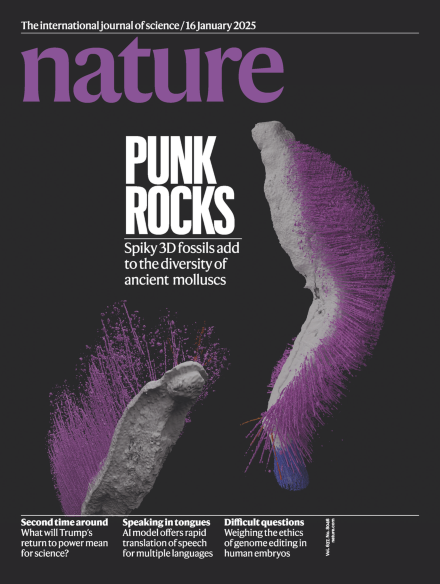
NATURE MAGAZINE (January 15, 2025): The latest issue features ‘Punk Rocks’ – Spiky 3D fossils add to the diversity of ancient molluscs…

Male spiders smell with their legs

Sensory organs on the walking legs of the male wasp spider can catch the scent of a female in a mood for romance.

Particle accelerators get an assist from AI co-pilots

Large language models can propose fine-tuning adjustments for an electron accelerator in Germany.

How the brain cleans itself during deep sleep

Blood vessels in the brain rhythmically constrict and dilate to drive waves of cleansing fluid through the organ.

Cosmic carnage: planetary rubble spotted at a dying star

Dust cloud is thought to be the first debris disk to be seen around a planetary nebula.

Science Magazine —- January 10, 2025 Issue

Science issue cover

SCIENCE MAGAZINE (January 9, 2025): The latest issue features ‘Not Skipping Meals’ – A narrow diet not responsible for extinction of short-faced kangaroos…

Fish could personalize cancer treatments

The first clinical trial of zebrafish embryos acting as cancer “avatars” will start soon

‘Good boring’: How Bluesky is shaping scientists’ discourse

The fast-growing platform may be more equitable than X, but gives scientists a smaller stage

Dogs sniff out truffles—in the name of science

Their keen noses are helping researchers uncover the diversity of the Pacific Northwest’s underground fungi

How a neurotransmitter drives brainwashing during sleep

Pulsating blood vessels push fluid into and out of the brains of slumbering mice

Science: Nature Magazine – January 9, 2025 Preview

Volume 637 Issue 8045

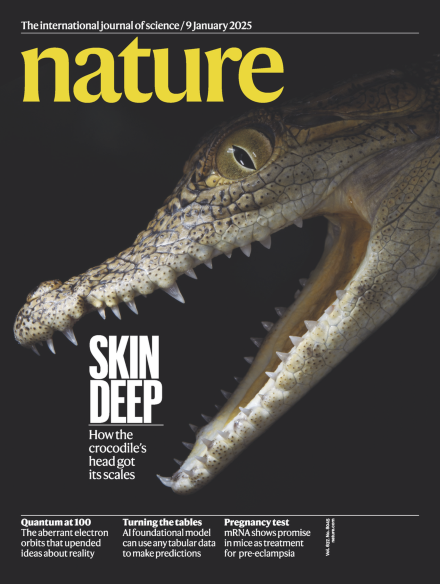
NATURE MAGAZINE (January 8, 2025): The latest issue features ‘Skin Deep’ – How the crocodile’s head got its scales…

This digital-memory device keeps its cool even at 600 °C

A battery-like technology uses a metal called tantalum to create an equivalent of digital 0s and 1s.

Fancy birds decorate nests with a natural pattern: snakeskin

The use of shed skins might help to ward off predators, experiments suggest.

A blood test detects aged cells

Proteins could serve as biomarkers for senescent cells, which have stopped dividing but have not yet died.

That Christmas jumper is a marvel of complicated physics

Models and experiments demonstrate what happens when a knitted fabric is deformed.

Book Reviews: The Best Scholarly Books Of 2024

Collage of covers of The Review's best books of 2024

THE CHRONICLE OF HIGHER EDUCATION (December 20, 2024): The Best Scholarly Books of 2024 from Michael Clune, Jessica Riskin, Fara Dabhoiwala, and others on their favorites of the year.

Fragile Insights

By Michael Clune

Charles Taylor’s revelatory Cosmic Connections: Poetry in the Age of Disenchantment (Harvard University Press, 2024) draws together different strands from Taylor’s storied philosophical career to present a new account of Romantic poetry. “Philosophy moves us because it convinces us; poetry convinces us because it moves us.” Taylor asks what it would mean to take seriously poetry’s ambition to reveal new dimensions of the world through the resources of image and symbol. Readers of Friedrich Hölderlin or William Wordsworth are familiar with the feeling that a poem is true or right in some deep sense, without being able to defend or even describe that rightness in philosophical terms. Consider the climax of Wordsworth’s “Lines Composed a Few Miles Above Tintern Abbey,” which serves as Taylor’s central example. The poet discerns

A motion and a spirit, that impels
All thinking things, all objects of thought,
And rolls through all things.

A New Theory of Evolution

By Jessica Riskin

Evolution Evolving: The Developmental Origins of Adaptation and Biodiversity (Princeton University Press, 2024) makes for an exhilarating reading. It is not just a book but an intellectual revolution. The authors show that the experiences and behaviors of living beings shape the course of evolution. You might find it strange that this would be a revolutionary idea. You might wonder how it could possibly be otherwise: How could the experiences and behaviors of living beings have no bearing whatsoever on the course of evolution?

Adventures With Books

By Priya Satia

Debate about the role of Western education in Britain’s colonies and former colonies (including the United States) is as old as the British empire itself. Those ever-evolving debates have, in turn, been studied for decades by historians, literary scholars, sociologists, and other scholars trained in the Western system that has become a global inheritance. Saikat Majumdar’s The Amateur: Self-Making and the Humanities in the Postcolony (Bloomsbury Academic, 2024) opens up a startlingly fresh perspective on these debates, attending to the unexpected and agonistic ways in which this education system shaped particular individuals whose work has had profound impact around the world.

Psychedelic Rabbit Holes

By Susan Stryker

I came for the acid, and stayed for the deep roots of gender theory that I found in Benjamin Breen’s Tripping on Utopia: Margaret Mead, the Cold War, and the Troubled Birth of Psychedelic Science (Grand Central Publishing, 2024). Admittedly, gender is not the main focus of Breen’s book. But in using the personal, professional, and intellectual partnership of Margaret Mead and Gregory Bateson to structure the narrative of this work of breathtaking originality, Breen reveals the kernel of a far-flung constellation of ideas and contexts that has rewired my brain’s understanding of the gender concept’s origins.

Read more…

Back to Top

Reality in Revolution

By Hal Foster

What does political revolution require of writers, artists, photographers, and filmmakers? How do they transform their ways of making in order to keep pace with such upheaval? In Soviet Factography: Reality Without Realism (University of Chicago Press, 2024), Devin Fore uncovers an entire archive of radical responses to these questions in the wake of the Russian Revolution of 1917, revealing a fascinating array of original strategies to record a world turned upside down. We follow all manner of “factographic” authors and artists (writer Sergei Tret’iakov and filmmaker Dziga Vertov are only the best known) as they scramble to register the revolution as immediately as possible. Their aim is not to arrest this transformation but, on the contrary, to dynamize it anew, to carry it forward into all areas of life, private and public, subjective and social. This riveting study of “reality in revolution” pressures our understanding of both terms; it also shows us how a reordering of any society involves a refashioning of its individuals.

Read more…

Back to Top

Landscapes of Empire

By Fara Dabhoiwala

Corinne Fowler’s enjoyable and thought-provoking The Countryside: Ten Rural Walks Through Britain and Its Hidden History of Empire (Scribner, 2024) achieves many things with an admirably light touch. Combining her lifelong passion for walking with her pathbreaking work linking England’s buildings and landscapes to the nation’s imperial past, she explores the many ways in which rural Britain was indelibly shaped by its overseas endeavors. She highlights how money, people, and rural industries closely connected the Cotswolds to Calcutta, the Scottish Highlands to Jamaica, Cornwall to West Africa and the Americas, and so on.

Ego, Redux

By Jonathan Lear

It surprised me to discover that The Revised Standard Edition of the Complete Psychological Works of Sigmund Freud (Rowman & Littlefield, 2024) is distinguished by its fidelity to two authors, not just one. Over 30 years in the making — though time was wasted with in-fighting among psychoanalysts — The Revised Standard Edition (RSE) aims to reanimate the distinctive translation into English of James Strachey. This is striking because so many of Strachey’s choices — for example, translating Ich as “Ego,” or Besetzung as “cathexis” — have been the subject of intense criticism. Why, the criticism goes, translate the wonderfully colloquial German that Freud used into a Latinized, “scientific” English? And why not use the occasion of a revised edition to make corrections?

Read more…

Back to Top

Life on the Street

By Shamus Khan

Neil Gong’s Sons, Daughters, and Sidewalk Psychotics: Mental Illness and Homelessness in Los Angeles (University of Chicago Press, 2024) does what the best ethnographies do: provide the reader with an empathetic understanding of its subject. Gong’s comparative work provides a portrait of “sidewalk psychotics” in Los Angeles and compares their experiences to the children of elite families who have similar mental-health struggles.

For those on the street, the aim of most social programs begins with getting them housed. Gong follows people from homelessness into apartments and finds that our social programs of “tolerant containment” do little to tackle mental-health challenges. Policies and programs that focus on housing first are meant to provide a wider range of services, and through detailed observations Gong shows that this rarely happens. The mantra seems to be: get housed, and hopefully the rest will take care of itself. Once housed, people are quite free from intervention or monitoring, including free from programs that might help them address their mental health.

Read more…

Back to Top

The Letters of a Master

By Julianne Werlin

In 1660, the first national post was established in England. By the Victorian age, there were 12 mail deliveries a day in London; friends could dash off a letter in the morning and expect to continue an exchange until late at night. Today, the personal letter in its physical form is largely extinct. But in the era of WhatsApp chats and exchanges on X, its legacy has never been more obvious. Far more than the novel, confession, or diary, the letter is the literary genre at the origins of the modern self: social rather than solitary, reactive rather than reflective, on the cusp of public and private life.

Read more…

Back to Top

Globalism’s Failures

By David Singh Grewal

Wolfgang Streeck’s Taking Back Control?: States and State Systems After Globalism (Verso, 2024) may not make for particularly cheerful reading for the holidays. But it is essential for any scholar seeking to make sense of a range of current trends: the ongoing retreat from 1990s-style globalization, the crisis of liberal democracy, and the rapid return of hot wars, cold wars, and trade wars to a world that just yesterday claimed to have overcome them all. It was written before Donald Trump was re-elected as president of the United States, but it helps make sense not only of the recent U.S. election but the broad trend of elections over the last decade and a half, from roughly the start of the financial crisis of 2007-8 down to the present, and not only in the United States but around the world.

Read more…

Back to Top

Shards of a Life

By Marisa Anne Bass

It is a bold move to write a biography in 2024 of an artist like Josiah Wedgwood, a British man of the 18th century. Iris Moon knows as much. She describes her book Melancholy Wedgwood (The MIT Press, 2024) as an “experimental biography,” by which she implies something more than defiance of the genre’s conventions. Wedgwood is most familiar today as the name attached to your grandmother’s prized vase. To a narrower audience, he is known as the ceramics entrepreneur whose successful factory embodies the emergence of modern capitalism in England. Neither of those stories is at the heart of Melancholy Wedgwood.

Read more…

Back to Top

Researching in Community

By Adia Benton

The circumstances that you bring to read — that bring you to read — shape how you receive a text. It just so happens that I was reviewing a stack of grant applications and planning an ethnographic writing course for next term when I stumbled upon The Ethnographer’s Way: A Handbook for Multidimensional Research Design (Duke University Press, 2024), by the anthropologists Kristin Peterson and Valerie Olson. This research-design manual, whose title is a play on Julia Cameron’s The Artist’s Way, is unconventional in many ways: It eschews a linear, hierarchically constructed style of formulating “scientific” research proposals and encourages a collective, creative, and conceptual approach to research design that pushes back against the demands of the neoliberal university and the idea of the “lone, isolated anthropologist.” It’s even a little woo-woo. (The authors admit as much). Peterson and Olson’s model for building and working in community from the inception of a research project aims to “mitigate disheartening experiences of disconnection that occur throughout institutionalized landscapes, such as those between professors and students, people working inside and outside of bounded organizations, and those with expertise versus those with experience.”

Read more…

Research Preview: Science Magazine – Dec. 20, 2024

Science issue cover

Science Magazine (December 18, 2024): The latest issue features ‘Light Emission with a Twist’ – Hot, twisted carbon nanotube yarns emit bright circularly polarlized light…

Can psychedelics improve well-being in autism?

A brace of new studies probes benefits and risks for an understudied group

Thermal radiation with a twist

Carbon nanotube filaments with a twisted geometry emit spinning heat waves at high temperatures

Research Preview: Science Magazine-Dec. 13, 2024

Science Magazine – December 13, 2024: The new issue features ‘2024 Breakthrough Of The Year’…

The long shot

An injectable HIV drug with a novel mechanism shows remarkable ability to prevent infection

Mantle waves sculpt the continents

When the forces of plate tectonics tear continents apart, it’s an incredibly violent process, unfolding in slow motion. It was also thought to be very local: Magma from hot, rising mantle rock seeds volcanoes along the rift zone, while the far-removed cold interiors of continents remain intact.

Multicellularity came early for ancient eukaryotes

Microscopic algalike fossils from China reported early this year astounded evolutionary biologists with their extreme age. Dated at 1.6 billion years old, the specimens suggest one of the hallmarks of complex life—multicellularity—arose far earlier than previously thought.

A new type of magnetism emerges

For 98 years, physicists knew of two types of permanently magnetic materials. Now, they’ve found a third. In familiar ferromagnets such as iron, unpaired electrons on neighboring atoms spin in the same direction, magnetizing the material so that, for example, it sticks to a refrigerator. Antiferromagnets such as chromium have zero overall magnetism, but they possess an atomic-scale magnetic pattern, with neighboring electrons spinning in opposite directions. Novel altermagnets—hypothesized 5 years ago—share aspects of both.