Tag Archives: Political News

Politics: The Guardian Weekly – February 23, 2024

Image

The Guardian Weekly (February 22, 2024) – The new issue features ‘Ukraine’s Lonely Road’ – After two years, is there a way out of Putin’s war?…

Shaun Walker reports on this week’s big story, the fall of the strategic town of Avdiivka to Russian troops has come at a grim time for Ukraine’s president, Volodymyr Zelenskiy. While the army is struggling to hold ground, war fatigue is setting in among parts of the population and disagreements among the leadership have been spilling into the open.

At the same time, the death of the jailed Russian critic Alexei Navalny last week – widely seen as another political assassination – appears to emphasise the strengthening hand of Vladimir Putin, who is expected to secure another six-year term as Russia’s president in tightly controlled elections next month. Amid a familiar wave of international outrage, our Russia affairs reporter Pjotr Sauer asks what Putin might do next.

Coupled with the possibility of a Donald Trump victory in the US elections later this year, it all makes for a deeply worrying outlook for Ukraine, reflected in the Kyiv-based illustrator Sergiy Maidukov’s haunting cover artwork for the magazine this week.

“This war is the hardest test of my life, similar to an endless ultramarathon,” writes Sergiy. “It is good to try to not think about the finish when running long distance. This is important knowledge to endure.”
Politics: The Guardian Weekly – February 9, 2024

Image

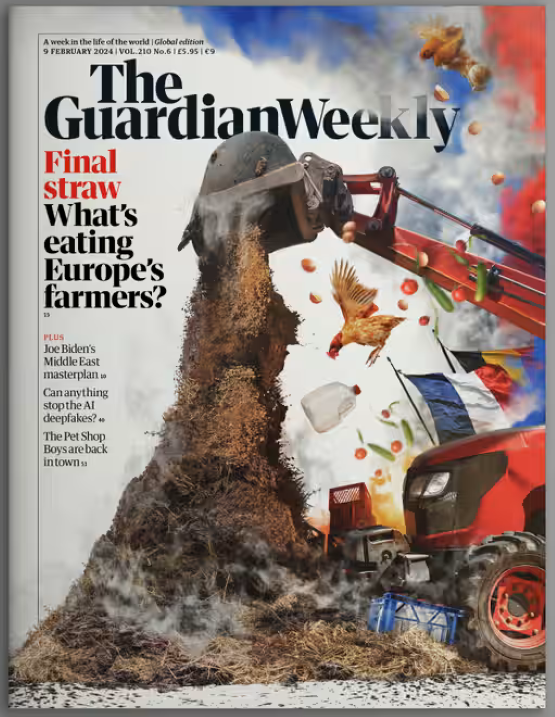
The Guardian Weekly (February 8, 2024) – The new issue features ‘Final Straw’ – What’s eating Europe’s Farmers?; Joe Biden’s Middle East masterplan; Can anything stop the AI deepfakes? and The Pet Shop Boys are back in town…

If you live in France, Germany, Belgium, the Netherlands, Poland or Greece, you may well have already run into one of the numerous roadblocks or protests formed in recent weeks by furious farmers. If you’re in Spain and Italy, take cover – because they are coming to you soon, if not already.

In this week’s cover story, we explore what has proved to be the final straw for Europe’s farmers. A combination of rising costs, environmental rules and grievances over EU policies, coupled with more localised complaints, seem to be the factors driving the convoys of tractors. But far-right and anti-establishment parties, who could make major gains in forthcoming European parliament elections, have also picked up on the protests as part of their agenda against EU influence.

Paris correspondent Angelique Chrisafis and Europe correspondent Jon Henley delve into the protests (if not the piles of steaming dung being dumped on the continent’s roads, as illustrated wonderfully by Neil Jamieson on this week’s cover), and ask what can be done to placate them.

Politics: The Guardian Weekly – February 2, 2024

Image

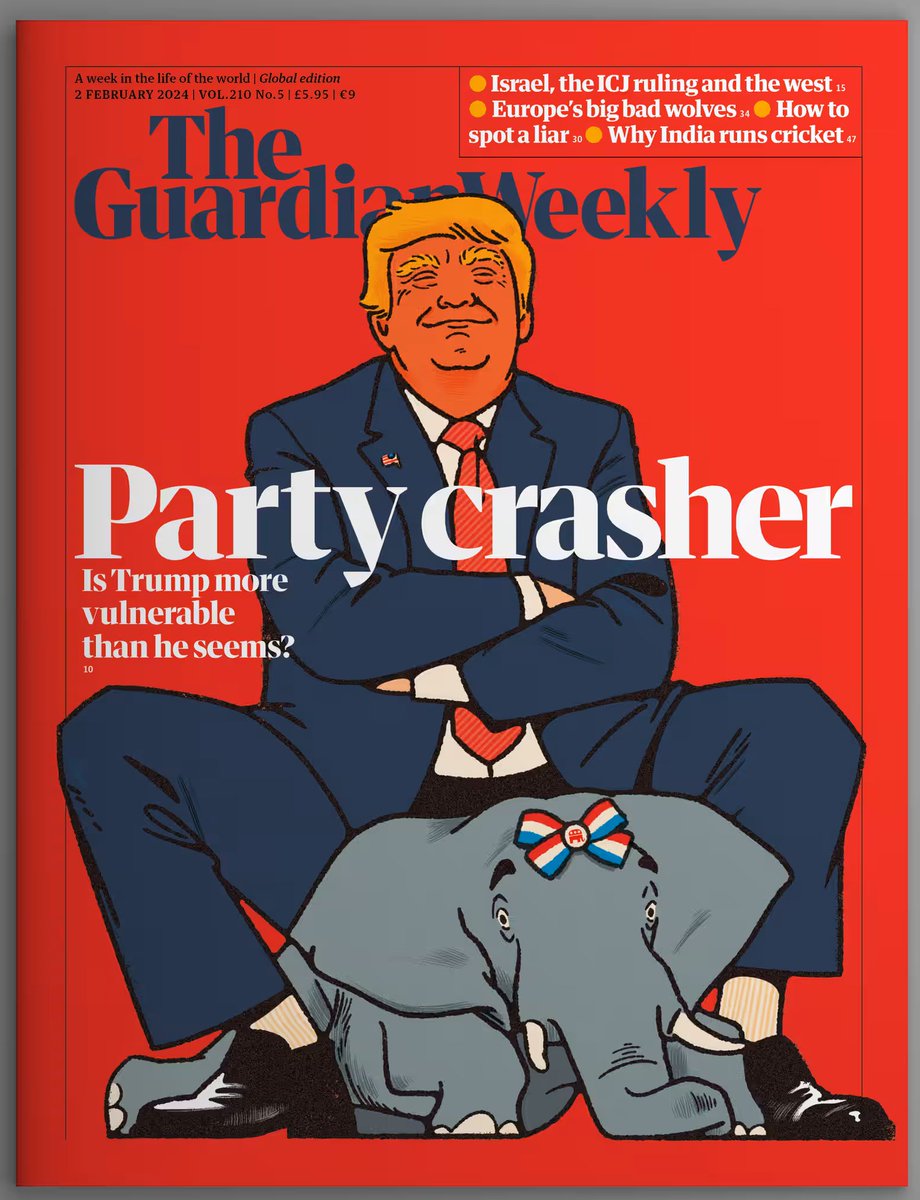
The Guardian Weekly (February 1, 2024) – The new issue features ‘Party Crasher’ – Is Trump more vulnerable than he seems?; Israel, the ICJ ruling and The West; Europe’s Big Bad Wolves and more….

It had all seemed like business as usual for Donald Trump in the aftermath of last week’s New Hampshire Republican primaries, where he scored a comfortable victory over his only remaining challenger, Nikki Haley. And yet … was there something in his subsequent outburst towards Haley that suggested all was not well in Trumpworld?

Barring the mother of all reversals, Trump will soon be confirmed as the Republican presidential nominee. But, as David Smith and Jonathan Freedland outline in this week’s big story, Trump remains a deeply polarising figure in American politics, not least within his own party.

And his petulant irritation at Haley over her refusal to concede the race was a visible reminder to American floating voters of the unhinged personality that lurks beneath the orange veneer, something his campaign team will be desperate to avoid more of.

“The shadow of Trump is long, and his return seems closer than ever,” explains illustrator Alberto Miranda on his cover art for this week’s Guardian Weekly. “He is a controversial figure with a dangerous side and, at the same time, has an utterly comical aspect. That’s why we wanted to portray his influence in the Republican party in an almost grotesque manner.”

Politics: The Guardian Weekly – January 26, 2024

The Guardian Weekly (January 25, 2024) – The new issue features ‘True Colours’ – What the AFD really wants for Germany; The fading hopes for Middle East Peace; Trump’s victory and DeSantis’s doomed campaign…

Events in the Middle East continue to unfold at a bewildering pace, with pockets of conflict opening up across the region. Diplomatic editor Patrick Wintour rounds up a week of flashpoints and assesses increasingly slim hopes for controlling the situation. And Oliver Holmes provides a revealing profile of Yemen, one of the most unchanging and least visited countries in the Middle East.

The Weekly went to press before news of Donald Trump’s victory in the New Hampshire Republican primary on Tuesday night, but you can catch up with all the latest Guardian coverage and reaction here. In the magazine, David Smith delivers a postmortem on Ron DeSantis’s doomed campaign, while Jonathan Freedland argues that Trump’s march to the White House can still be stopped.

Our long-read features take somewhat divergent paths this week. First, Charlotte Edwardes meets Gary Lineker, the former England footballer turned TV presenter whose penchant for regularly airing his liberal worldviews has made him public enemy No 1 for Britain’s anti-woke brigade.

Then, Chananya Groner unearths a remarkable story of factionalism and messianic fervour within New York’s Hasidic Jewish community, stretching back 30 years, which led to secret tunnels recently being discovered beneath a Brooklyn synagogue.

And in Culture, Charlotte Higgins meets the classical musicians Dalia Stasevska and Joshua Bell, who are resurrecting a long-forgotten Ukrainian concerto as a gesture of defiance to Russia.

Finally, we’re on the lookout for your best photographs of the world around us. For a chance for your picture to feature in the magazine, send us your best shot, telling us where you were in the world when you took it and why the scene resonated with you at that particular time.

Politics: The Guardian Weekly – January 19, 2024

Image

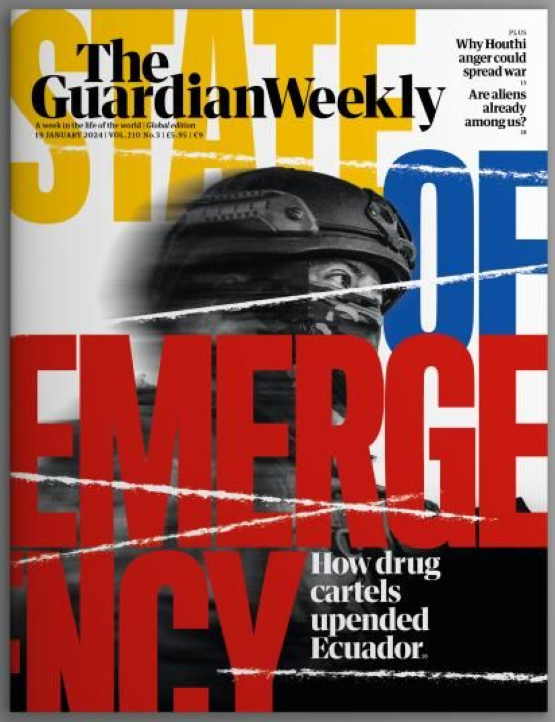
The Guardian Weekly (January 18, 2024) – The new issue features ‘State Of Emergency’ – How drug cartels upended Ecuador; Why Houthi anger could spread war; Are aliens already among us?…

Not long ago, Ecuador was chiefly known for its volcanoes, wildlife and eco-tourism. It’s an image that may now need some rehabilitation after chaos and bloodshed sparked by the prison escape last week of Adolfo Macías, the country’s most notorious gang leader and drug lord.

With cartels from Peru and Colombia routinely funnelling narcotics through Ecuador’s ports en route to Europe, Latin America correspondent Tom Phillips reports on a rising problem that threatens to tear apart the once-peaceful Andean state.

In the Middle East, Yemen’s Houthi rebels could stymie the increasingly slim chances of preventing a regional war. With the US and UK bombing Houthi bases in response to attacks on commercial shipping, diplomatic editor Patrick Wintour recounts the Houthis’ rise and why military strikes against them may not lead to the desired outcome.

Politics: The Guardian Weekly – January 11, 2024

Image

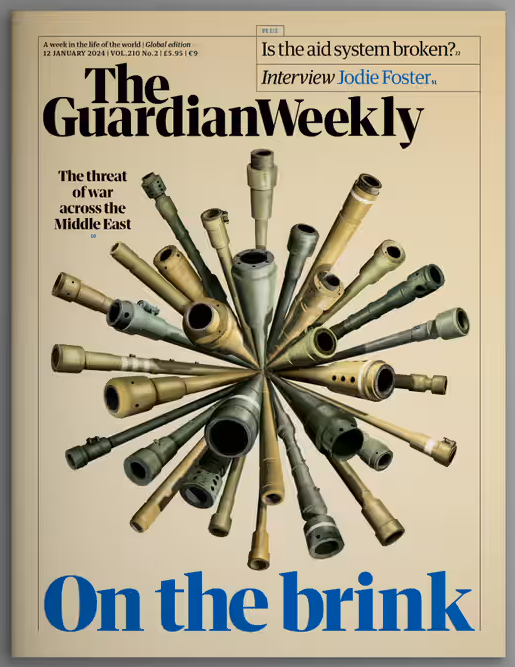
The Guardian Weekly (January 10, 2024) – The new issue features ‘Middle East on the brink’ – The threat of a regional war. Also, Inside the Post Office Horizon IT scandal…

The assassination of a Hamas chief in Lebanon. A terror attack on mourners of an Iranian former general. Commercial shipping in the Red Sea targeted by Yemeni rebels, and a US airstrike in Iraq. All were separate events in the Middle East last week but all were linked, in one way or another, to the presence of autonomous but Iranian-backed militia forces in the region.

When asked to visualise the threat of war engulfing the Middle East, for this week’s cover, illustrator Carl Godfrey took a literal approach. “I wanted to convey the tense and unpredictable situation,” says Carl, “and there’s nothing more tense than looking down the barrel of a gun. Especially when those barrels are pointing in all directions, and the risk of war is expanding in all directions.”

Politics: The Guardian Weekly – January 5, 2024

Image

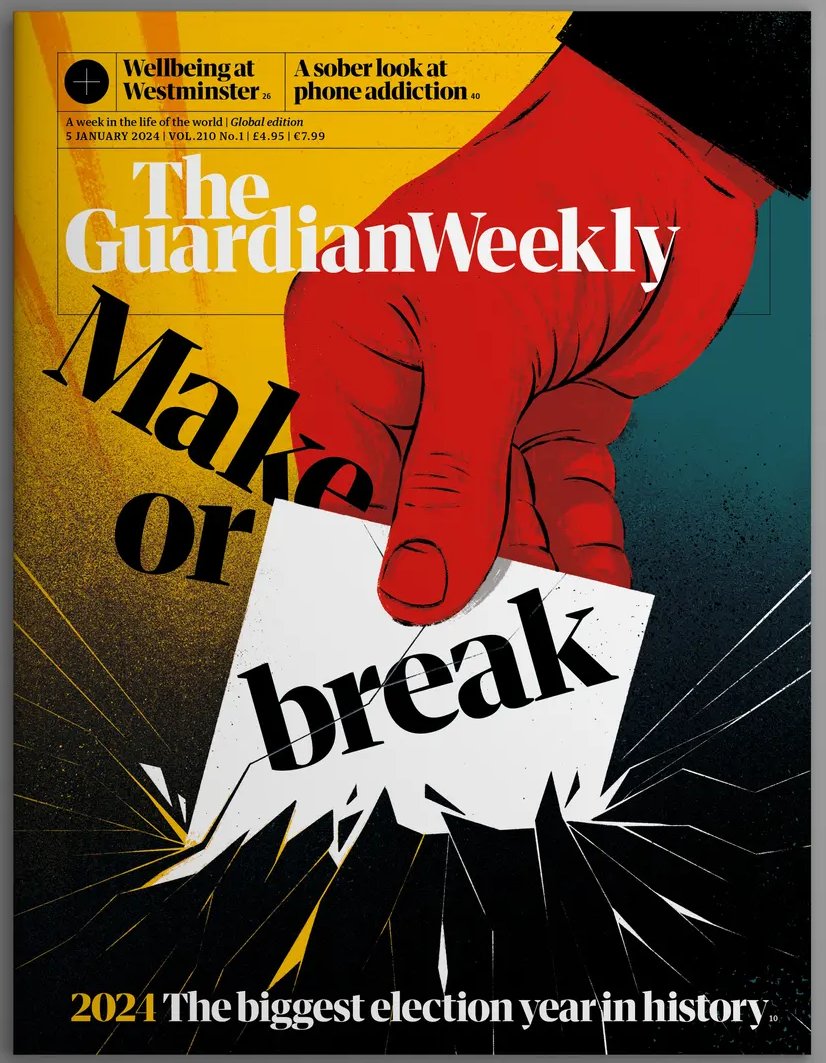
The Guardian Weekly (January 4, 2024) – The new issue features ‘Make or Break 2024’ – The biggest election year in history.

About 2 billion people have the opportunity to cast their ballots in polls that span the globe from the United States to Taiwan, and India to Mexico in 2024. The outcomes, as our analysts and correspondents explain in our big story, have implications for us all.

Washington bureau chief David Smith looks at the likely rerun of 2020’s Biden v Trump contest in November and explores what has changed and what has not in the US as the old adversaries square up. It is an almost foregone conclusion that Narendra Modi will be back for a third term as Indian prime minster, reports Hannah Ellis-Petersen from Delhi where analysts fear his victory will further imperil the country’s Muslim minority. And while Vladimir Putin will certainly continue as president in Russia, Pjotr Sauer explains why the man about to become fifth-time president might allow other candidates onto the ballot list. From Taiwan’s poll on 13 January to the 27-state European elections in June, how citizens vote will influence the geopolitical landscape for us all, while the conduct of campaigns will reveal how vulnerable democracies now are to misinformation and cyber interference from malign actors.

Politics: The Guardian Weekly – December 22, 2023

Image

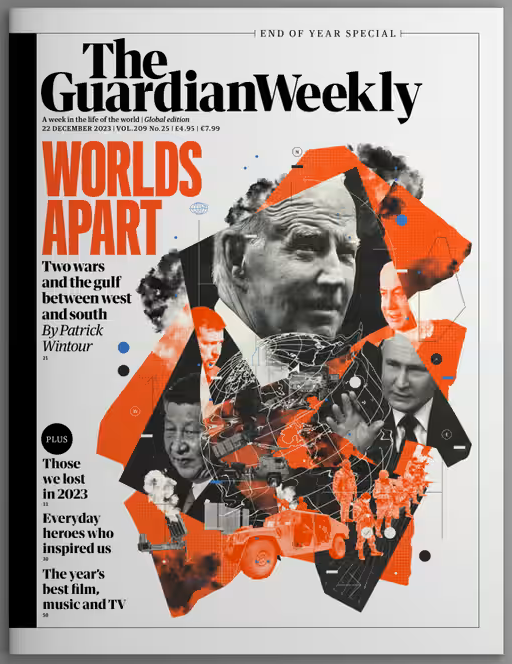
The Guardian Weekly (December 20, 2023) – The new issue features Two wars and a growing divide between the global west and south. Plus: Best culture of 2023.

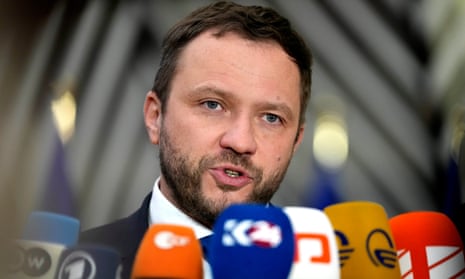
World risks new age of empires where might makes right, warns Estonian foreign minister

Margus Tsahkna

International institutions seem powerless in face of Russia’s invasion of Ukraine, writes Margus Tsahkna, arguing they ‘cannot survive unchanged’

The international rules-based system needs urgent and fundamental change if it is not to collapse, the Estonian foreign minister has said, calling for “a new global conversation” to begin on how to reform the UN and the international criminal court.

Writing in the Guardian on Wednesday, Margus Tsahkna says Russia’s invasion of Ukraine has highlighted flaws in the system that risk fatally undermining people’s faith in it.

_______________________________

Elsewhere, we shouldn’t forget there are plenty of reasons for hope. Having been expected to deliver little, the Cop28 climate summit turned out to be full of surprises – but was the final deal on fossil fuels just a ruse, asks environment editor Fiona Harvey.

Writers from the Guardian’s global development team reflect on the inspirational figures they met in 2023, from leaders to dancers to dads, who proved that humanity still has much to give. And leading conservationists and scientists tell us about the mysteries of the planet they wish they better understood.

The review of 2023 continues with the Observer’s selection of those we lost, recalled with affection by their friends. There’s also a dazzling range of images courtesy of the Guardian agency photographers of the year.

Last but not least, the Guardian critics’ top 10 rundowns of the best film and music of 2023, topped off with the Guardian Weekly team’s now-legendary television selections of the year.

Politics: The Guardian Weekly – December 1, 2023

Image

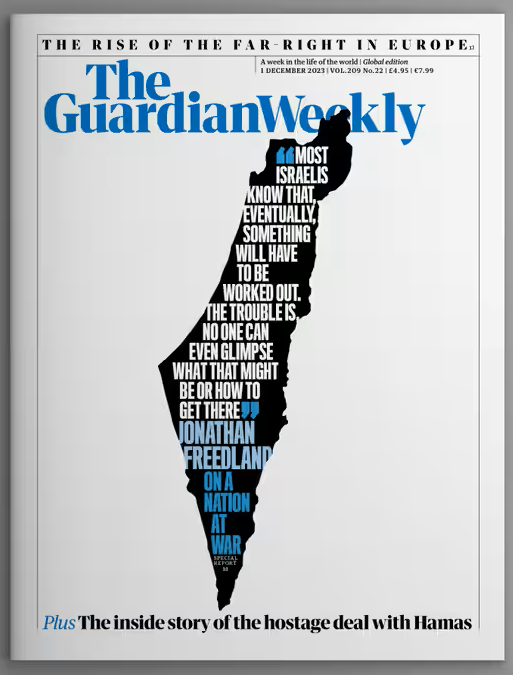
The Guardian Weekly (November 29, 2023) – The new issue features the ceasefire between Israel and Hamas may have been weeks in the making – as detailed this week by Julian Borger and Ruth Michaelson – and led to the release of dozens of hostages on either side, but behind the scenes there was little expectation that it would lead to a longer-term pause in hostilities.

In a special report, almost two months after the deadliest attack on Israel in its 75-year history and as the world focuses on its retaliatory bombardment of Gaza that has seen around 14,000 people killed, Jonathan Freedland finds a country still convulsed with rage and sorrow, unable to see the pain of its Palestinian neighbours as it faces an uncertain future. As one senior Israeli military figure remarked: “It’s not yet post-traumatic stress disorder. We’re still in it.”

The far-right politician Geert Wilders stunned onlookers by finishing well ahead of the field in the Dutch election last week. But race riots in Ireland, a country previously thought immune to such extremism, were equally shocking. Rory CarrollLisa O’Carroll and Jon Henley report on contrasting manifestations of the rise of the far right across Europe.

Politics: The Guardian Weekly – November 3, 2023

Image

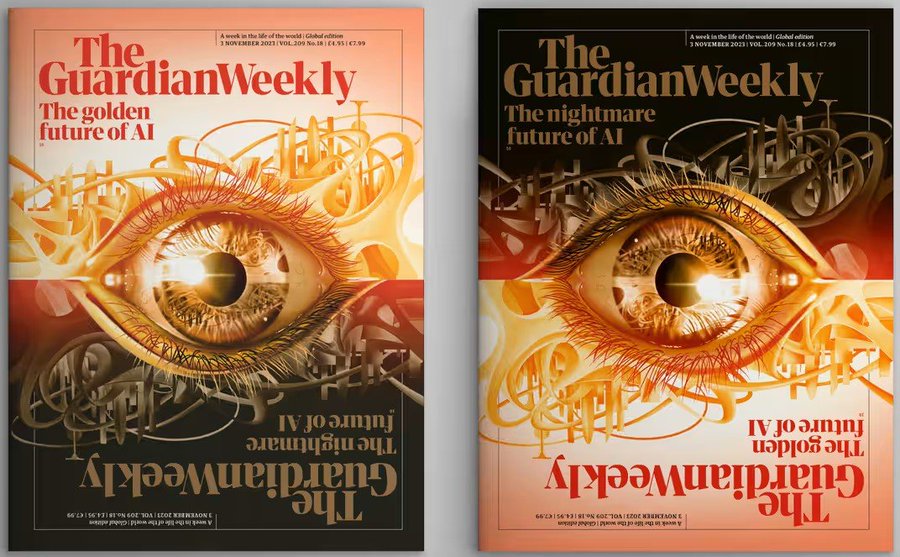
The Guardian Weekly (November 3, 2023) – The new issue features Bletchley Park, the main center of allied second world war codebreakers, and it’s no coincidence that the English country house was chosen as the venue for this week’s landmark summit on safety in artificial intelligence. The age of AI brings opportunities but also significant risks, as a number of experts in the field outlined in an open letter last week.

Global technology editor Dan Milmo discusses the pros and cons with one of the technology’s leading thinkers, Demis Hassabis, the CEO of Google DeepMind, who says the rise of AI must be thought of as seriously as the climate crisis. Then, Observer columnist Sonia Sodha argues that calling for AI to be reined in is not simply a sign of luddism.

As Israeli forces entered Gaza this week, Bethan McKernan and Rory Carroll report for us on the increasingly unbearable nature of life in the besieged enclave, and there’s expert analysis and commentary from Julian BorgerPeter Beaumont and Jason Burke.