
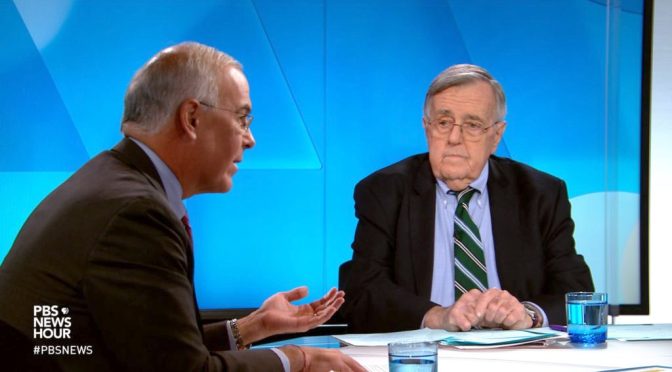
 Syndicated columnist Mark Shields and New York Times columnist David Brooks join Judy Woodruff to discuss the latest political news, including trends around the federal judges President Trump is appointing, the Department of Justice’s criminal probe of the Russia investigation, how the impeachment inquiry is evolving and campaign anxiety regarding 2020 Democratic candidates.
Tag Archives: Podcasts
Top Science Podcasts: Earthworm Study, Bias In Health Algorithms & “Dr. Space Junk” (ScienceMag)
 This week in Science, Helen Philips, a postdoctoral fellow at the German Centre for Integrative Biodiversity Research and the Institute of Biology at Leipzig University, and colleagues published the results of their worldwide earthworm study, composed of data sets from many worm researchers around the globe.
Sarah also talks with Ziad Obermeyer, a professor in the School of Public Health at the University of California, Berkeley, about dissecting out bias in an algorithm used by health care systems in the United States to recommend patients for additional health services.
Finally, in the monthly books segment, books host Kiki Sanford interviews author Alice Gorman about her book Dr. Space Junk vs The Universe: Archaeology and the Future. Listen to more book segments on the Science books blog: Books, et al.
To read more: https://www.sciencemag.org/podcast/worldwide-worm-survey-and-racial-bias-health-care-algorithm
Top Art Podcasts: Harvard Psychologist Steven Pinker Analyses “Charnel House” By Picasso (BBC)
 Today’s edition features Harvard professor Steven Pinker. As an experimental psychologist, Steven has written extensively about violence – and for his choice from the gallery’s collection he has selected two of Pablo Picasso’s most gruesome depictions of man’s inhumanity, Charnel House and Guernica, now housed in Madrid.

Radio 3 presents a radiophonic art exhibition, as 30 of the world’s most creative minds choose a favourite work from the Museum of Modern Art in New York. Ep5 Pinker and Picasso.
“The Way I See It” is a co-production of the BBC and the Museum of Modern Art, New York.
Top Science Podcasts: Quantum Computing, Speediest Ants & Altering The “Deaf” Gene (Nature)
 Listen to the latest from the world of science, with Nick Howe and Shamini Bundell. This week, a milestone in quantum computing, and rethinking early mammals.
In this episode:
00:43 A quantum computing milestone
A quantum computer is reported to have achieved ‘quantum supremacy’ – performing an operation that’s essentially impossible for classical computers. Research Article: Arute et al.; News and Views: Quantum computing takes flight; Editorial: A precarious milestone for quantum computing; News: Hello quantum world! Google publishes landmark quantum supremacy claim
08:24 Research Highlights
The world’s speediest ants, and the world’s loudest birdsong. Research Highlight: A land-speed record for ants set in Saharan dunes; Research Highlight: A bird’s ear-splitting shriek smashes the record for loudest song
10:19 The mammals that lived with the dinosaurs
Paleontologists are shifting their view of Mesozoic era mammals. News Feature: How the earliest mammals thrived alongside dinosaurs
18:00 News Chat
A Russian researcher’s plans to edit human embryos, and ‘prime editing’ – a more accurate gene editing system. News: Russian ‘CRISPR-baby’ scientist has started editing genes in human eggs with goal of altering deaf gene; News: Super-precise new CRISPR tool could tackle a plethora of genetic diseases
Top Podcasts: US Constitutional Law Expert Brian Kalt On 25th Amendment (Quillette)
 Brian Kalt, an expert on US constitutional law and the presidency, talks to Jonathan Kay about the 25th Amendment and whether it can be used to remove a president. Professor Kalt recently published a book called Unable: The Law, Politics, and Limits of Section 4 of the Twenty-Fifth Amendment.
To read more: https://quillette.com/2019/10/18/podcast-58-professor-brian-kalt-us-constitutional-law-expert-on-the-25th-amendment/

Top Podcasts: Mark Shields And David Brooks On Latest In Washington
 Syndicated columnist Mark Shields and New York Times columnist David Brooks join Judy Woodruff to discuss the week’s political news, including how the impeachment inquiry is affecting President Trump’s support among Republicans, fallout from Trump’s handling of northern Syria and the military advance by Turkish President Recep Tayyip Erdogan and the changing dynamics of the 2020 presidential race.
Neuroscience Podcast: “Consciousness Theories” And “Biased Childhood Memories” (ScienceMag)
We don’t know where consciousness comes from. And we don’t know whether animals have it, or whether we can detect it in patients in comas. Do neuroscientists even know where to look? A new competition aims to narrow down the bewildering number of theories of consciousness and get closer to finding its biological signs by pitting different theories against each other in experimental settings. Freelance journalist Sara Reardon talks with host Sarah Crespi about how the competition will work.
 In our second segment, we talk about how we think about children. For thousands of years, adults have complained about their lack of respect, intelligence, and tendency to distraction, compared with previous generations. A new study out this week in Science Advances suggests our own biased childhood memories might be at fault. Sarah Crespi talks with John Protzko of the University of California, Santa Barbara, about how terrible people thought kids were in 3800 B.C.E. and whether understanding those biases might change how people view Generation Z today.
To read more: https://www.sciencemag.org/podcast/trying-find-mind-brain-and-why-adults-are-always-criticizing-kids-these-days
Top Science Podcasts: Child Mortality Rates, Evolving New Genes & Vaping Deaths (Nature)
Listen to the latest from the world of science, with Benjamin Thompson and Shamini Bundell. This week, investigating child mortality rates at a local level, and building genes from non-coding DNA.
In this episode:
00:43 A regional view of childhood mortality
Researchers map countries’ progress towards the UN’s Sustainable Developmental Goals. Research Article: Burstein et al.; World View: Data on child deaths are a call for justice; Editorial: Protect the census
07:22 Research Highlights
Astronomers identify a second visitor from beyond the solar system, and extreme snowfall stifles animal breeding in Greenland. Research Highlight: The comet that came in from interstellar space; Research Highlight: Extreme winter leads to an Arctic reproductive collapse
09:22 Evolving genes from the ground up
Natural selection’s creative way to evolve new genes. News Feature: How evolution builds genes from scratch
15:43 News Chat
A spate of vaping-related deaths in the US, and Japan’s import of the Ebola virus. News: Scientists chase cause of mysterious vaping illness as death toll rises; News: Why Japan imported Ebola ahead of the 2020 Olympics

Top Political Podcasts: Shields And Brooks On October 11, 2019 (PBS)
 Syndicated columnist Mark Shields and New York Times columnist David Brooks join Judy Woodruff to discuss the week’s political news, including President Trump’s attitude toward Kurds in Syria and stance toward Turkey’s Syria offensive, testimony from the former U.S. ambassador to Ukraine and how the prospect of impeachment affects the race among 2020 Democrats.
Top Science Podcasts: Estimating Earthquake Risk, And Difficulties For Deep-Learning (Nature)
 This week, a method for predicting follow-up earthquakes, and the issues with deep learning systems in AI.
In this episode:
00:47 Which is the big quake?
A new technique could allow seismologists to better predict if a larger earthquake will follow an initial tremor. Research Article: Real-time discrimination of earthquake foreshocks and aftershocks; News and Views: Predicting if the worst earthquake has passed
07:46 Research Highlights
Vampire bats transmitting rabies in Costa Rica, and why are some octopuses warty? Research Article: Streicker et al.; Research Article: Voight et al.
10:03 Problems for pattern-recognition
Deep-learning allows AIs to better understand the world, but the technique is not without its issues. News Feature: Why deep-learning AIs are so easy to fool
16:31 News Chat
We roundup the 2019 Nobel Prizes for science. News: Biologists who decoded how cells sense oxygen win medicine Nobel; News: Physics Nobel goes to exoplanet and cosmology pioneers; News: Chemistry Nobel honours world-changing batteries
 Boomers Daily