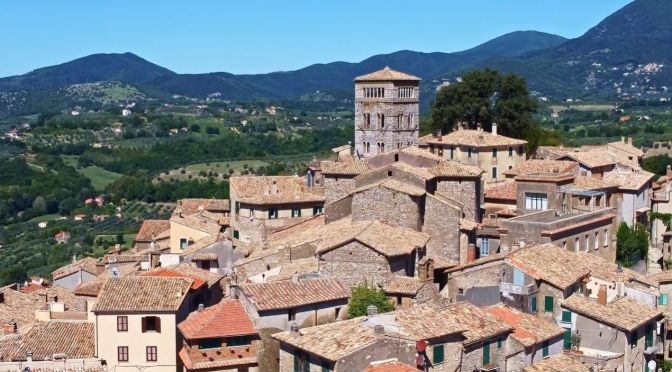
Casperia is a fortified medieval village in the Sabine Hills, province of Rieti. That’s north Lazio and just a short hop to the regional border with Umbria.
Built on top of a rocky hill and surrounded by mountains and deep valleys, the village commands a wonderful view of the Appenines.
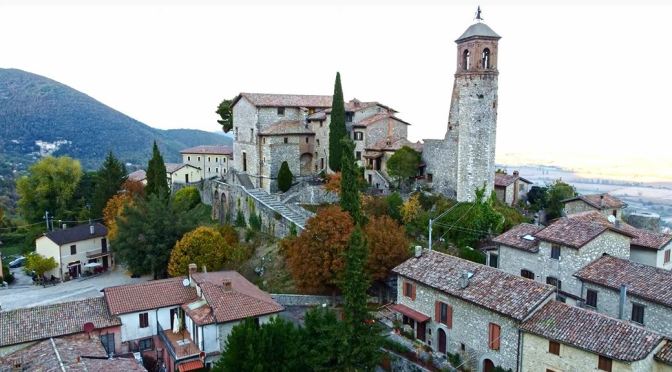
Greccio is an old hilltown and comune of the province of Rieti in the Italian region of Lazio, overhanging the Rieti valley on a spur of the Monti Sabini, a sub-range of the Apennines.
Greccio was founded, according to tradition, by a Greek colony or family, who fled or exiled from their homeland following wars and destruction who fell in love with the amenity of the place and the comfort of natural defense it offered, and settled there. Hence the name Greece, Grece, Grecce and finally Greccio. The first certain information dates back to the 10-11th century. when the fragmentary possessions of the Abbey of Farfa were reunited and the fortification of the curtis proceeded. The Benedictine monk Gregorio da Catino (1062-1133) refers to the locality of Greccio (curte de Greccia) in his work “Regesto Farfense”.
A walking tour in 𝗖𝗶𝘃𝗶𝘁𝗮𝘃𝗲𝗰𝗰𝗵𝗶𝗮 𝗱𝗶 𝗔𝗿𝗽𝗶𝗻𝗼, region 𝗟𝗮𝘇𝗶𝗼, center Italy, province of Frosinone, a small town of about 𝗼𝗻𝗹𝘆 𝟭𝟮𝟯 𝗶𝗻𝗵𝗮𝗯𝗶𝘁𝗮𝗻𝘁𝘀.
𝗧𝗵𝗲 𝗼𝗿𝗶𝗴𝗶𝗻𝘀 The birth of the first settlement on today’s Arpinian territory can be traced back to the Volsci. However, dating is difficult. Some scholars fix its birth around the 7th-6th century. BC, others, however, around the middle of the 4th century. B.C. Beyond Arpino there are several cities founded in the Ciociaria area by this ancient population. That of the Volsci was a population that lived above all on agriculture and pastoralism, but it was also very warlike. The wars with Rome are proof of this. The choice to build the first settlement on such high ground was due to defensive objectives. In fact, that of the Volsci was not the only population in central Italy and Marsi and Sanniti were among the most dangerous. It is for this reason that huge cyclopean (or polygonal) walls were erected to defend what would become Civitavecchia di Arpino, still visible today.
News, Views and Reviews For The Intellectually Curious


 Boomers Daily