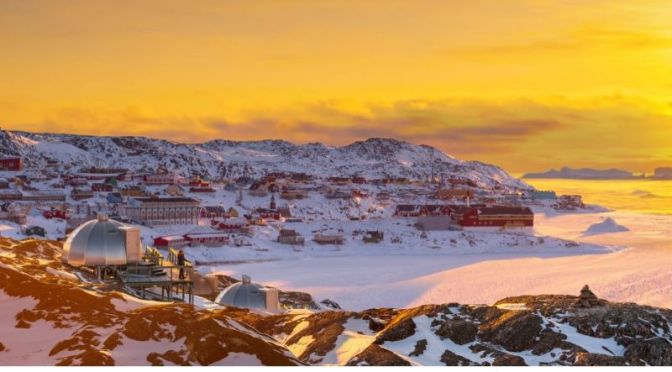
Experience Ilulissat, Greenland – Breathtakingly beautiful and unimaginable vast landscape. During the winter filming temperatures ranged between -25°C and -35°C (-13°F -31°F).
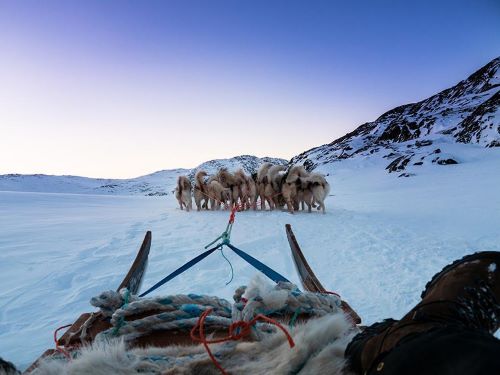
Ilulissat is a coastal town in western Greenland. It’s known for the Ilulissat Icefjord and for huge icebergs Disko Bay, shed by the Sermeq Kujalleq glacier. Trails run to the Sermermiut settlement for dramatic views over the ice. The Ilulissat Museum traces the area’s history and the life of local-born explorer Knud Rasmussen. The area is home to thousands of Greenland dogs, used for dogsledding.
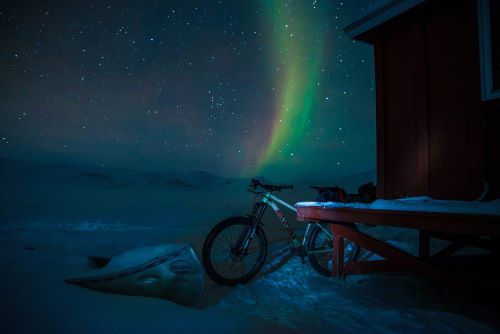
Connected by a beautiful ring of light, traversing the fields of ice that form the majestic wilderness of Greenland is an experience like no other. Hard to reach, with an almost prehistoric terrain, and a climate that feels imagined for a novel—there is something both daring and challenging about the world’s largest island. But it poses a uniqueness, something strangely difficult to find in a world of global travel and instant messaging.
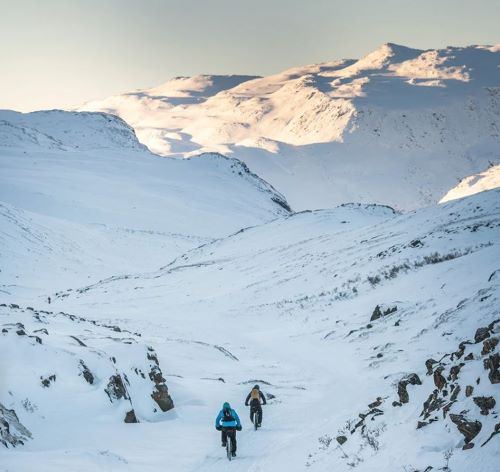
During the dim wintry months, these vast plains are stacked with three to five meters of snow. Not many people travel to these immense ice masses in January, even fewer to cycle across. But that is what Tobias Woggon and Philip Ruopp settled upon for their next adventure. In Nordic Cycle, Woggon explains that not many people who took their tour had experienced biking at minus 30 degrees. “I consulted our friend Max,” he explains, “who had been riding his bike in Lapland, Finland the year before and was already experienced with the necessary technology and knew how to handle the cold.”
How current and future ice loss in Greenland compares to the past, Long-Covid, and using graphene to make ultra-sensitive radiation detectors.
In this episode:
00:45 Greenland’s historic ice loss
Climate change is accelerating the loss of ice and glaciers around the world leading to unprecedented levels of disappearance. Researchers have drilled samples from deep in the Greenland ice sheet, to model how current, and future, losses compare to those seen in the last 12,000 years. Research Article: Briner et al.; News and Views: The worst is yet to come for the Greenland ice sheet; Editorial: Arctic science cannot afford a new cold war
09:23 Coronapod
Despite recovering from an initial COVID-19 infection, many patients are experiencing severe symptoms months later. We find out about the impact of ‘Long Covid’ and the research that’s being done to try and understand it. News Feature: The lasting misery of coronavirus long-haulers
Radiation-detectors known as bolometers are vital instruments in many fields of science. This week, two groups of researchers have harnessed graphene to make super sensitive bolometers that could be used to improve quantum computers, or detect subtle traces of molecules on other planets. Research Article: Lee et al.; Research Article: Kokkoniemi et al.
27:49 Briefing Chat
We discuss some of the latest stories highlighted in the Nature Briefing. This week we chat about the lack of diversity in academia, and an animal ally that can protect wildlife during forest fires. Nature Careers: Diversity in science: next steps for research group leaders; National Geographic:
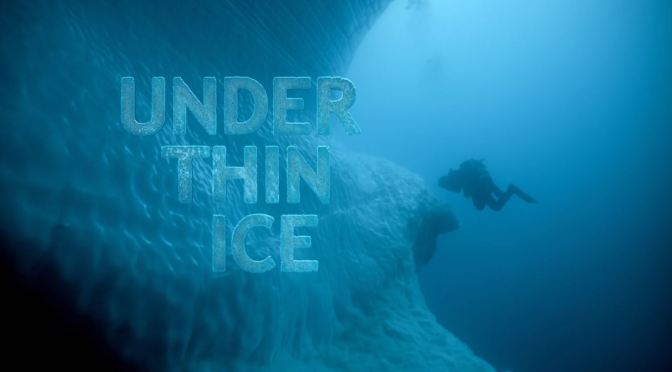
“Under Thin Ice”. World Premiere at the 2020 WCFF. Natalie Dubois, Producer and Denis Blaquiere, Director.
SYNOPSIS The Arctic is a majestic world, home to wildlife rarely seen in the south: bowhead whales, polar bears, narwhals, walrus, seals, zooplankton, algae. At the end of each spring, after long months of darkness, the sun shines for 24 hours a day and all living species gather at the floe edge — where ice meets open ocean — for a feeding frenzy. But global warming is threatening this ecosystem. Temperatures are rising and the ice sheet is melting at an alarming rate. In the last 40 years, more than 75% of the summer ice cover has disappeared.
Diving with whales, walruses and polar bears, Jill and Mario bring viewers into a majestic underwater world trying to adapt to ice loss and climate change. Viewers will travel on ice floes with Jill and Mario to Tallurutiup Imanga (also known as Lancaster Sound) in Nunavut, Canada, where they will dive with belugas and narwhals in the open Arctic Ocean. They will follow them to Greenland’s Disko Bay to explore the underside of icebergs and discover the luminescent world of algae. Back to Canada in the Naujaat region, they will swim with walruses and polar bears, the supreme predators of the Arctic. Filmed in stunning 4K, Under Thin Ice brings viewers into an awe-inspiring underwater world threatened by melting ice and rapid climate change.
The WCFF mission is to inform, engage and inspire wildlife conservation through the power of film and media.
The 10th annual WCFF in New York, NY will be a virtual event October 1-31. This is due to COVID-19 restrictions. New York State and the City of New York have not allowed movie theaters to reopen. Each day of the virtual festival will have LiveChats where the audience can interact with filmmakers, conservationists and scientists.
Kimberly Prather, an atmospheric chemist at the University of California, San Diego, who studies how ocean waves disperse virus-laden aerosols, joins host Sarah Crespi to talk about how she became an outspoken advocate for using masks to prevent coronavirus transmission. A related insight she wrote for Science has been downloaded more than 1 million times.
Mikkel Sinding, a postdoctoral fellow at Trinity College Dublin, talks sled dog genes with Sarah. After comparing the genomes of modern dogs, Greenland sled dogs, and an ancient dog jaw bone found on a remote Siberian island where dogs may have pulled sleds some 9500 years ago, they found that modern Greenland dogs—which are still used to pull sleds today—have much in common with this ancient Siberian ancestor. Those similarities include genes related to eating high-fat diets and cold-sensing genes previously identified in woolly mammoths. In this month’s book segment, Kiki Sanford talks with Rutger Bregman about his book, Humankind: A Hopeful History, which outlines a shift in the thinking of many social scientists to a view of humans as more peaceful than warlike.
News, Views and Reviews For The Intellectually Curious







 Kimberly Prather, an atmospheric chemist at the University of California, San Diego, who studies how ocean waves disperse virus-laden aerosols, joins host Sarah Crespi to talk about how she became an outspoken advocate for using masks to prevent coronavirus transmission. A related insight she wrote for Science has been downloaded more than 1 million times.
 Boomers Daily