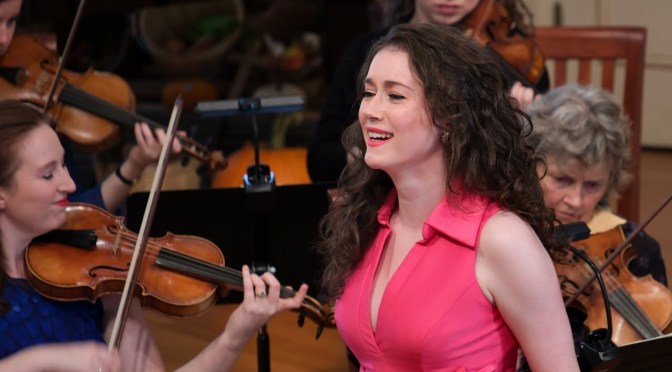
Voices of Music (October 12, 2024): Mozart’s motet Exsultate Jubilate, performed on original instruments by the award winning Early Music ensemble Voices of Music. Nola Richardson, soprano. The complete is work presented here for the first time in 8K video on period instruments.
Video timeline: 0:00 I. Exsultate Jubilate 5:00 II. Recit: Fulget amica dies 6:04 III. Aria: Tu Virginum Corona 13:11 IV. Alleluia 16:05 Credits
Reconstruction of the recitative: directors Hanneke van Proosdij and David Tayler reconstructed the recitativo accompagnato string parts from Mozart’s continuo part, and this receives its world premiere here. Months after completing the Divertimento in D Major,
Leopold and Wolfgang Mozart left for their third tour of Italy, with a first stop in Milan. There they met the soprano castrato, composer, and harpsichordist Venanzio Rauzzini, who was cast as one of the leads in Wolfgang Mozart’s new opera Lucio Silla opposite the prima donna Anna Lucia de Amicis.
‘To me, Song for Octave welcomes you into a different world. A dreamland in slow motion. I imagine being a child and walking in a glass house for the very first time, watching the rays of sunshine coming through the leaves of a big tree. It’s a quiet and peaceful conversation between light and shadow. (Pure and beautiful).‘
Rich in contemporary colour and contrast, LIFE – Mari Samuelsen’s third album for Deutsche Grammophon – is inspired by her experience of becoming a mother. Known for her vibrant and imaginative programming as well as her passionate and virtuosic playing, the Norwegian violinist has created a kaleidoscopic musical reflection of some of the emotional discoveries that come with parenthood.
The album presents music by Olivia Belli, Bryce Dessner, Ludovico Einaudi, Nils Frahm, Jóhann Jóhannsson, Mário Laginha, Hania Rani, Max Richter and Steve Reich, with a dash of Schubert also thrown into the mix. Samuelsen was joined at Teldex Studios in Berlin last autumn by a small group of fellow musicians, including the string players of Scoring Berlin, conducted by Jonathan Stockhammer. LIFE comes out digitally and on vinyl on 23 August 2024.
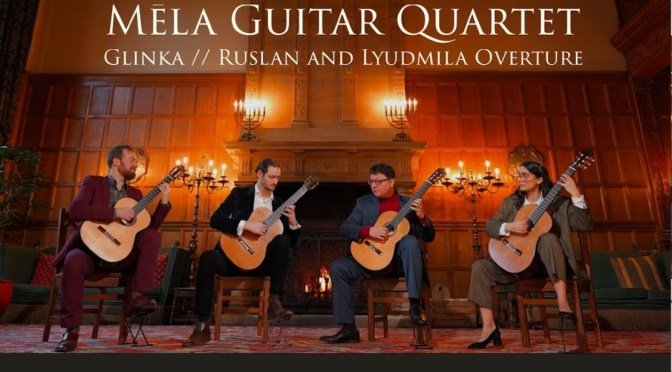
Omni Foundation (March 3, 2024): The Omni Foundation for the Performing Arts presents the Mēla Guitar Quartet performing the Ruslan and Lyudmila Overture by Mikhail Glinka from inside the West Dean Estate in the United Kingdom. This video is presented by the Omni Foundation’s Omni On-Location series, Concerts from Historic Sites.
DW Classical Music (February 4, 2024): Robert Schumann’s “Kinderszenen” (“Scenes from Childhood”) is one of the most popular piano works of the Romantic period. The highlight of the 13-part piano cycle is the “Träumerei” (Dreaming). The work is considered the epitome of romantic piano compositions.
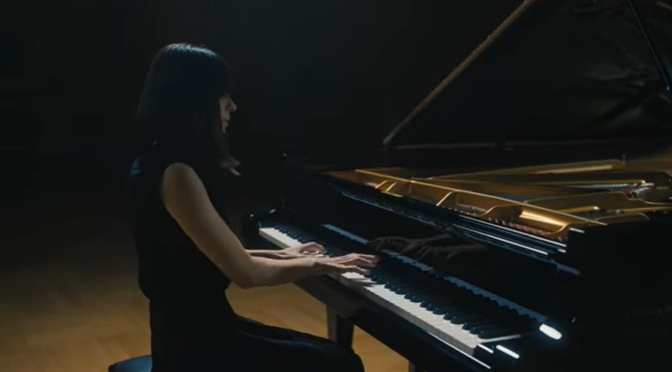
New York pianist, Tiffany Poon, played Robert Schumann’s “Kinderszenen”, Op. 15 at the Dresden Music Festival 2023. The concert took place on June 17, 2023, at the Palais im Großen Garten.
Video timeline: (00:00) Coming on stage (00:21) 1. Von fremden Ländern und Menschen (Of Foreign Lands and Peoples) (02:02) 2. Kuriose Geschichte (A Curious Story) (03:07) 3. Hasche-Mann (Blind Man’s Buff) (03:39) 4. Bittendes Kind (Pleading Child) (04:39) 5. Glückes genug (Happy Enough) (05:17) 6. Wichtige Begebenheit (An Important Event) (06:09) 7. Träumerei (Dreaming) (08:51) 8. Am Kamin (At the Fireside) (09:47) 9. Schumann Ritter vom Steckenpferd (Knight of the Hobbyhorse) (10:32) 10. Fast zu ernst (Almost Too Serious) (12:40) 11. Fürchtenmachen (Frightening) (14:13) 12. Kind im Einschlummern (Child Falling Asleep) (16:16) 13. Der Dichter spricht (The Poet Speaks)
Robert Schumann’s “Kinderszenen” was composed in 1838 and published the following year without a dedication and with the misleading subtitle “Easy Pieces for the Pianoforte.” Unlike the “Album for the Young,” which Schumann had composed for “younger children” in his own words, he did not write the “Kinderszenen” for children, but for adults reflecting on their own childhood.
At first, the cycle was to be titled “Children’s Stories” and preceded or appended to the “Novelettes,” Op. 21. However, Schumann later refrained from doing so. He wanted to have the “Kinderszenen” published as a separate opus. Although the work was not very successful during the composer’s lifetime, it eventually evolved independently and was highly regarded. It had a significant influence on the Romantic program miniature for piano.
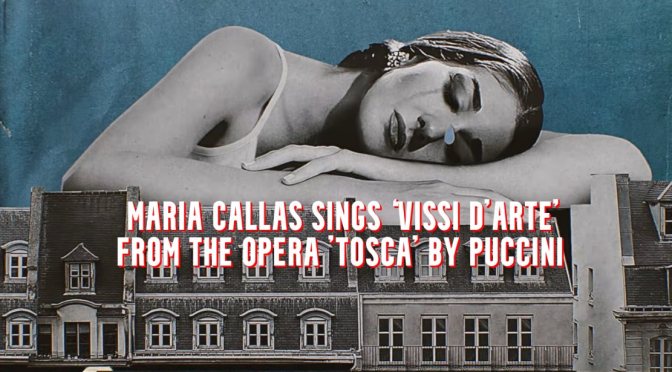
Warner Classics (January 12, 2024) – An aria powerfully reminiscent of Maria Callas’s own story, Tosca’s tragic manifesto, “Vissi d’arte” (“I lived for art”), unfolds in this illustrated retelling by Matteo Cozzo.
The story is told through the designer’s unique style, using the collage technique to create unique textures, expressions, and effects.
DW Classical Music (January 7, 2024) – A furious piano piece of the Romantic period. Tiffany Poon plays Robert Schumann’s Davidsbündlertänze, Op. 6 at the Dresden Music Festival 2023. The concert took place in the Palais im Grossen Garten.
Video timeline: (00:00) Coming on stage (00:27) 1. Lebhaft (02:03) 2. Innig (03:36) 3. Etwas hahnbüchen (05:10) 4. Ungeduldig (06:30) 5. Einfach (08:21) 6. Sehr rasch und in sich hinein (10:05) 7. Nicht schnell mit äußerst starker Empfindung (14:07) 8. Frisch (15:14) 9. No tempo indication (16:46) 10. Balladenmäßig sehr rasch (18:15) 11. Einfach (19:51) 12. Mit Humor (20:36) 13. Wild und lustig (23:44) 14. Zart und singend (25:50) 15. Frisch (27:58) 16. Mit gutem Humor (29:22) 17. Wie aus der Ferne (32:56) 18. Nicht schnell
The Davidsbündlertänze, Op. 6, are a two-part piano cycle by Robert Schumann, each consisting of nine character pieces. Schumann wrote 19 pieces, the last of which remains incomplete. The work was composed in the two months following his engagement to Clara Wieck on August 14, 1837. In the first piece, he quotes a motif from the Mazurka No. 5 from her Soirées musicales Op. 6 in the Motto of C. W. He speaks to her of wedding thoughts, which he has incorporated into the pieces. To his friend Carl Montag, however, he spoke of “death dances, St. Vitus’ dances, dances of graces and goblins”.
Schumann’s pseudonyms Florestan and Eusebius also play an important role here. The two characters symbolize his dual role in the fictitious Davidsbund, which also gives this cycle its name. Florestan is the “roaring, exuberant stormtrooper”. Eusebius represents the opposite pole as “the gentle youth who always remains modestly in the background”. In the first edition, the plays are either titled “Florestan and Eusebius” or just one of the two names.








 Boomers Daily