
Tag Archives: Book Review

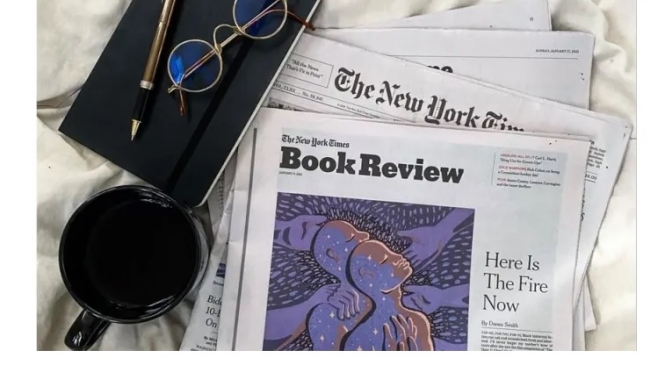
The New York Times Book Review — July 16, 2023

Image

THE NEW YORK TIMES BOOK REVIEW – JULY 16, 2023: This week, Jeff Goodell’s “The Heat Will Kill You First,” feels particularly apt. “This is a propulsive book, one to be raced through; the planet is burning,” writes our critic Jennifer Szalai. But maybe you don’t want to think more than you already do about impending doom. We’ve got you covered: The issue brims with diversions — a charming novel about a reality TV show set on Mars,  fiction about complicated families and a slew of good memoirs, including ones from a senior intelligence officialthe war reporter Jane Ferguson and the actor Elliot Page.

Extreme Heat Is Here to Stay. Why Are We Not More Afraid?

This illustration depicts a large, bright purple iris, its petals on fire. Behind the flaming flower, we see a bright yellow, desert-like landsape, with low orange mesas and, above them, a sky that shifts from yellow to bright red — as if the sky itself is on fire.

In “The Heat Will Kill You First,” Jeff Goodell documents the lethal effects of rising temperatures and argues that we need to take hot weather a lot more seriously.

What Does It Even Mean to Be Real?

In Deborah Willis’s novel “Girlfriend on Mars,” a young woman enters a reality-TV contest to leave the planet, and her marijuana-farming boyfriend, behind.

GIRLFRIEND ON MARS, by Deborah Willis


Sometimes, a girlfriend needs space. Sometimes, she goes to space. That’s the — OK, obvious — premise of “Girlfriend on Mars,” a novel by the Canadian writer Deborah Willis, who knows what we’ve wished for from books all along, which is that they were TV instead.

The New York Times Book Review — July 9, 2023

Image

THE NEW YORK TIMES BOOK REVIEW – JULY 9, 2023: In Too Deep – Laura Trethewey’s “The Deepest Map” plumbs the new world of oceanic exploration, and its dangers; “Fancy Bear Goes Phishing”; Lorrie Moore’s New Novel; Read your way through L.A., and more…

In Too Deep

Laura Trethewey’s “The Deepest Map” explores the new world of oceanic exploration — and its dangers.

By Simon Winchester

In the past days, the world has been riveted by the story of the Titan submersible, which we now know imploded some 1,600 feet from the wreckage of the Titanic, killing all aboard. Beyond the human tragedy — and the macabre fact that James Cameron’s blockbuster is trending online — comes an opportunity for serious reflection.

From ‘Front-Page Girls’ to Newsroom Leaders

“Undaunted,” Brooke Kroeger’s new history of women in journalism, tracks the victories, setbacks and pathbreaking careers that have marked the decades-long fight for gender parity in the field.

This black-and-white photo shows 13 men and one woman in business attire seated around a long oval conference table in a corporate boardroom. On the table are several ashtrays, a couple of folded newspapers and, in front of each person, a sheet of paper. In addition, two men stand behind the seated group, on opposite sides of the table and in front of a wall decorated with a world map.
The New York Times editorial council, photographed in 1951.

By Jane Kamensky

Raise your hand if you’ve heard of Anne O’Hare McCormick. I hadn’t, and as the director of Radcliffe’s Schlesinger Library on the History of Women in America, which holds peerless collections documenting pioneers in print journalism, I could have, and definitely should have. Brooke Kroeger’s compendious and lively “Undaunted: How Women Changed American Journalism” introduced me to her.

If We Are What We Eat, We Don’t Know Who We Are

In “Ultra-Processed People,” Chris van Tulleken takes a close look at the franken-snacks that barely resemble what they’re imitating.

The New York Times Book Review — July 2, 2023

Image

THE NEW YORK TIMES BOOK REVIEW – JULY 2, 2023: The entire issue is devoted to literature in translation – reviews of translated books (by Javier Marías, Seamus Heaney, Natalia Ginzburg…); Daniel Hahn’s essay about translating picture books; Emily Wilson’s look at “Iliad” translations over the years, culminating with her own; a By the Book interview with the translator Jennifer Croft; and lots more.

Exit Hector, Again and Again: How Different Translators Reveal the ‘Iliad’ Anew

An 1878 illustration of the meeting between Hector and Andromache, based on a design by John Flaxman.

Over the years, some 100 people have translated the entire “Iliad” into English. The latest of them, Emily Wilson, explains what different approaches to one key scene say about the original, and the translators.

Jennifer Croft Knows a Good Translation When She Reads One

This illustration shows Jennifer Croft with long, straight blond hair and bangs. She’s wearing a shoulderless top that crosses at her neck, with variously colored stripes.

“There has to be chemistry,” says the writer and prolific translator, whose second book will come out next year. “You don’t need prior knowledge of, say, Iceland or Icelandic in order to appreciate Victoria Cribb’s translation of Sjón.”

The New York Times Book Review — June 25, 2023

Image

THE NEW YORK TIMES BOOK REVIEW – JUNE 25, 2023: The Reading Crisis by @aoscott; ‘Little Monsters’ by @adriennebrodeur; ‘The Art Thief’ by @MikeFinkel and more…

Everyone Likes Reading. Why Are We So Afraid of It?

This image features a folded pair of black frame glasses. The left lens is tinted yellow. The right lens is clear but fractured, as if the glass has been hit by something hard.

Book bans, chatbots, pedagogical warfare: What it means to read has become a minefield.

By A.O. Scott

Everyone loves reading. In principle, anyway. Nobody is against it, right? Surely, in the midst of our many quarrels, we can agree that people should learn to read, should learn to enjoy it and should do a lot of it. But bubbling underneath this bland, upbeat consensus is a simmer of individual anxiety and collective panic. We are in the throes of a reading crisis.

Family Politics as a Predictor of Mayhem on a Bigger Scale

In her new novel, “Little Monsters,” Adrienne Brodeur takes readers on a stressful march toward a patriarch’s 70th birthday party.

By MARY POLS

Adrienne Brodeur’s “Little Monsters” is cleverly calculated to push all the buttons for a wide swath of women. Like her 2019 memoir “Wild Game,” which examined the role Brodeur played in her mother’s long affair with a family friend, “Little Monsters” is a tale of dysfunction and buried secrets, set in and around moneyed Cape Cod.

The New York Times Book Review — June 18, 2023

Image

THE NEW YORK TIMES BOOK REVIEW – JUNE 18, 2023: Stephen King reviews of S. A. Cosby’s blistering new Southern gothic, “All the Sinners Bleed,” which graces our cover this week. Also featured are  John Vaillant’s chillingly prescient book about a 2016 Canadian wildfirea history that pieces together a botany expedition in the Grand Canyon some 85 years ago; and the spiky, percussive, heavy-metal-infused novel “Gone to the Wolves.

In This Thriller, the Psycho Killers Have a Southern Drawl

This illustration shows a sheriff on a dark rural street, one hand on the grip of his holstered pistol and the other hand shining a flashlight into the woods. Out of his line of sight, the silhouette of a man in a wolf mask lurks behind a tree, watching ominously.

Stephen King reviews S.A. Cosby’s latest novel, “All the Sinners Bleed.”

Titus Crown is an ex-F.B.I. agent who gets a sheriff’s job, almost by accident, in a rural Virginia community. He’s Black. Mr. Spearman teaches geography and wears a coat of many countries on Earth Day. He’s white. Given the name of the town and county where these two live — Charon — one can expect bad things to happen, and they certainly do. As in S.A. Cosby’s previous two novels, “Blacktop Wasteland” and “Razorblade Tears,” the body count is high and the action pretty much nonstop.

They Overcame Hazards — and Doubters — to Make Botanical History

In a black-and-white photograph from 1938, two women and four men sit in a boat looking at the camera. One woman wears a white dress and hat; the other wears slacks and a blouse. Three of the men are shirtless; two wear pith helmets.

In Melissa Sevigny’s “Brave the Wild River,” we meet the two scientists who explored unknown terrain — and broke barriers.

Let’s start this story on a sun-blistered evening in August 1938. A small band of adventurers had just concluded a 43-day journey from Utah to Nevada — although perhaps “journey” is too tame a description for a trip that had required weeks of small wooden boats tumbling down more than 600 miles of rock-strewn rivers. The goal was twofold. First, to simply survive. And then, to chart the plants building homes along the serrated walls of the Grand Canyon.

The New York Times Book Review — June 11, 2023

Image

THE NEW YORK TIMES BOOK REVIEW – JUNE 11, 2023: This week’s issue brims with even more books to add to your teetering nightstand pile: talky new novels by Brandon TaylorR.F. Kuang and Luis Alberto Urreaa wistful ode to a beloved neighborhood barthe latest crime fiction; even some Martin Amis titles you’ve always meant to pick up, plucked from A.O. Scott’s  beautiful appraisal of the late British writer.

Good Night, Sweet Prince

This black-and-white photograph is a close-up of the writer Martin Amis’s face. He is staring intently into the camera.

Our critic assesses the achievement of Martin Amis, Britain’s most famous literary son.

By A.O. Scott

On May 6, at the age of 74, Charles III was crowned king of England. A few weeks later, at 73, Martin Amis died at his home in Florida. One event seemed almost comically belated, the other tragically premature. Charles took over the family business well past normal retirement age, while Amis was denied the illustrious dotage that great writers deserve.

For ‘The Late Americans,’ Grad School Life Equals Envy, Sex and Ennui

The book jacket for “The Late Americans,” by Brandon Taylor, is an abstract illustration of two men’s faces; one man is kissing the chin of the other.

Brandon Taylor’s novel circulates among Iowa City residents, some privileged, some not, but all aware that their possibilities are contracting.

By Alexandra Jacobs

Reading Brandon Taylor’s new novel, “The Late Americans,” I thought more than once of the Bad Sex in Fiction Award that the English magazine Literary Review gave to decades of authors, many esteemed, before showing mercy in pandemic-chilled 2020. Not because the sex in Taylor’s novel is described badly, but because — described well! — so much of it is bad.

The New York Times Book Review-Sunday June 4, 2023

Image

THE NEW YORK TIMES BOOK REVIEW – JUNE 4, 2023: The summer reading issue lands this weekend, 56 pages filled with suggestions of books to keep you company at the beach or in that shady mothballed nook you discovered in your rental share. The issue closes with a beautiful photo essay of swimmers pictured underwater, from an art book that evokes summer as vividly as fried clam strips and soft-serve ice cream: “Swimmers,” by Larry Sultan.

Deep-Sea Creatures of Bittersweet Orange and Metallic Opaline Green

This illustration depicts two enormous fish with red eyes and lots of teeth swimming around the bathysphere, an underwater exploration machine from the 1930s.

In “The Bathysphere Book,” Brad Fox chronicles the fascinating Depression-era ocean explorations of William Beebe.

Consider the siphonophore. An inhabitant of the lightless ocean, it looks like a single organism, but is actually a collection of minute creatures, each with its own purpose, working in harmony to move, to eat, to stay alive. They seem impossible but they are real. In 1930 William Beebe was 3,000 feet underwater in a bathysphere, an early deep-sea submersible, when he spotted a huge one: a writhing 20-yard mass whose pale magenta shone impossibly against the absolute blackness of the water. As you can imagine, it made an impression.

An Indictment of Human Culture, Narrated by a Mountain Lion

This is a close-up illustration of a lion’s eye, reflecting the silhouette of a man against a blue sky and greenery.

Henry Hoke’s latest novel, “Open Throat,” follows an observant — and starving — cougar living in the Los Angeles hills surrounding the Hollywood sign.

There is a moment toward the end of “Open Throat,” Henry Hoke’s slim jewel of a novel, where the narrator, a mountain lion living in the desert hills surrounding Los Angeles’s Hollywood sign, falls asleep and dreams of Disneyland. It will be hard for those who haven’t yet read this propulsive novel to understand, but the lion’s waking life at this moment is so precarious that this slippage into pleasant dream left me scared to turn the page.

Summertime in America, Beneath the Surface

A new book of photographs by Larry Sultan captures recreational swimmers at public pools in 1970s and ‘80s California.

The New York Times Book Review-Sunday May 28, 2023

Image

THE NEW YORK TIMES BOOK REVIEW – MAY 28, 2023:

The New Definitive Biography of Martin Luther King Jr.

“King: A Life,” by Jonathan Eig, is the first comprehensive account of the civil rights icon in decades.

Growing up, he was called Little Mike, after his father, the Baptist minister Michael King. Later he sometimes went by M.L. Only in college did he drop his first name and began to introduce himself as Martin Luther King Jr. This was after his father visited Germany and, inspired by accounts of the reform-minded 16th-century friar Martin Luther, adopted his name.

Victor LaValle’s Latest Mixes Horror With a History of the West

A black-and-white historical photograph of a farm with mountains in the background.

His novel “Lone Women” follows a Black homesteader in Montana who is haunted by secrets and a dark past.

Victor LaValle’s enthralling fifth novel, “Lone Women,” opens like a true western, with a scene of dark, bloody upheaval and a hint of vengeance. But nothing in this genre-melding book is as it seems. When we meet Adelaide Henry, the grown daughter of Black farmers, she is in a daze, dumping gasoline all over her family’s farmhouse. We don’t know why she’s doing what she’s doing, what happened to her family or, most important, what else she has or hasn’t done.

The New York Times Book Review-Sunday May 21, 2023

Illustration by Dakarai Akil

THE NEW YORK TIMES BOOK REVIEW – MAY 21, 2023

In This Satire, Televised Blood Baths Offer Prisoners a Path to Freedom

You can’t applaud Nana Kwame Adjei-Brenyah’s thrilling debut novel, “Chain-Gang All-Stars,” without getting blood on your hands.

The Martian Chronicles

Astronauts simulating a Mars spacewalk. As Matthew Shindell points out, our obsession with the planet is a relatively recent phenomenon.

In Matthew Shindell’s “For the Love of Mars,” perceptions of the planet reflect the changing culture of Earth.

Essential Neil Gaiman and A.I. Book Freakout

From the cult comic book series “The Sandman” to the giddy novel “Good Omens” (co-written with his friend Terry Pratchett) to the horror-tinged children’s story “Coraline” and beyond, the fantasy writer Neil Gaiman is so inventive and so prolific that you’ve probably stumbled across his influential work without even realizing it.

The New York Times Book Review-Sunday May 14, 2023

Image

THE NEW YORK TIMES BOOK REVIEW – MAY 14, 2023

Abraham Verghese’s Sweeping New Fable of Family and Medicine

This illustration, in shades of deep green, shows a young woman standing at the edge of a lush landscape with ferns or palm fronds surrounding her and joining above her head.

“The Covenant of Water” follows three generations of a close-knit and haunted family in southwestern India.

Pablo Picasso, the Pariah of Paris

This sepia photograph of a young Picasso shows him standing in front of a run-down Parisian building.

As Annie Cohen-Solal shows in “Picasso the Foreigner,” the Spanish master was always under suspicion in France, simply for being not-French.

By Holland Cotter