

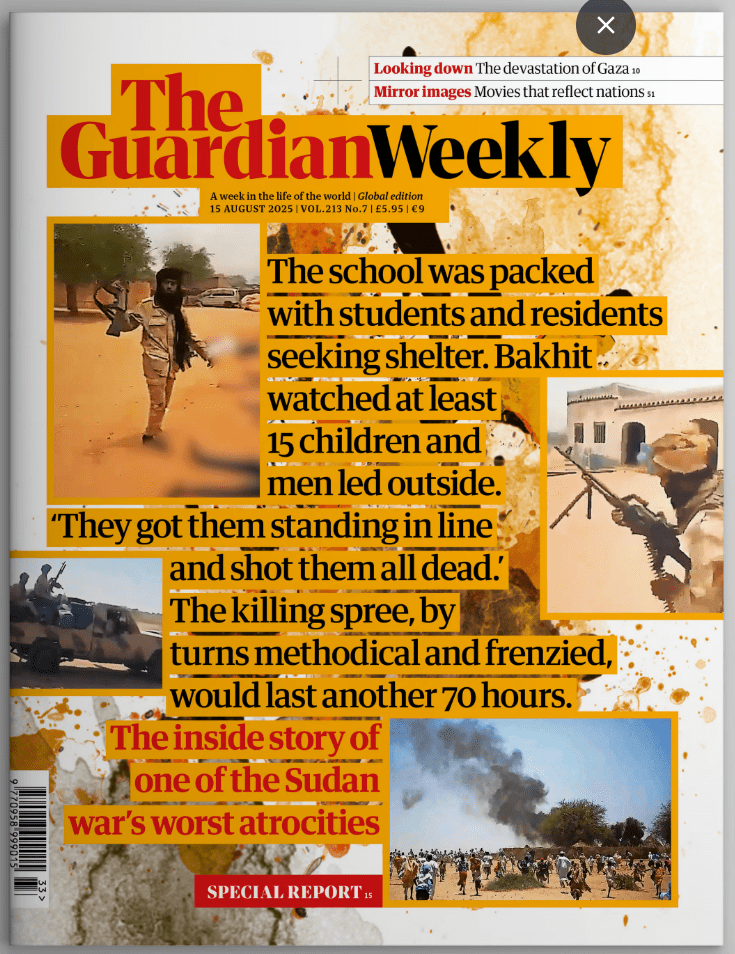
While the wars raging in Ukraine and Gaza have dominated global news agendas for months turning into years, relatively little attention has been paid to the ongoing civil war in Sudan – which for many western media outlets remains out of sight and largely out of mind.
This can’t be said of the Guardian’s Mark Townsend, who has reported tirelessly on the effects of the war between the Arab-led Rapid Support Forces and Sudanese military since it broke out in April 2023. It’s a conflict that has been characterised by repeated atrocities, forcing millions from their homes and causing the world’s largest humanitarian crisis.
In April this year, just as a British-led conference was being held in London to explore how to end the war, one such atrocity was unfolding in Zamzam refugee camp in North Darfur. Details were at first sketchy, but only now – thanks to the piecing together of intelligence reports and witness testimony – can it be revealed what happened during the attack on the camp by RSF forces and why it was not stopped.
As Mark’s remarkable account reveals, the 72-hour rampage in April may have taken the lives of more than 1,500 civilians in one of the most notorious war crimes of Sudan’s catastrophic conflict.
Five essential reads in this week’s edition
The big story | The ruins of Gaza, as seen from above
Guardian international correspondent Lorenzo Tondo joins a Jordanian military airdrop for a rare chance to observe a landscape devastated by Israel’s offensive. With photography by Alessio Mamo
Science | The truth about sunscreen
Too much exposure to the sun has traditionally been seen as a danger. Now claims that sunscreen is toxic flood the internet. Our science editor, Ian Sample, weighs up the evidence
Interview | Demis Hassabis, the cautious AI optimist
The head of Google’s DeepMind tells Steve Rose how artificial intelligence could usher in an era of ‘incredible productivity’ and ‘radical abundance’. But who will it benefit?
Opinion | The world is in flames. But I’ve found some hope amid the gloom
Columnist Jonathan Freedland makes a moral case for escapism, as a means of retaining the ability to see the world – and the people – around us
Culture | The films that capture a nation’s soul
What single film best represents a nation? Twelve writers choose the one work they believe most captures their home’s culture and cinema – from a bold cricket musical to a nine-hour documentary, gritty crime dramas to frothy tales of revenge
 Boomers Daily