
Tag Archives: Stephen King

The New York Times Book Review – April 7, 2024

Image

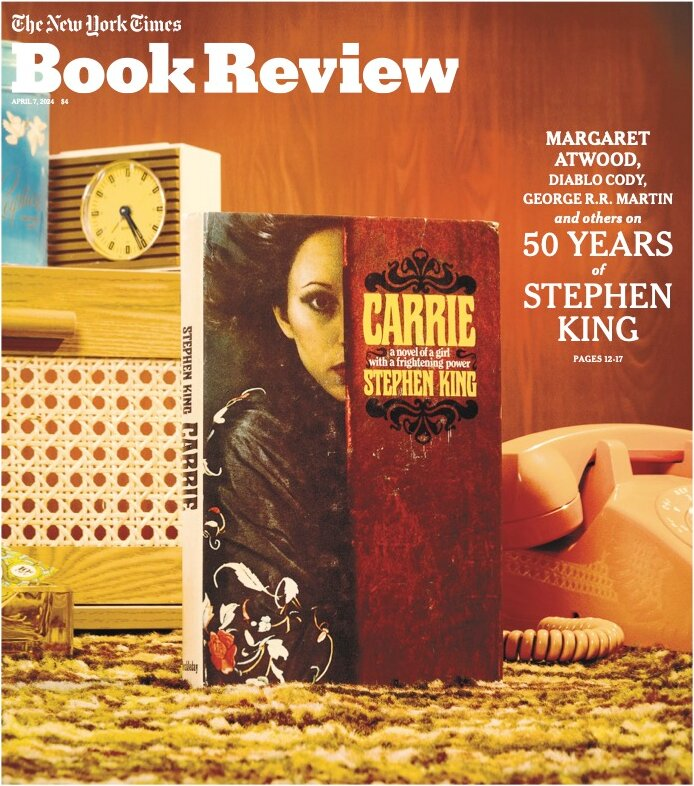
THE NEW YORK TIMES BOOK REVIEW (April 5, 2024): The latest issue features Stephen King’s first novel, “Carrie,” published 50 years ago. The Book Review editors weren’t sure what to do with it, so they handed it to their mystery columnist, Newgate Callendar. He called it “brilliant” but conceded, “Maybe, strictly speaking, it is not a mystery.” Still, he added, “That this is a first novel is amazing. King writes with the kind of surety normally associated only with veteran writers.”

Stephen King’s First Book Is 50 Years Old, and Still Horrifyingly Relevant

This photo still life shows a hardcover edition of “Carrie” on a brown shag carpet, next to an orange rotary-dial telephone and a section of chair caning with an analog clock balanced on top. The wall behind them is paneled wood.

“Carrie” was published in 1974. Margaret Atwood explains its enduring appeal.

By Margaret Atwood

Stephen King’s “Carrie” burst upon an astonished world in 1974. It made King’s career. It has sold millions, made millions, inspired four films and passed from generation to generation. It was, and continues to be, a phenomenon.

“Carrie” was King’s first published novel. He started it as a men’s magazine piece, which was peculiar in itself: What made him think that a bunch of guys intent (as King puts it) on looking at pictures of cheerleaders who had somehow forgotten to put their underpants on would be riveted by an opening scene featuring gobs of menstrual blood? This is, to put it mildly, not the world’s sexiest topic, and especially not for young men. Failing to convince himself, King scrunched up the few pages he’d written and tossed them into the garbage.

How Stephen King Got Under Their Skin

As “Carrie” turns 50, George R.R. Martin, Sissy Spacek, Tom Hanks, the Archbishop of Canterbury and others recall the powerful impact the writer’s work has had on their lives.

This is a photo-illustration with a movie still of blood-covered Carrie, from the Stephen King novel, at its center.

In the late ’70s the image of Carrie covered in blood at the high school dance was already part of the national narrative — in a fun way. Struggling to afford the rent and the diapers while navigating those first years of a creative journey in the big city, I had not seen the movie nor read the book. Then a copy of “The Stand” was being gobbled up by our gang — read in a fever pitch on every subway ride and first thing in the morning. Once done, the copy was passed along to the next pair of eyes and promptly devoured.
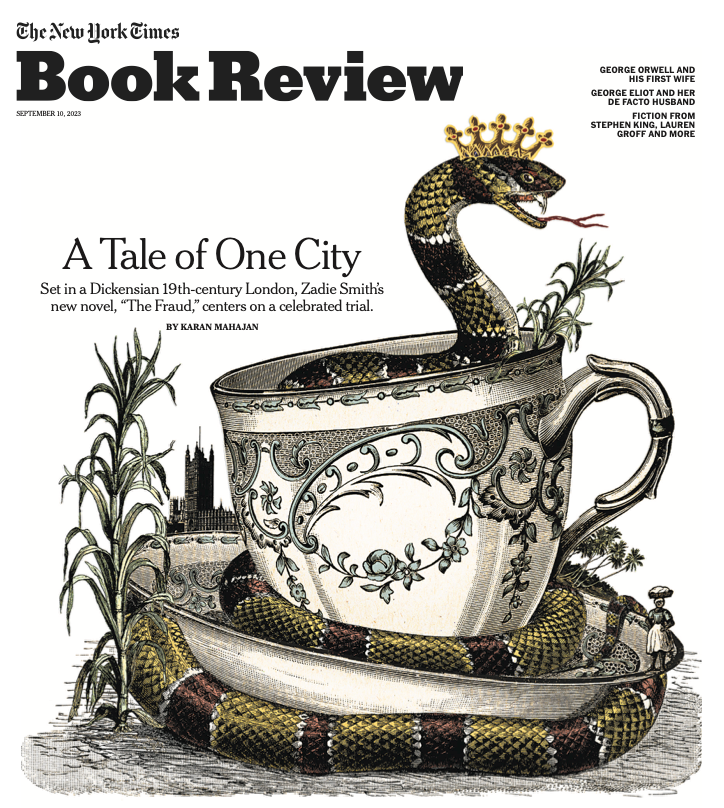
The New York Times Book Review – Sept 10, 2023

Image

THE NEW YORK TIMES BOOK REVIEW (September 10, 2023): The new issue features Zadie Smith’s very Dickensian new novel, “The Fraud,” In nonfiction, the extremely different romantic lives of George Orwell and George Eliot are reviewed, and a biography of the con man who paved the way for all those “Nigerian prince” email scams.

Zadie Smith Makes 1860s London Feel Alive, and Recognizable

In this illustration, a serpent with maroon and gold bands and wearing a gold crown sits inside a delicate filigreed teacup, with its body coiled around the bottom of the cup and the saucer. The cup rests next to a sugar cane plant, and a London tower looms in the distance.

Her new novel, “The Fraud,” is based on a celebrated 19th-century criminal trial, but it keeps one eye focused clearly on today’s political populism.

By Karan Mahajan

All over the dorm in California glinted pale-orange and tabasco-red and steel-blue copies of Zadie Smith’s “White Teeth,” with their hard white bright lettering. The year was 2001, and “White Teeth” had been assigned as incoming reading for my freshman dorm. I remember loving the sprawling, rude, funny, slapdash narration, the magical way in which Smith brought it all together in the figure of a genetically engineered mouse.

Lauren Groff’s Latest Is a Lonely Novel of Hunger and Survival

A color illustration of a girl wearing a torn blue coat and boots with a bag strapped around her back, looking back toward a coastal settlement as she enters the woods, covered in snowfall.

“The Vaster Wilds” follows a girl’s escape from a nameless colonial settlement into the unforgiving terrain of America.

By Fiona Mozley

Jamestown, Va., the first permanent English settlement in the Americas, very nearly didn’t survive. A few years into its existence, in the early 1600s, the majority of the population had succumbed to famine and disease. The period known as the Starving Time has taken on allegorical status. Jamestown is the colony that tried too much too soon; that underestimated the harsh climate, the foreign land, its existing, Indigenous population. Pilgrims went in search of heaven and found hell.

The New York Times Book Review – September 3, 2023

Image

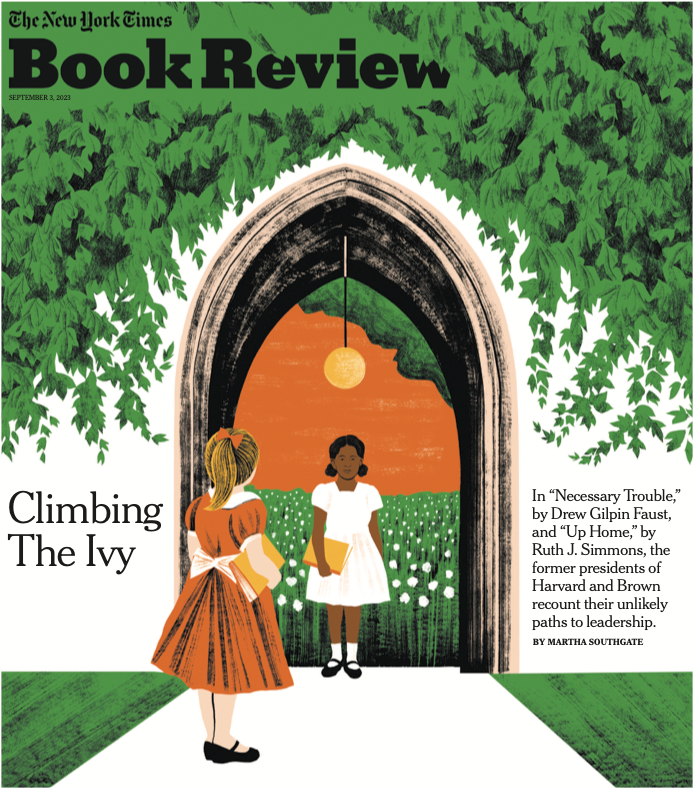
THE NEW YORK TIMES BOOK REVIEW (September 3, 2023): The new issue features “THE EXHIBITIONIST“, a barbed comic novel about a midwardly mobile London family by Charlotte Mendelson;  “THE GUEST“, by Emma Cline, “about one woman’s week of lying, scamming and conning her way through the Hamptons; CROOK MANIFESTO, the sequel to Colson Whitehead’s 2021 novel “Harlem Shuffle” (and the middle volume of a planned trilogy), and more….

In Stephen King’s Latest, Beware the Kindly Old Professors

His new novel, “Holly,” charges into thorny contemporary debates with a pair of unassuming fiends.

The New York Times Book Review — June 18, 2023

Image

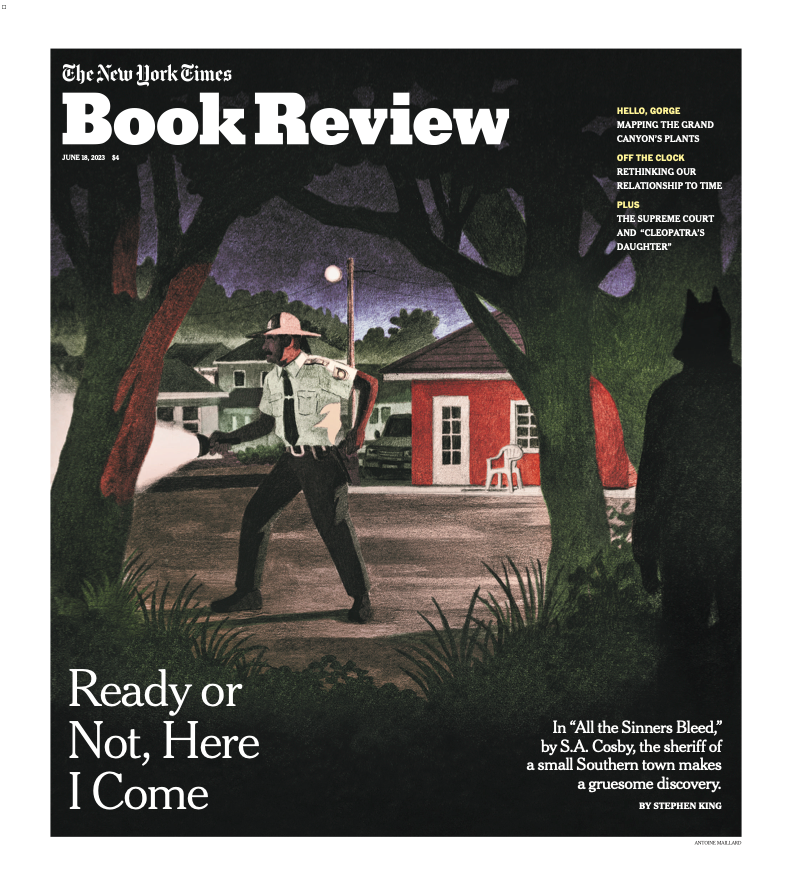
THE NEW YORK TIMES BOOK REVIEW – JUNE 18, 2023: Stephen King reviews of S. A. Cosby’s blistering new Southern gothic, “All the Sinners Bleed,” which graces our cover this week. Also featured are  John Vaillant’s chillingly prescient book about a 2016 Canadian wildfirea history that pieces together a botany expedition in the Grand Canyon some 85 years ago; and the spiky, percussive, heavy-metal-infused novel “Gone to the Wolves.

In This Thriller, the Psycho Killers Have a Southern Drawl

This illustration shows a sheriff on a dark rural street, one hand on the grip of his holstered pistol and the other hand shining a flashlight into the woods. Out of his line of sight, the silhouette of a man in a wolf mask lurks behind a tree, watching ominously.

Stephen King reviews S.A. Cosby’s latest novel, “All the Sinners Bleed.”

Titus Crown is an ex-F.B.I. agent who gets a sheriff’s job, almost by accident, in a rural Virginia community. He’s Black. Mr. Spearman teaches geography and wears a coat of many countries on Earth Day. He’s white. Given the name of the town and county where these two live — Charon — one can expect bad things to happen, and they certainly do. As in S.A. Cosby’s previous two novels, “Blacktop Wasteland” and “Razorblade Tears,” the body count is high and the action pretty much nonstop.

They Overcame Hazards — and Doubters — to Make Botanical History

In a black-and-white photograph from 1938, two women and four men sit in a boat looking at the camera. One woman wears a white dress and hat; the other wears slacks and a blouse. Three of the men are shirtless; two wear pith helmets.

In Melissa Sevigny’s “Brave the Wild River,” we meet the two scientists who explored unknown terrain — and broke barriers.

Let’s start this story on a sun-blistered evening in August 1938. A small band of adventurers had just concluded a 43-day journey from Utah to Nevada — although perhaps “journey” is too tame a description for a trip that had required weeks of small wooden boats tumbling down more than 600 miles of rock-strewn rivers. The goal was twofold. First, to simply survive. And then, to chart the plants building homes along the serrated walls of the Grand Canyon.