
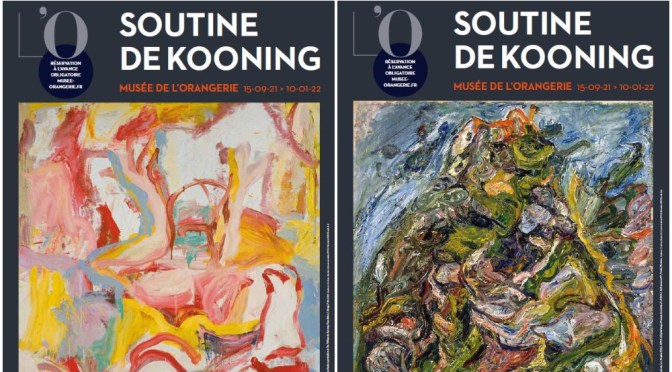
The Musée de l’Orangerie presents an exhibition bringing together the works of Chaïm Soutine (1893–1943), painter of the Paris School of Russian origin (now Belarus) and Willem de Kooning (1904-1997), abstract expressionist American of Dutch origin.
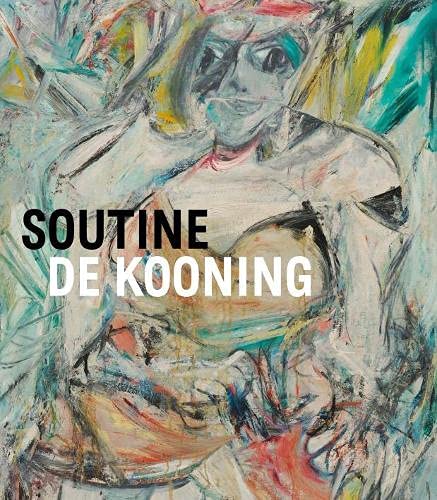
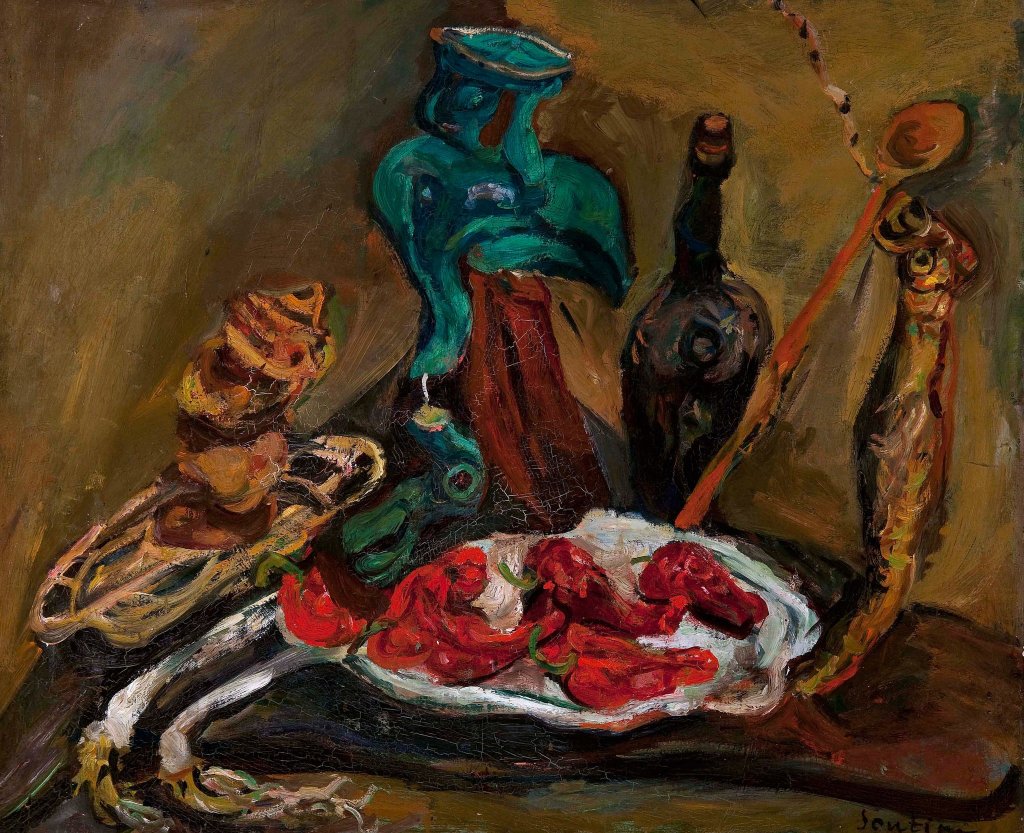

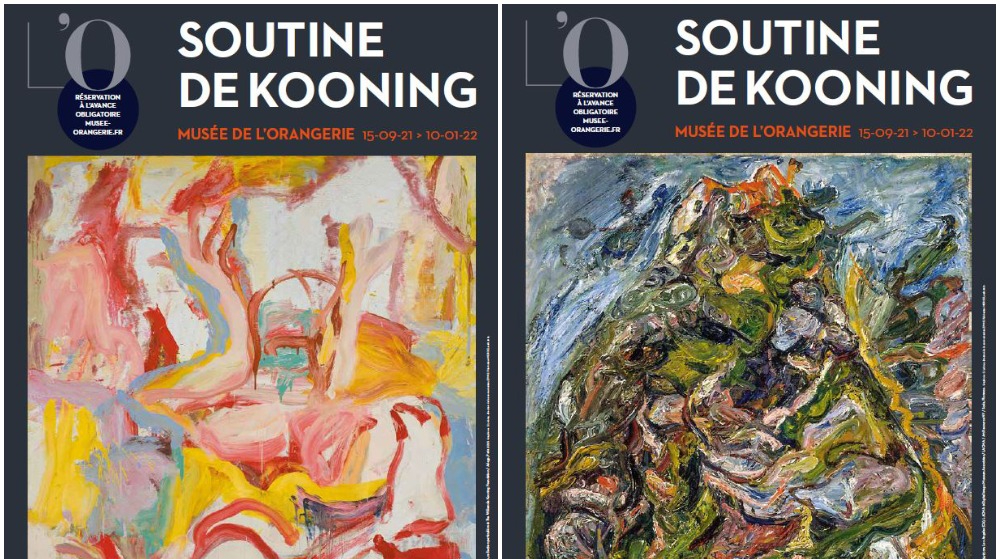
This exhibition will focus more specifically on exploring the impact of Soutine’s painting on the pictorial vision of the great American painter.
Soutine indeed marked the generation of post-war painters by the expressive force of his painting and his figure of “accursed artist”, grappling with the vicissitudes and excesses of Parisian bohemia. His work was particularly visible in the United States between the 1930s and 1950s, when the figurative artist of European tradition was re-read in the light of new artistic theories. The gestural painting and the pronounced impasto of Soutine’s canvases lead critics and curators to proclaim him a “prophet”, herald of American abstract expressionism.
It was precisely at the turn of the 1950s that Willem de Kooning began the pictorial work of Women, canvases in which a singular expressionism was built, between figuration and abstraction. The development of this new language corresponds to the moment when the painter summons the artistic universe of Chaïm Soutine and confronts it. De Kooning discovered his predecessor’s paintings in the 1930s, then at the retrospective which devoted the painter to the Museum of Modern Art in New York in 1950. He was then particularly marked by the presentation of Soutine’s paintings in the Foundation’s collections. Barnes of Philadelphia, where he visited with his wife Elaine in June 1952.
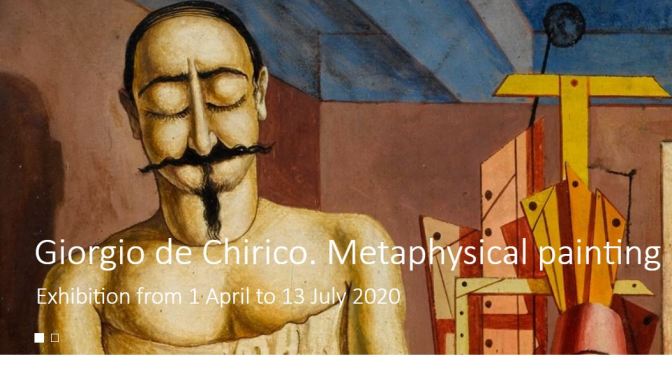
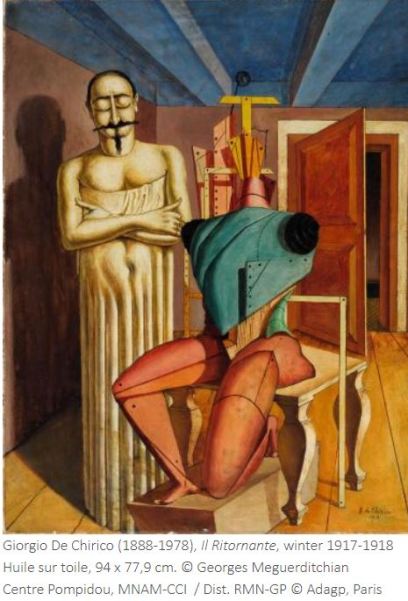 subsequently backed by the art dealer Paul Guillaume – and the Parisian cultural and literary circles will be highlighted as never before.
 The exhibition thus comes into its own at the Musée de l’Orangerie alongside the figure of Paul Guillaume, the first art dealer to work with Giorgio de Chirico. On his return to Italy in 1915, he and his brother Savinio were sent to Ferrare for military reasons, where he continued his artistic research. This period (June 1915-December 1918) provided an opportunity for painters Carlo Carrà and Giorgio Morandi to get to know the two brothers, thus resulting in the creation of what was later to be known as the “metaphysical movement” which brings the exhibition to a close.
 Boomers Daily