
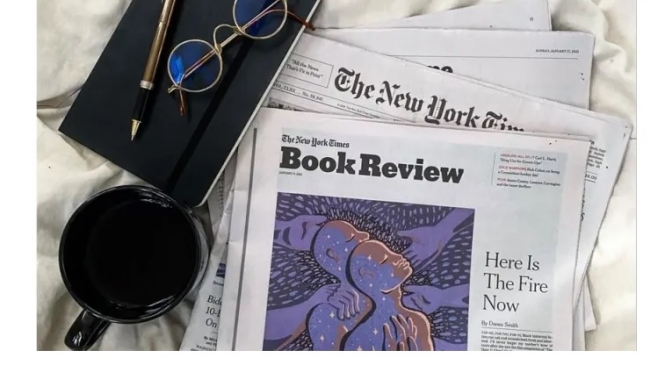
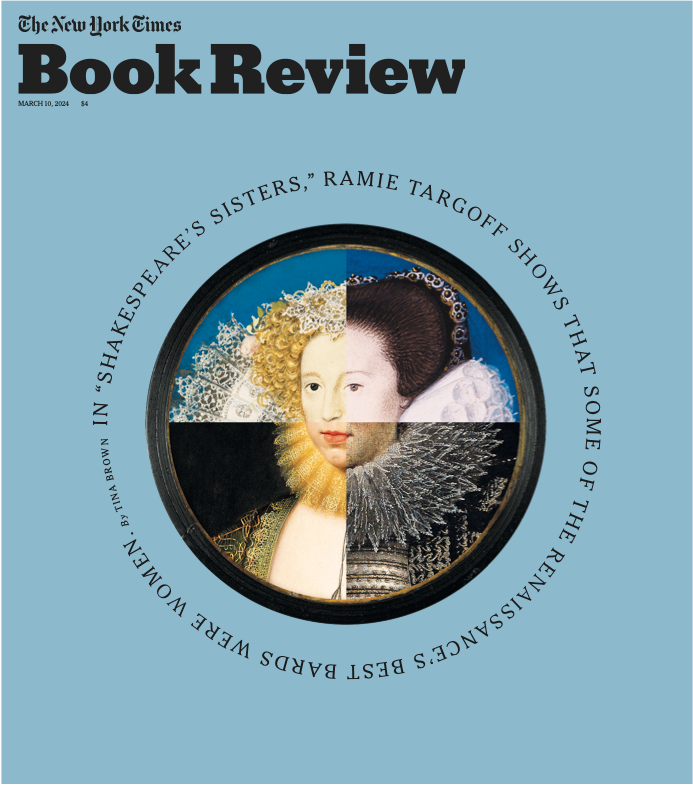

THE NEW YORK TIMES BOOK REVIEW (March ,8 2024): The latest issue features Renaissance scholar Ramie Targoff’s new book, “Shakespeare’s Sisters,” which sets out to show modern readers that the Elizabethan era did indeed produce its share of great women writers, and she details four of them across a range of disciplines.
Some of the Best Bards Were Women

In “Shakespeare’s Sisters,” the Renaissance scholar Ramie Targoff presents an astounding group of Elizabethan women of letters.
By Tina Brown
SHAKESPEARE’S SISTERS: How Women Wrote the Renaissance, by Ramie Targoff
Judith Shakespeare, Virginia Woolf’s imaginary sister of the Bard, was for years the accepted portrait of the nonexistent writer of Renaissance England. In “A Room of One’s Own,” her seminal feminist essay, Woolf concluded that any glimmer of female creativity in Shakespeare’s time would have been expunged by a pinched life as a breeding machine of children who so often died, disallowed opinions of her own. Had any woman survived these conditions, wrote Woolf, “whatever she had written would have been twisted and deformed, issued from a strained and morbid imagination.”
A Bee’s-Eye View of the World

Using clever camera methods, a new photo book illuminates how honeybees see plants and flowers.
By William Atkins
In WHAT THE BEES SEE: The Honeybee and Its Importance to You and Me, Craig P. Burrows’s ultraviolet-lit photographs mimic the fluorescence his botanical subjects emit when exposed to sunlight, revealing colors and textures usually obscured by the dazzle of visible light. Because bees see in the ultraviolet spectrum, Burrows’s method can afford us a glimpse of the world as they perceive it: His portraits of plants are, in part, prompts for interspecies empathy at a time when bees are under attack on multiple fronts, from air pollution to pesticides.
 Boomers Daily