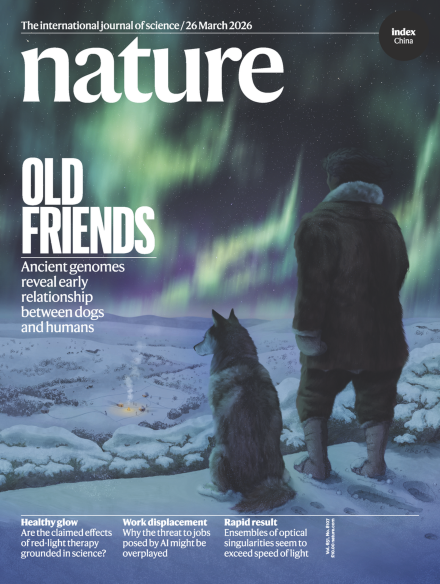
NATURE MAGAZINE: The latest issue features ‘Old Friends’ – Ancient genomes reveal early relationship between dogs and humans…
Microbial diversity loss seen after a course of some commonly prescribed antibiotics can persist for years.
A compact device can produce a magnetic field that is more than 800,000 times stronger than Earth’s.
Compounds that are used to make plastics and personal-care products were found in all types of marine environment, a meta-analysis shows.
Muscle mass increased or remained stable relative to body weight in middle-aged mice and humans on GLP-1 drugs.
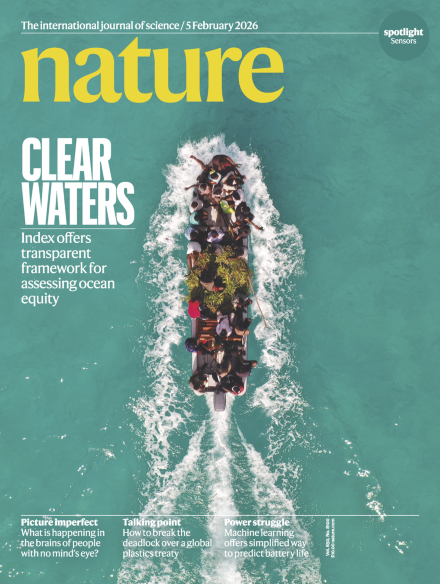
NATURE MAGAZINE: The latest issue features ‘Clear Waters’ – Index offers transparent framework for assessing ocean equity…
Field pennycress could become a valuable winter crop, with benefits for both carbon storage and farm profitability.
Engineered Escherichia coli could open the door to more sustainable routes to new drugs and other chemicals.
The six-year results from the Dark Energy Survey highlight unresolved tensions in standard cosmological theory.
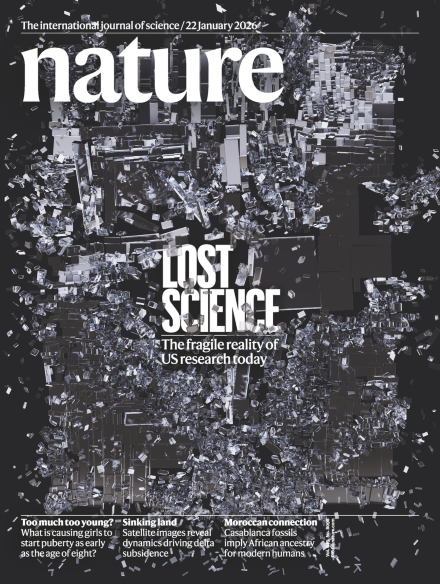
NATURE MAGAZINE: The latest issue features ‘Lost Science’ – The fragile reality of US research today.
Symmetrical arrangements of botanical motifs indicate a grasp of spatial division long before the advent of formal written numbers.
A drop in precancerous growths in women who hadn’t received the jab suggests the existence of a ‘herd effect’ against the virus.
Better understanding of multi-year global weather cycles could help airlines to reduce fuel consumption and cost.
Particularly talented canines have sociolinguistic skills akin to those of young toddlers.
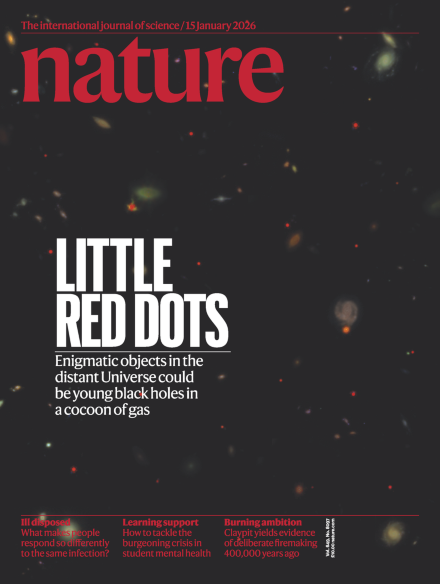
NATURE MAGAZINE: The latest issue features ‘Little Red Dots’ – Enigmatic objects in the distant Universe could be young black holes in a cocoon of gas…
Drugs that limit the activity of cells called neutrophils could make heart attacks less severe without compromising the immune system.
Ocean temperatures well below freezing in Earth’s deep-past glacial phases imply some very salty waters.
What was originally thought to be a planet orbiting the Fomalhaut star was probably just the fallout of a wild collision.
A huge data set has confirmed a long-theorized relationship between the size of stock trades and the impact on prices.
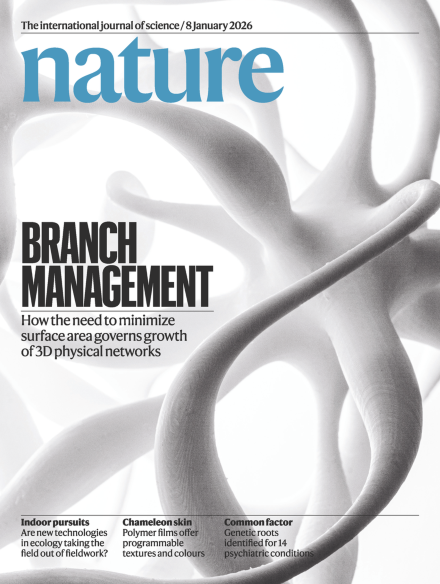
NATURE MAGAZINE: The latest issue features ‘Branch Management’ – How the need to minimize surface area governs growth of 3D physical networks.
It’s a mystery why TOI-561 b’s blanket of gases hasn’t boiled off.
Some cycads warm up their reproductive organs to attract specially equipped pollinating beetles in the dark.
A unique archaeological site at Pompeii, Italy, reveals the secrets of peculiarly durable Roman building materials.
NATURE MAGAZINE: The latest issue features
Nuclear fusion. People on Mars. Artificial general intelligence. These are just some of the advances that could come by the mid-century mark.
The United States tops the remaining areas in an assessment of 74 technologies.
Researchers are devising ways to make new machines face off, without the hype.
A database of 2.75 billion buildings could help scientists to monitor urban planning, climate change, disaster risks and even corruption.
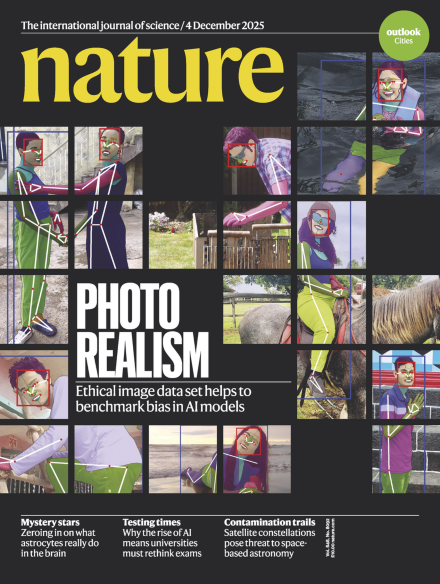
NATURE MAGAZINE: The latest issue features ‘Photo Realism’ – Ethical image data set help to benchmark bias in AI models…
A study of the effects of COVID-19 policies highlights the underexplored impacts of commercial cooking on air quality.
Emerald’ or ‘Paris’ green was once a highly popular pigment among painters, but the chemistry behind its slow decay over time has been unclear.
Studying trapped antimatter could help to explain why our world is so full of matter.
A specially trained algorithm could aid the search for biological activity both on the early Earth and on other worlds.
NATURE MAGAZINE: The latest issue features
Biologically inspired electronic neurons could boost the efficiency of artificial-intelligence systems.
People who rack up most of their daily steps in walks lasting less than five minutes have a higher risk of cardiovascular disease than do those who amass their steps in big blocks.
Modelling shows how the infant Universe might have stayed warm and dense during its primoridal expansion.
The moisture emitted by forests travels across national borders to provide precipitation to far-away fields.
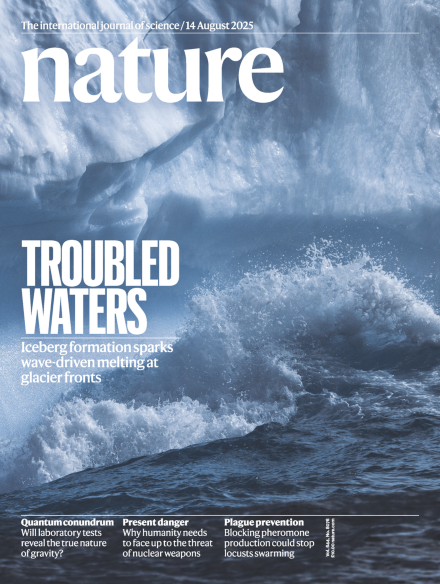
NATURE MAGAZINE: The latest issue features ‘Troubled Waters’ – Iceberg formation sparks wave-driven melting at glacier fronts.
Ice coverage is shrinking on Heard Island — a UNESCO World Heritage Site and a haven of biodiversity.
A nanoscopic machine transforms a molecular chain into interlocking loops.
In creatures that walk on land, a protein called Slurp1 protects skin cells from stress.
Experiments identify a bacterium as the cause of sea-star wasting disease, which has devastated populations along the western coast of North America.
NATURE MAGAZINE: The latest issue features
Pollution emitted by fossil-fuel usage in Asia influences sea-ice coverage in Antarctica.
Data from a South Pole observatory show that the fraction of protons in ultrahigh-energy cosmic rays is lower than expected.
Genetic analysis helps to reveal why flying foxes can measure almost 2 metres from wingtip to wingtip.
A study in mice finds that a high-sucrose diet during youth has long-term implications for learning and brain connectivity.
Posts navigation
News, Views and Reviews For The Intellectually Curious

 Boomers Daily