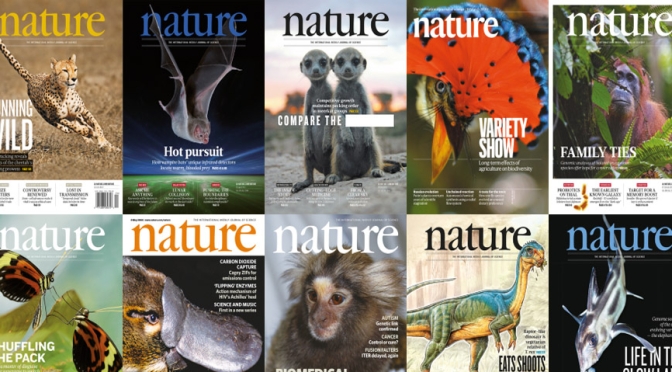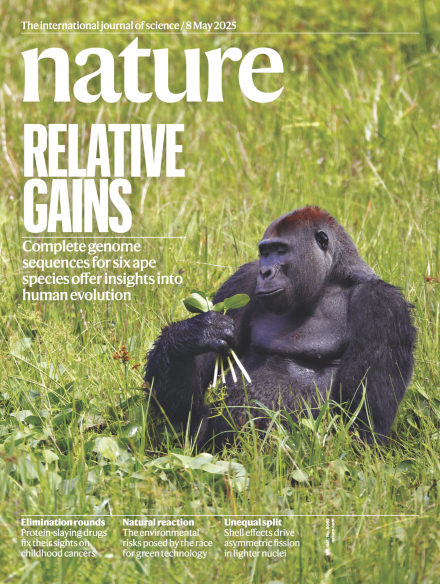
NATURE MAGAZINE (May 7, 2025): The latest issue features ‘Relative Gains’ – Complete genome sequences for six ape species offer insights into human evolution…
The treatment, which aimed to block production of a mutant protein, reduced the frequency of infant’s seizures, but did not improve neurological impairments.
The stone fragments had been discovered inside ‘Handprint Cave’ in Belize alongside other artefacts suggestive of ritual use.
Lithium that pooled in a volcanic caldera in the western United States had no way out, thanks to a lack of rivers.
Over time, young fringe-lipped bats learn how to distinguish the calls of palatable frogs from those of toxic ones.
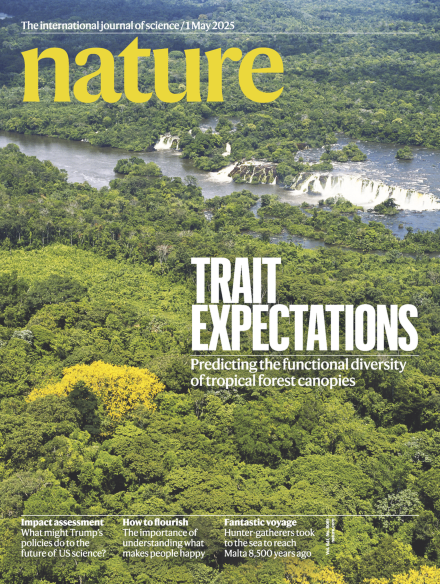
NATURE MAGAZINE (April 30, 2025): The latest issue features ‘Trait Expectations’ – Predicting the functional diversity of tropical forest canopies.
Two studies show the extent of gunshot wounds inflicted by police and link certain police-department policies with a lower death toll.
Tecovirimat, which has been approved to treat mpox, was no better than a placebo in a large trial.
Carbonate mineral is long-sought evidence of conditions that supported liquid water.
Like the Star Wars planet, a distant world follows a path around two stars, both of them small, cool bodies called brown dwarfs.
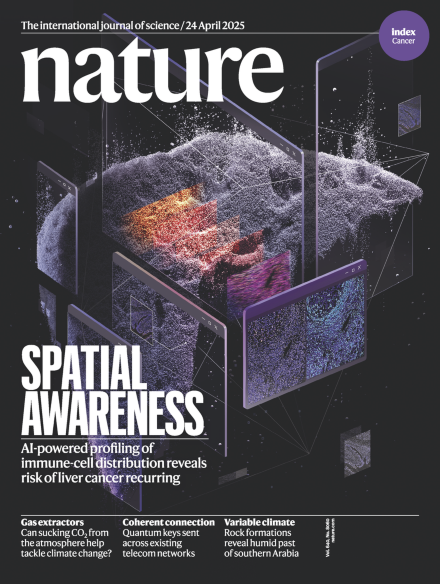
NATURE MAGAZINE (April 23, 2025): The latest issue features ‘Spatial Awareness’ – AI-powered profiling of immune-cell distribution reveals risk of liver cancer recurring…
Biomolecular analysis shows that unusual book coverings are made of sealskin, hinting at far-flung trade networks.
Complex shapes made of a specially formulated resin are easily recycled into other, equally durable objects.
A genomic analysis of 84 species in the genus Rosa traces the evolutionary history of the beloved flower.
Oil and water contained in a cylinder with magnetic nickel particles form the shape of a Grecian urn.
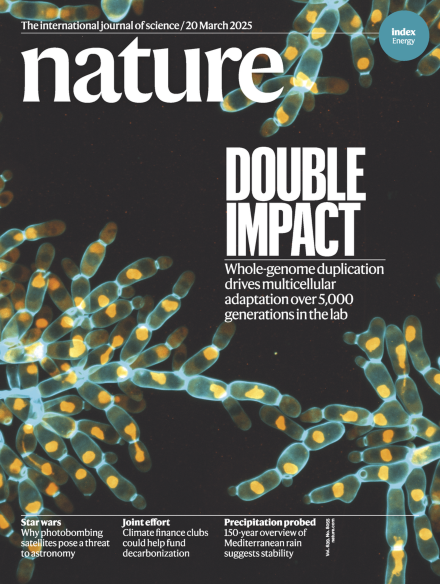
NATURE MAGAZINE (March 19, 2025): The latest issue f eatures ‘Double Impact’ – Whole genome duplication drives multicellular adaptation over 5,000 generations in the lab…
A well-timed atmospheric river dropped enough snow on Greenland for its ice sheet to lose 8% less mass than expected.
The paralysing toxin deployed by the male blue-lined octopus might help to protect him from being eaten.
The drop in body temperature that occurs during a torpid state is linked to molecular markers of longer life in mice.
Prosthetic appendage uses three layers of touch sensors to accurately differentiate between textures.
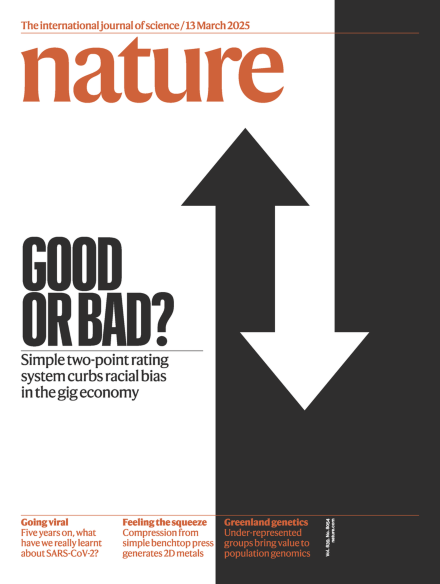
NATURE MAGAZINE (March 12, 2025): The latest issue features ‘Good Or Bad?’ – Simple two-point rating system curbs racial bias in the gig economy.
The presence of a pattern called a sleep spindle helps to predict which people will recover from an unresponsive state.
A network of two polymers plus sulfuric acid allows a hydrogel to keep its elasticity and softness at extreme temperatures.
Clay figurines found on top of the remnants of a pyramid in what is now El Salvador might have been used in public ceremonies.
Analysis of satellite imagery of the Brazilian Amazon, the Congo Basin and New Guinea helps to show that ‘secondary’ roads take an outsized toll.
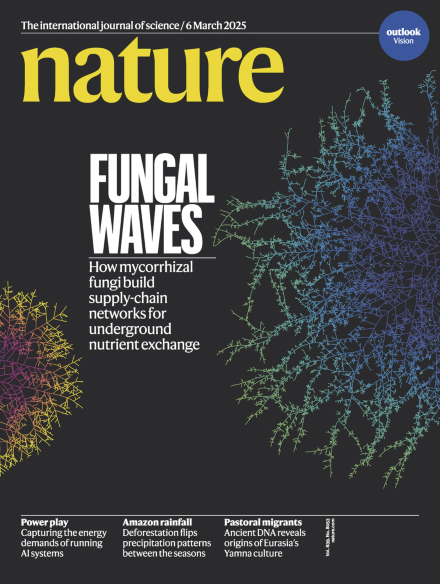
NATURE MAGAZINE (March 5, 2025): The latest issue features ‘Fungal Waves’ – How mycorrhizal fungi build supply-chain networks for underground nutrient exchange…
Granite from the chunk of Earth’s crust called the Lhasa terrane did not come from India, as had previously been thought, but from much further afield.
The James Webb Space Telescope uncovered repeated flares from the supermassive object called Sagittarius A*.
The standard protective dose is almost 14,000 units, but even 500 units raises antibody levels sufficiently to do the job.
NATURE MAGAZINE (February 12, 2025): The latest issue features ‘Cosmic Catcher; – Deep sea telescope detects neutrino with highest energy ever recorded.
Process turns out eggs with delectable texture and high nutritional value.
The vaccines’ effect on inflammation-promoting cells might help to explain why the jabs protect against severe disease.
A Copper Age burial in Spain holds the largest collection of beads ever found ― enough to require a tonne of shellfish as raw material.
NATURE MAGAZINE (February 5, 2025): The latest issue features ‘Sight Unseen’ – Infrared capabilities of JWST reveal horde of previously undetectable asteroids…
Brain regions linked to the sense of smell in adults were activated in infants exposed to the odours of petrol, strawberry and more.
A flexible dart with a weighted tip can have 60% more kinetic energy than a rigid one, experiments show.
The large carnivores are spreading out of remote mountains and into areas settled by humans.
One of Jupiter’s biggest moons has the potential to harbour life in a subsurface sea. The nature of its core will provide information about that ocean.
NATURE MAGAZINE (January 29, 2025): The latest issue features ‘Deposit Accopunt’ – How brine evaporation left sodium salts on the asteroid Bennu…
First estimate of its type shows that cultivated seaweed beds can accumulate as much carbon as some natural ecosys
Myostatin, which blocks muscle development, unexpectedly has an effect on ovulation in female mice.
Seeds, fruit stones and other remnants hidden in a Sydney barracks in the nineteenth century show residents’ deviation from the standard diet.
NATURE MAGAZINE (January 22, 2025): The latest issue features ‘Net Gains’ – Small-scale fisheries make major contribution to sustainable food, nutrition and livelihoods…
Vegetation clearing to extract nickel, which is used in renewable technologies, leads to greater carbon emissions than realized.
Blurry markings more than 1,000 years old become clear again thanks to scanning method.
Influenza viruses have not evolved resistance to suraxavir marboxil, which relieves cough, fever and other symptoms.
Model that predicts the spread of winning margins could be used to detect electoral interference.
Posts navigation
News, Views and Reviews For The Intellectually Curious