

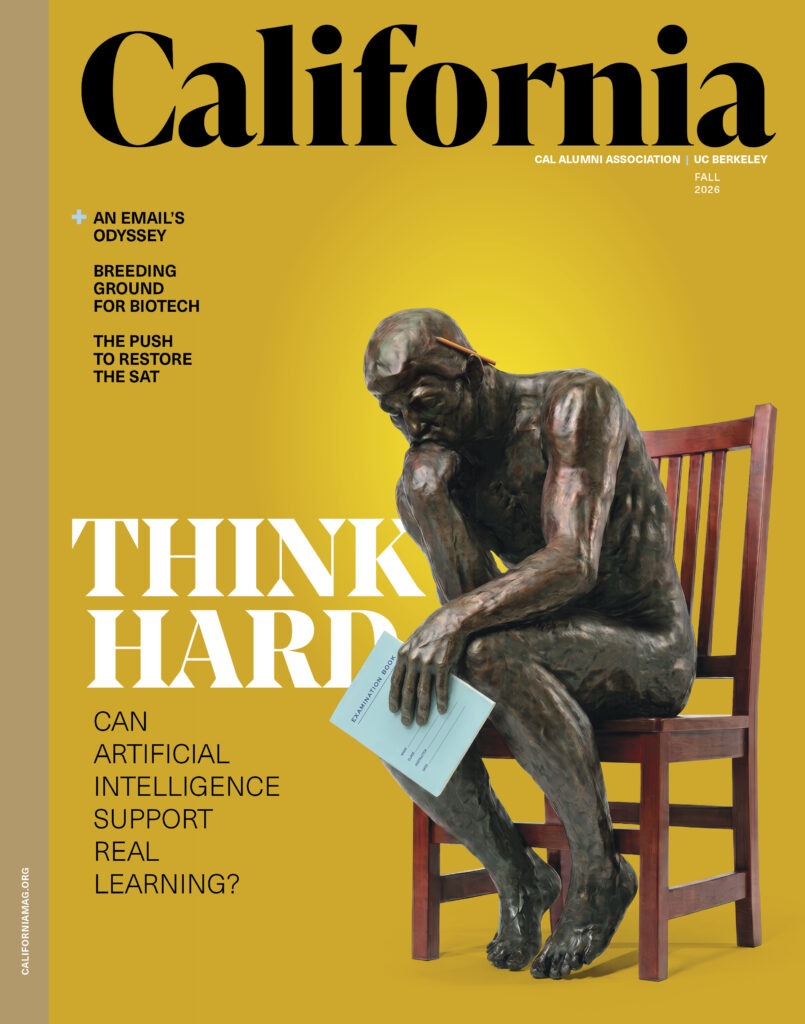
Test Case
Hard questions about AI in the classroom by Nathalia Alcantara
Mark Brilliant misses plagiarism.
The old kind, that is. Back when his students copied from Wikipedia, and when Turnitin, a text-matching software developed at Berkeley, could match plagiarized paragraphs to their original sources.
Brilliant has taught American history at Berkeley for more than two decades—before that, he taught high school—and for most of that time, catching a cheater was just a routine, though unpleasant, part of the job. What’s different now is not that students cheat. It’s what happens when he catches them.
Test Blinded
UC faculty split over standardized test requirement by Margie Cullen
In the spring of 2023, UC Berkeley math professor Zvezdelina Stankova began to notice that about a third of her students were “in freefall.” They weren’t showing up to lectures or doing their homework, and, on tests, they scored far below the average. At first, she thought it was an anomaly, but her observations were reinforced by a 2025 UC San Diego report that found that 1 in 12 of the campus’s incoming students tested below middle school math standards.
The development comes after the UC Board of Regents dispensed with standardized testing as a requirement of admission in 2020. That decision has since caused a rupture between faculty who feel the tests are an important measure of college preparedness and those who feel they discriminate against underrepresented students.
The House that Doudna Built
IGI-affiliated researchers have spawned more than 30 startups. Here are just six of them. By James Pagett Tollen
Berkeley Professor Jennifer Doudna, who shared the Nobel Prize for developing the gene-editing tool CRISPR-Cas9, founded the Innovative Genomics Institute in 2015 to advance new applications of the revolutionary technology. Since then, IGI-affiliated researchers have spawned more than 30 startups. Here are just six of them.
Amber Bio
Basem Al-Shayeb, Ph.D. ’22, a graduate of the Banfield and Doudna Labs, cofounded Amber Bio in 2021 to address a limit of the gene-editing field: The current paradigm of genetic medicine relies on developing independent therapies for each separate mutation, the company says. Amber Bio’s RNA-writing platform will enable thousands of mutations to be edited simultaneously. Importantly, the company adds, these RNA-based edits will be reversible.
Editpep
The goal of Editpep, per the company’s website, is straightforward: “To bring life-changing genome-editing therapies to patients with devastating neurological diseases.” They will do so by safely delivering CRISPR straight into the brain. Ross Wilson, IGI’s director of therapeutic delivery and an assistant adjunct professor at Berkeley, cofounded the company in 2023.
 Boomers Daily